





 Portuguese
  English
  Spanish
  5 min of reading
  0 comments


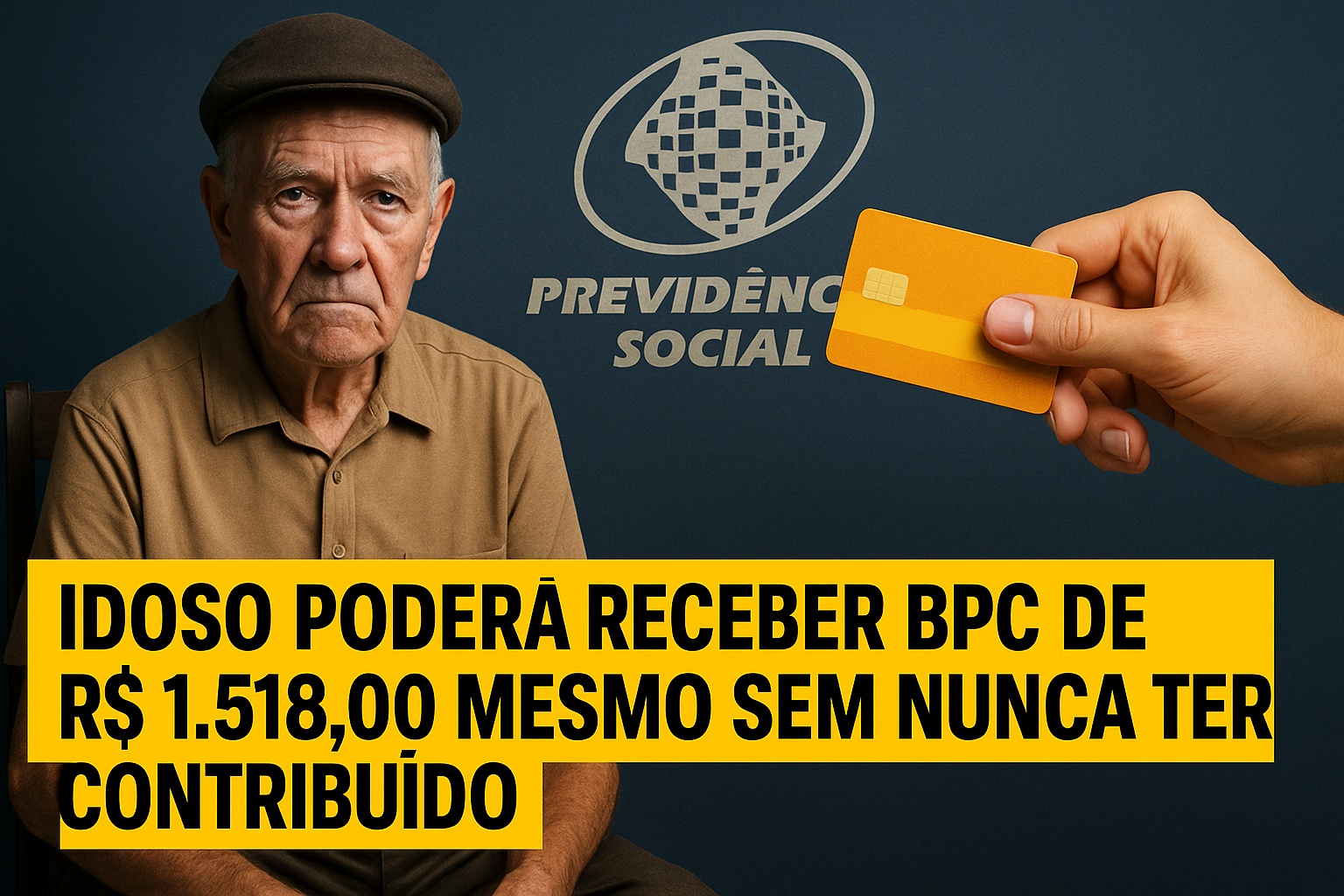
Elderly Without Contributions Can Receive BPC of R$1,518 in 2025. INSS Benefit Guarantees Vital Minimum Income and Waives Contribution History.
Few people know, but there is a benefit paid by INSS that guarantees a minimum monthly wage to elderly individuals who have never contributed to Social Security. This is the Continuous Provision Benefit (BPC/LOAS), an assistive right provided for in the Federal Constitution and regulated by the Organic Law of Social Assistance (Law No. 8,742/1993).
In 2025, the amount is R$1,518.00 per month, corresponding to the national minimum wage. Unlike retirement, BPC does not require a contribution history, but rather the fulfillment of age and income requirements. It is precisely this detail that makes the benefit vital for millions of Brazilians in vulnerable situations.
What is BPC and Who is Entitled
The Continuous Provision Benefit is paid to two specific groups:
-
The noise law will no longer be in effect at 10 PM starting in June with a new rule valid during the 2026 World Cup.

-
The Chamber opens a debate on driver’s licenses at 16 years old as part of a reform that includes around 270 proposals to change the Brazilian Traffic Code and may redesign rules for licensing, enforcement, and circulation in the country.

-
The new Civil Code could revolutionize marriages in Brazil with “express divorce” and changes that could exclude spouses from inheritance.
-
Banco do Brasil sues famous influencer for million-dollar debt and intensifies debate on delinquency, risks of seizure, and direct impact on Gkay’s credibility.


- Elderly Individuals Aged 65 or Older, in low-income situations;
- People with Disabilities of Any Age, as long as they have long-term impairments and are also in a condition of social vulnerability.
For the elderly, the central point is that it is not necessary to have ever contributed to INSS. This is because BPC is not a retirement pension, but rather a public policy of an assistive nature, financed by the Union’s budget and executed by the INSS.


The main requirement is that the family income per person is equal to or less than ¼ of the minimum wage (R$ 379.50 in 2025). In some cases, judicial decisions have relaxed this calculation, also considering expenses with medications and other basic family needs.
Difference Between Retirement and BPC
Many confuse BPC with traditional retirement. The difference is crucial:
- Retirement requires a history of contributions to INSS and guarantees the right to a 13th salary and survivor’s pension.
- BPC does not require contributions, but it does not grant the right to a 13th salary and is not transferred to dependents after the beneficiary’s death.
In practice, BPC functions as a minimum income that ensures dignity for poor elderly individuals, preventing them from being completely without support.
Value of BPC in 2025
In 2025, the benefit remains linked to the national minimum wage, which has been adjusted to R$1,518.00. This means that all beneficiaries receive exactly this amount monthly, without deductions, which becomes essential for thousands of Brazilian families living at the subsistence limit.
It is estimated that more than 5 million people are currently receiving BPC, including elderly individuals and people with disabilities.
The benefit has a strong social impact, reducing extreme poverty and ensuring basic access to food, housing, and healthcare.
How to Apply for BPC at INSS
The application process for the benefit is handled by INSS, but there is a mandatory step beforehand: the elderly individual or person with a disability needs to be registered in the CadÚnico (Unified Registry for Social Programs of the Federal Government).
The steps are:
- Register or update the CadÚnico at a CRAS (Social Assistance Reference Center).
- Request the benefit through the Meu INSS app or website, or directly at an agency.
- Provide personal documents, income verification, and, in the case of people with disabilities, undergo a medical and social evaluation.
The average analysis time is 45 days, but in some places it may be longer due to demand. In case of denial, it is possible to appeal administratively or through judicial means.
The Role of Judicial Decisions in Accessing the Benefit
Despite the general income limit rule, the Judiciary has played a fundamental role in expanding access to BPC.
Courts have recognized that the criterion of ¼ of the minimum wage per person can be relaxed when there are high expenses with medications, diapers, special food, or other essential costs.
This interpretation ensures that the benefit reaches families that, although they slightly exceed the income limit, live in conditions of real vulnerability.
Social and Economic Impact of BPC
BPC is considered one of the most important programs in Brazil’s social protection network. It:
- Guarantees dignity to elderly individuals who have worked all their lives informally and were unable to retire.
- Reduces regional inequalities, as a large part of the beneficiaries are in the North and Northeast.
- Stimulates the local economy, as the amount is immediately spent on basic items such as food and medicines.
According to data from the Ministry of Citizenship, every real spent on BPC has a multiplier effect in the economy, as it helps small businesses and services in small and medium-sized cities.
Controversies and Challenges
Despite its importance, BPC faces challenges. The main one is the low benefit amount, limited to a minimum wage, which often does not cover the real needs of elderly individuals.
Another controversial point is the bureaucracy of access. Many elderly individuals face difficulties in gathering documents, updating the CadÚnico, or obtaining medical assistance to prove their situation.
In addition, there are discussions in Congress about possible changes to BPC rules, such as changes to the income criteria, which raises concerns among beneficiaries and social entities.
The Future of the Benefit
With the accelerated aging of the Brazilian population, the number of elderly individuals depending on BPC is expected to grow. Projections indicate that by 2040, more than 10 million elderly Brazilians could be entitled to the benefit if current rules are maintained.
This trend puts pressure on public finances but reinforces the need to maintain and even expand this protective network, as millions of Brazilians have aged without ever contributing to formal Social Security.
The BPC/LOAS is one of the pillars of social protection in Brazil. It guarantees R$1,518.00 per month in 2025 to elderly individuals aged 65 or older in low-income situations, even if they have never contributed to INSS. Although it is not a retirement pension, the benefit represents financial relief and a chance to age with dignity.
Little publicized, this right is still unknown to many Brazilians. Therefore, understanding the rules, requirements, and the process to apply for the benefit is essential so that more families can access this legal protection.









-

2 pessoas reagiram a isso.