





 Portuguese
  English
  Spanish
  5 min of reading
  0 comments


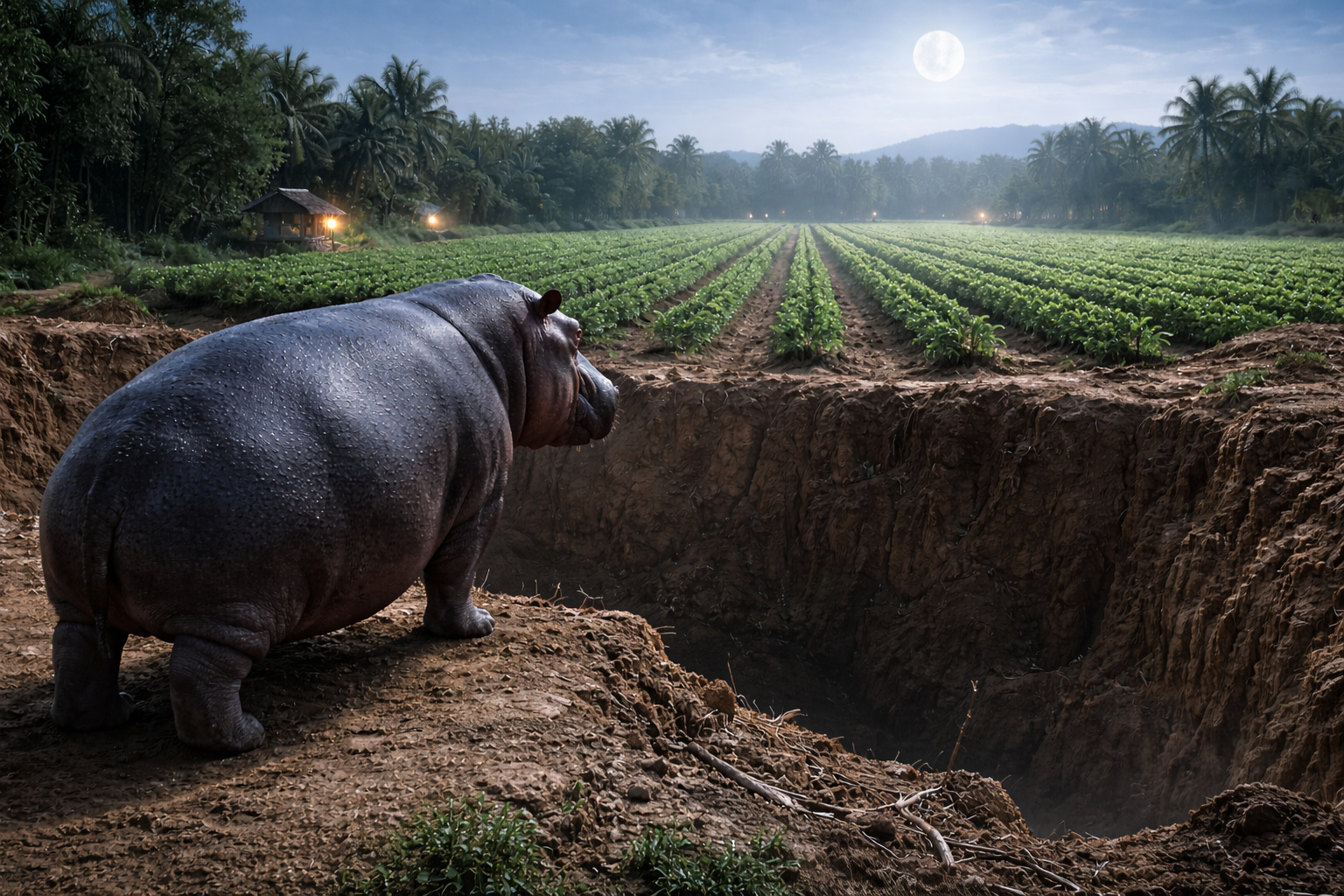
To Contain Hippos That Destroyed Crops at Night, Farmers Started Digging Deep Ditches Around the Crops, Trying to Reduce Million-Dollar Losses and Rural Conflicts.
During the day, they seem slow, almost harmless. They spend hours submerged in rivers and lakes, motionless, with only their eyes and nostrils visible. But when night falls in various regions of Africa, one of the most dangerous animals on the planet leaves the water and silently advances over entire crops. Hippos, responsible for thousands of human conflicts every year, have become a direct threat to the livelihoods of farming communities living near rivers. The response found by many farmers did not come from weapons, sophisticated electric fences, or cutting-edge technology, but from something old, physical, and brutally effective: ditches dug in the ground.
Why Hippos Have Become a Direct Threat to Agriculture
The hippopotamus is a large herbivore, with adults that easily exceed 1.5 tons. Despite this, it consumes relatively modest amounts of food individually.
The problem arises when entire groups leave the rivers every night to feed. In just a few hours, dozens of animals can devastate fields of corn, rice, cassava, sugarcane, and vegetables.
-
The eggshell that almost everyone throws away is made up of about 95% calcium carbonate and can help enrich the soil when crushed, slowly releasing nutrients and being reused in home gardens and vegetable patches.

-
This farm in the United States does not use sunlight, does not use soil, and produces 500 times more food per square meter than traditional agriculture: the secret lies in 42,000 LEDs, hydroponics, and a system that recycles even the heat from the lamps.

-
The water that almost everyone throws away after cooking potatoes carries nutrients released during the preparation and can be reused to help in the development of plants when used correctly at the base of gardens and pots, at no additional cost and without changing the routine.

-
The sea water temperature rose from 28 to 34 degrees in Santa Catarina and killed up to 90% of the oysters: producers who planted over 1 million seeds lost practically everything and say that if it happens again, production is doomed to end.



These nighttime attacks are not occasional. In regions of East and Southern Africa, they occur almost every day during the growing season. The proximity between agricultural areas and watercourses — essential for irrigation — has created an inevitable conflict.
For the farmer, losing a crop means hunger, debt, or abandonment of the land. For the hippo, crossing a field is just part of its natural foraging territory.
Why Common Fences Don’t Work Against Hippos
Unlike other wild animals, hippos do not respect light fences. Wooden stakes, simple wires, and even metal fences are often destroyed when an animal weighing over a ton decides to cross.
Additionally, electric fences present two recurring problems: high installation and maintenance costs, and low efficiency in flooded areas or dense vegetation.
Another critical factor is the territorial behavior of the hippo. When cornered or injured, it becomes extremely aggressive. Attempts at direct blocking with rigid structures have often increased conflicts and attacks on people instead of reducing them.
The Solution Found: Agricultural Ditches as a Physical Barrier
In light of this scenario, farming communities have begun to adopt a simple, geography-based solution: digging ditches around cultivated areas. These ditches serve as a barrier that exploits a physical limitation of the animal.
Despite their strength, hippos have limited mobility out of the water, especially when dealing with abrupt slopes and unstable terrain.
The ditches are usually deep enough to prevent crossing without the risk of falling. Once inside, the animal encounters extreme difficulty in getting out, which discourages it from attempting to pass. Unlike fences, the ditch does not need to withstand direct impacts: it creates a topographical obstacle.
Dimensions and Techniques Used in Ditches
The dimensions vary according to the soil and resources available, but technical reports indicate ditches with an average depth between 1.5 and 2.5 meters and width sufficient to prevent jumping or climbing. In firmer soils, the walls are left almost vertical. In sandy or wet terrain, the sides are sloped to prevent collapses.
In some cases, the ditches are combined with internal slopes or vegetative covering to reduce erosion. There are also communities that reinforce the bottom with stones or logs, creating unstable surfaces that increase the difficulty of traction for the animals.
Practical Results in the Field
The results observed are significant. Regions that have adopted continuous ditches around cultivated areas have recorded significant drops in nighttime invasions. In many cases, attacks have been almost eliminated after the completion of digging.
In addition to the direct protection of crops, there has been a reduction in human confrontations. Farmers have stopped monitoring the fields armed at night, decreasing deaths and injuries caused by direct encounters with hippos, considered one of the animals that kills the most people in Africa.
A Low-Cost, High-Efficiency Solution
Another decisive factor for the adoption of ditches was cost. Unlike industrial fences or electrical systems, digging can be done with simple tools, community labor, and minimal maintenance. In many regions, the ditches are dug collectively, reinforcing community bonds and distributing the effort.

Maintenance mainly consists of removing sediments after heavy rains and repairing any collapses on the edges. Even so, the annual cost remains far below the losses caused by a single night of crop destruction.
Environmental Impacts and Coexistence with Fauna
Although it seems like an aggressive solution, ditches are considered a less lethal coexistence alternative. Instead of killing or injuring the animals, they simply divert their path. Many projects have been implemented with the support of environmental organizations, precisely because they reduce the need for control culling.
In some regions, ecological corridors have been maintained between rivers and natural grazing areas, ensuring that hippos still have access to food without crossing agricultural zones.
An Example of Adaptive Rural Engineering
The use of ditches to contain hippos is a clear example of adaptive rural engineering: simple solutions, shaped to the environment, that solve real problems without relying on imported technology or high investments. There are no sensors, software, or complex structures. There is only earth, gravity, and understanding of animal behavior.
This approach shows that, in many conflicts between humans and nature, the most effective response is not to dominate the environment, but to intelligently redesign the space.
When Soil Becomes a Defense Line
By digging trenches around the crops, farmers have turned the very soil into a permanent defense line. Where there was once nighttime vigilance, fear, and constant losses, there is now predictability and food security. In regions where a single night could signify the loss of months of work, the landscape has been reshaped to ensure survival.
It is a silent solution, invisible from a distance, but it represents one of the most effective responses ever found to one of the oldest conflicts between agriculture and wildlife.










-

-

-

-

-

-

79 pessoas reagiram a isso.