





 Portuguese
  English
  Spanish
  4 min of reading
  3 comments


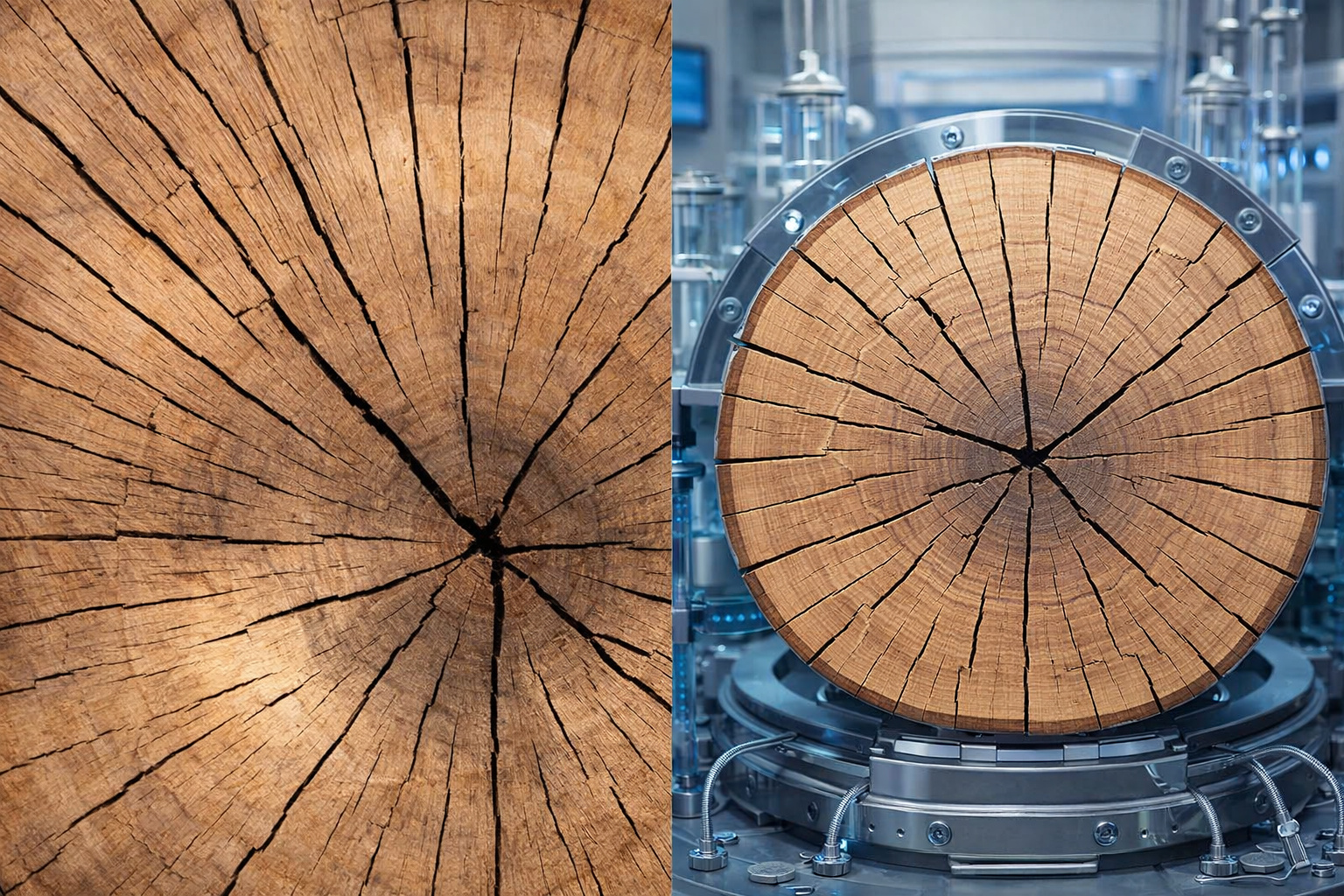


Scientific Advancement Points to a New Way of Producing Wood Without Cutting Down Trees and, at the Same Time, May Change the Logic of Forest and Industrial Extraction
Food production in the lab has ceased to be just a scientific curiosity. Now, following the so-called cultivated meat, researchers are advancing in another promising frontier: wood production in the lab from plant cells. This study indicates that in the future, it will be possible to obtain wood and fibers without the need to cut down entire trees.
The information was released by specialized science and technology outlets, based on a study conducted by researchers at the Massachusetts Institute of Technology (MIT), in the United States. According to the article, initial tests showed that plant tissues can develop in a controlled laboratory environment.
Furthermore, this advancement comes at a time of growing concern over deforestation, illegal logging, and the excessive use of natural resources. Therefore, the research presents not just a technical innovation. In practice, it proposes a structural change in the way the world produces and consumes wood.
-
Surrounded by the sea, the airport will have a system to prevent airplanes from falling into the water; technology will be installed in Ilhéus (BA), with an investment of R$ 70 million.

-
With a cost per shot close to zero, the DragonFire laser could change naval warfare in 2027 and provide British ships with nearly unlimited defense against drones.

-
A British startup creates tires that generate electricity in electric vehicles when passing over potholes, speed bumps, and cracks.

-
Scientists have created robots made with living cells that have their own nervous system, swim on their own, explore the environment, and self-organize without any genetic engineering, and now they want to do the same with human cells.

How Wood Production in the Lab from Plant Cells Works
The method developed by scientists follows a principle already known in biotechnology: selective cell cultivation, without needing to use the entire organism. In this case, the team led by Velásquez-García used cells taken from a zinnia leaf, an ornamental plant widely studied.
From this material, the researchers stimulated the growth of specific plant tissues in the lab. As a result, the cells responded well to the controlled environment. In this way, space is opened for, in the future, producing wood and plant fibers on an industrial scale.
Unlike traditional production, which depends on the slow growth of entire trees, laboratory cultivation directs development only to the tissues of interest. Thus, the process reduces common waste in the timber industry.
Additionally, scientists claim that the method is, in many respects, simpler than producing animal protein in the lab, such as cultivated meat. This is because plant cells reproduce more easily in artificial environments.
Although the study is still in its early stages, researchers explain that the costs of large-scale production will be evaluated in the future. Nonetheless, they remind us that traditional wood production involves high expenses related to planting, management, cutting, transportation, and processing.
Why Cultivated Wood May Reduce Waste and Transform the Industry

One of the central points of the research is the inefficiency of the current wood production model. Trees grow in cylindrical and elongated shapes. On the other hand, the industry often requires flat and standardized pieces.
As a consequence, a significant portion of the wood ends up being discarded during cutting and processing. According to engineer and co-author of the study, Ph.D. Ashley Beckwith, relying solely on forests represents an inefficient system.
She explains that years of growth are lost in the subsequent stages of the production chain. In contrast, laboratory wood production would allow cultivating the material already in the desired shape, such as panels or specific pieces for woodworking and construction.
As a result, material utilization could approach 100%, something impossible in the traditional system. Moreover, the innovation may reduce CO₂ emissions. This would happen both through forest preservation and decreased heavy logistics.
Currently, wood production relies on large machinery, trucks, and road construction. Consequently, these factors increase the environmental impact. Another relevant point is the indirect fight against illegal deforestation, still present in various regions around the world.
Environmental Impacts and the Future of Lab-Grown Wood
Despite the advancement, the researchers themselves emphasize that the technology is not yet ready for immediate commercial application. Even so, initial results indicate a promising path to optimize wood and plant fiber production.
If the technology evolves, it could benefit sectors such as construction, furniture industry, and paper and cellulose. At the same time, it can reduce socio-environmental conflicts related to forest exploitation.
Just as with cultivated meat, factors like social acceptance, final costs, and regulation will be decisive. Nonetheless, the study reinforces that rethinking traditional production models will be essential in the coming decades.
In conclusion, producing wood without cutting down trees may cease to be just a futuristic idea. The technology could solidify as a concrete solution to one of the greatest environmental challenges of the 21st century.
Would you trust furniture or constructions made with lab-grown wood, or do you still prefer traditional wood from forests?








florestas plantadas com rapido crescimento, sequestram carbono. Arvores adultas-maduras só armazenam…. o fluxo precisa de analisado
Se tiverem a mesma eficiência em todos os aspectos e com o acréscimo de serem livres de ataques de pragas, porque não!?
Após concluída essa etapa de estudos, diria que essa tecnologia tem grandes possibilidades de dominar o mercado de madeira.