





 Portuguese
  English
  Spanish
  5 min of reading
  0 comments



After Brussels Ignored The Paris Veto And Approved The Historic Treaty, The Government Faces Censorship Motions And Protests In The Field, Drowning The Country In A Crisis That Exposes Diplomatic Isolation And The Feeling Of National Humiliation In The Face Of The Economic Advance Of The South American Block.
The French government tried hard but failed to block the EU-Mercosur agreement, triggering censorship motions from the opposition and protests from farmers who consider the approval of the trade treaty for 750 million consumers a national humiliation and a direct economic threat to the country’s food sovereignty.
Censorship Motions Are Formal Instruments Of Parliament To Overthrow The Government Or Force Its Resignation, By Declaring That The Executive Has Lost The Confidence Of The Majority Of Deputies. They Exist In Various Parliamentary Systems But Take On Their Own Characteristics In The French Case.
Political Collapse And Isolation In Brussels
The French government has been harshly criticized by political rivals and farmers after failing to block the approval of the trade agreement.
-
The institute that trained the greatest aerospace engineers in Brazil has just opened its first campus outside São Paulo after 75 years: ITA Ceará will have R$ 445 million, new courses in energy and systems, and classes are expected to start in 2027.

-
Luciano Hang, owner of Havan, goes to Juiz de Fora after the tragedy in February, brings R$ 1 million, hands out R$ 2,000 cards, and donates up to R$ 15,000 to victims in the region.

-
The Brazilian passport allows legal residence in dozens of countries without the need for a prior visa, and most Brazilians are unaware that they can apply for residency directly upon arriving in nations in South America, Africa, and even Europe.

-
Petrobras sends a message to Brazilian truck drivers after fuel collapse and reveals plan to have 100% domestic diesel.


France joined Poland, Hungary, Ireland, and Austria in voting against the pact, but the group did not reach the minimum support necessary for a block.
The inability to veto the decision generated a feeling of national humiliation that was intensely echoed by local media, such as the broadcaster Europe 1. For analysts, the situation exposes that France has been “downgraded” in the European hierarchy. The country said “no,” but the European Union said “yes.”
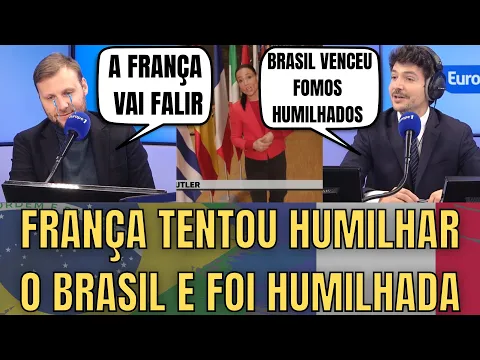

This diplomatic defeat symbolizes, for many, the end of French influence in building the bloc. The nation that founded and idealized the current European structure now finds itself powerless to defend its vital interests. The perception is that Paris has been run over by the industrial interests of Germany and Spain.
These countries argue that the agreement will help offset trade losses resulting from U.S. tariffs and reduce dependence on China.
In contrast, France, the largest agricultural producer in the EU, argues that its agriculture is being sacrificed in exchange for exports of cars, machinery, and chemicals.
Censorship Motions And Threat Of Dissolution

The far-left party France Unsubmissive (LFI) presented a censorship motion on Friday morning. At the same time, the far-right party National Rally (RN), led by Marine Le Pen, stated that it would also present a motion against the government in response to the outcome in Brussels.
The motions underscore the negative internal political reaction that Emmanuel Macron’s government faces. Mathilde Panot of the LFI declared that France was “humiliated” by Brussels and on the global stage, demanding immediate resignations from the leadership. The atmosphere is one of an imminent “political earthquake.”
In response to the instability, Sébastien Lecornu criticized the motions, stating that they send a negative signal abroad. However, behind the scenes, the threat of dissolving the National Assembly has returned to the table. There are reports of preparations for possible legislative elections in March, coinciding with the municipal elections.
Although analysts like Stewart Chau from the Verian Group say the motions have little chance of being mathematically approved, the symbolic damage is immense. Signing the agreement could give a significant boost to the RN, solidifying the narrative that the European Union acts against the interests of the French people.
Smear Campaign And The Anti-Mercosur Narrative
The French reaction is not limited to institutional politics; it is fueled by a strong rhetoric against South American production standards. In debates broadcast by Europe 1, the outrage focuses on the alleged “unfair competition” that the agreement will bring, painting a catastrophic scenario for agriculture.
Farmers and commentators in France claim that the agreement will flood the market with cheap products that do not follow the same sanitary rules. The focus of the criticism is on imports of sugar, poultry, and especially beef from Brazil and Argentina, seen as direct threats.
The prevailing narrative in France holds that the difference in production costs – about 30% lower in Mercosur – is due to the use of substances banned in Europe. The French media emphasizes repeatedly the use of growth hormones and antibiotics as factors of artificial price reduction.
This view, classified by Brazilian observers as a smear campaign, seeks to disqualify Mercosur’s production in the eyes of public opinion. The idea being sold is that Brazil produces “hormone beef,” ignoring local regulations, to justify European protectionism under the pretext of food safety.
For French farmers, national agriculture is the “lung of France” and is being exchanged for corporate interests. The feeling is that the country should not become the “hotel of Mercosur,” passively accepting products it considers inferior to benefit the German automotive industry.
Political Hypocrisy And The Future Of Elections
The current crisis has also exposed what analysts call the hypocrisy of the traditional political class. Parties such as The Republicans and the Socialist Party, which now criticize the agreement, have supported free trade treaties for decades. The agreement with Mercosur has been in negotiation for over 25 years.
Many of these negotiations took place under the leadership of figures who now try to distance themselves from the outcome. The assessment is that “the masks have fallen”: politicians who parade with farmers are, in fact, trying to save their parliamentary seats in front of an electorate weary of the current model of globalization.
The president of the RN, Jordan Bardella, classified Macron’s vote against the agreement as a “mere stance,” equating it to a betrayal of farmers. Marine Le Pen even suggested that Macron threaten to suspend France’s contribution to the EU budget as a form of protest.
France obtained concessions from Brussels to protect farmers, but the sector considers the measures insufficient. Even if wine and cheese industries might benefit, the mobilization of livestock farmers has dominated public debate, transforming the agreement into a symbol of national degradation.
With the presidential election of 2027 on the horizon, the political “tightrope” of Macron’s government is becoming increasingly dangerous. Rural France, feeling betrayed and sold out by Brussels, tends to vote massively for anti-EU platforms, profoundly altering the political landscape of the Fifth Republic.









-

Uma pessoa reagiu a isso.