





 Portuguese
  English
  Spanish
  7 min of reading
  1 comment


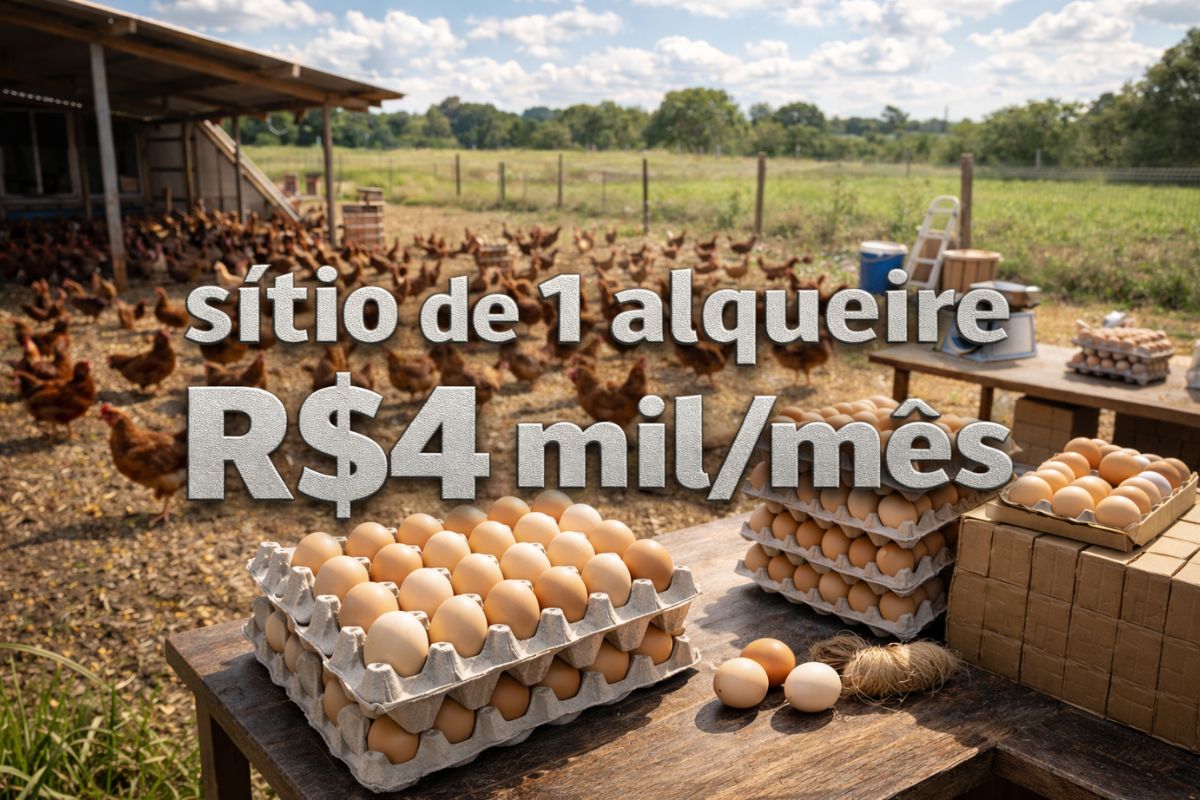


At Ana Maria’s Farm, One Acre of Hilly Land Shows That It’s Possible to Live Well with Small Production, Loyal Customers, and Dozens Sold for R$ 14, Without Relying on Market or Intermediaries.
Leandro still works as a painter, but it was between simple warehouses, well-cared-for chickens, and a streamlined distribution center that he built his routine as a free-range egg producer. With around 1,000 birds and a focus on quality, hygiene, and direct relationship with the end consumer, the king of free-range eggs already earns about R$ 4,000 monthly just from the eggs, in an operation designed to fit within the family’s budget and time.
From Painter to Producer: The Turnaround of the King of Free-Range Eggs
Before being known as the king of free-range eggs, Leandro already had an established profession. He works as a painter, and it was precisely his painting job that financed a good part of the initial structure of the farm.
Over time, the income from eggs started to come in, helping to build warehouses, adjust installations, and improve the family’s quality of life.
-
“No one will make us change the Pix,” says Lula after the US report.

-
Lula responds directly to Trump and says that Pix is from Brazil and will not change under pressure from anyone, after a report from the United States pointed out the Brazilian payment system as an American trade barrier.

-
Amazon has just announced a new fee on all deliveries, and your online purchases will become more expensive starting April 17, including for those buying from the United States here in Brazil.

-
He sold his share for R$ 4 thousand, saw the company become a giant worth R$ 19 trillion, and missed the opportunity of a lifetime.

The breeding started almost like a scene from a rural film. To him, the farm must have life, dogs, animals, and, of course, hens.
The first 70 birds were placed more out of desire than business planning. Sales emerged naturally, with acquaintances curious about the recent free-range eggs coming straight from the producer.
Without technical knowledge, the initial phase was marked by errors, mortality, and frustration. It was at this point that the story of the king of free-range eggs began to change.
He sought training at the poultry school, started watching videos, took courses, understood management, lighting, ambiance, feed, welfare, and health. When studying became part of his routine, free-range eggs stopped being just a hobby and turned into a structured project.
A Well-Used Acre Yields More Than It Seems
The farm has 1 paulista acre, about 24,000 square meters, in a very hilly area. This forces the king of free-range eggs to think carefully about every meter.
Even so, he managed to organize the house, warehouses, paddocks, and access points functionally.
The first warehouses housed around 300 birds, already ensuring some supplementary income. Over time, Leandro built new spaces, correcting design mistakes, improving ventilation, height, roof, and layout of nests and perches.
Today, he works with around 1,000 hens distributed across five warehouses, with the possibility of reaching approximately 1,300 birds without losing control of the routine.
The strategy was never to be gigantic. The focus of the king of free-range eggs is to have a system that he and his wife can manage in a few minutes of morning handling and some minutes of collection throughout the day, leaving time for other activities, rest, and family.
How Much Does the King of Free-Range Eggs Really Earn?

When talking numbers, Leandro tends to be conservative. He notes that just that “piece” of production, with a core of around 300 birds, already guarantees around R$ 4,000 monthly.
At other times, he admits that the accounts show the real income is higher, but he prefers to work with the figure of R$ 4,000 so that people don’t disbelieve and to encourage each producer to do their own math.
The calculation revolves around the combination of three central points. First, the king of free-range eggs sells directly to the final customer, which allows a better price per dozen.
Second, the selling price is R$ 14 per dozen, which is only possible with a product that the consumer perceives as superior. Third, he controls costs simply, without unnecessary luxury in the structure, but without compromising hygiene, good feed, and quality water.
The result is a stable income, built on a modest scale, with organized warehouses, predictable routines, and loyal clientele.
For him, it’s not necessary to earn R$ 50,000 a month to live well; it’s necessary to adjust the standard of living to the income and ensure constancy in the cash flow.
Quality and Added Value in Each Dozen
The heart of the model lies in the added value of the free-range eggs. Instead of relying on supermarkets and wholesale, the king of free-range eggs decided to work with direct sales.
He serves customers at home, at fairs, small local businesses, and some fixed points, but always with the concept of known origin.
Quality comes from a series of choices. The birds receive feed produced on the farm, mixed by him, always in small batches to ensure freshness.
The water is treated, with chlorine control. He avoids overcrowding in the warehouses, maintains proper ventilation, and manages light well with a timer. The priority is to have healthy, well-fed chickens and a clean environment, because this reflects in the shell, smell, yolk, and taste.
On the commercial side, Leandro maintains the price. If the market tightens, he prefers to donate rather than devalue the egg. In his view, lowering the dozen to very low prices makes it unfeasible to sustain feed, structure, labor, and accumulated knowledge.
For this reason, the king of free-range eggs insists that it’s better to educate the consumer to understand the value of well-produced eggs than to engage in a price war that doesn’t close the books.
One tip he considers fundamental is to use the first small eggs, which are less commercial, as a marketing tool. Rather than trying to sell, he donates them to neighbors, friends, and acquaintances.
People try them, feel the difference, and when they hear someone praise a local egg, it connects the producer to the product.
Simple Structure, Professional Farm Hygiene


The physical structure of Ana Maria’s farm is a reflection of the philosophy of the king of free-range eggs. The warehouses were made with accessible materials but with an efficient ambiance logic.
High ceilings in the new warehouses, roofs with eaves to protect nests and doors from rain, absence of side walls in some areas to favor air circulation, and intelligent placement of perches, feeders, and drinkers.
The mistakes from the first warehouses served as lessons. He realized, for example, that screens touching the wall create mosquito accumulation points.
He also noticed that perches attached to masonry accumulate dirt and increase the risk of contamination. Subsequently, he corrected these details in the new warehouses, distancing screens and perches, positioning nests to avoid broken eggs, and prioritizing easy access for handling and cleaning.
A highlight is the distribution center. Simple, compact, and regularized with a municipal inspection seal, it follows a clear flow.
The eggs arrive in buckets or trays, undergo pre-selection, candling, and weighing, are classified, and follow to selling trays.
Hand and boot hygiene is done in an appropriate location, with boot washes and pedal operation to avoid direct contact with taps.
The philosophy is clear. For the king of free-range eggs, the best egg is the one that comes out clean from the nest, minimizing washing as much as possible.
Very dirty eggs are usually reserved for family consumption. This view aligns with the idea that care starts in the warehouse, not just in the distribution center.
Grow Slowly to Avoid Breaking
At all times, Leandro repeats a message that serves almost as a mantra. He argues that, especially for small producers, growing slowly is a way to protect oneself.
Instead of starting with hundreds or thousands of birds, he recommends starting with around 100 hens, learning the management, testing the routine, observing mortality, organizing clientele, and only then expanding.
Another important point is the choice of pullets. The king of free-range eggs prefers to acquire birds that are around 90 to 100 days old, already grown, to shorten the time until they start laying and reduce the risks of the initial phase.
This helps balance cash flow since the producer does not spend many months only investing in feed without return.
The logic is one of security. If there’s a problem, it’s much simpler to adjust two or three small warehouses than to dismantle a large structure.
For Leandro, having a system that survives unexpected events is worth more than having a gigantic and fragile system.
Lessons from the King of Free-Range Eggs for Those Who Want to Start
The journey of the king of free-range eggs provides a set of practical lessons for those dreaming of earning income from the farm. The first is that study is not a luxury; it’s a foundation.
Courses, videos, and exchanges in producer groups prevented him from repeating mistakes that cost money and time.
The second is that quality comes before quantity. There’s no point in having thousands of birds if cleanliness, management, and organization don’t keep up.
Another important lesson is the power of direct sales. By working with the end customer, the king of free-range eggs can set prices that cover expenses and still allow reinvestment.
Trust is born from contact with the producer, visits to the farm, videos showing clean warehouses, organized nests, and transparent routines. When the consumer understands where the egg comes from, they are more willing to accept the price charged.
Finally, there is a human dimension that nourishes the business. Leandro speaks fondly of the customers, the neighbors who help when he needs to go out, the girl from the community who helps classify the eggs, and the father of a neighbor who can come to help with handling.
The king of free-range eggs didn’t just build a farm. He helped form a small network around production, where knowledge, work, and income circulate.
In essence, the story shows that a one-acre farm, with 1,000 well-managed hens, can indeed guarantee a solid income, provided there is discipline, study, and respect for the product.
The king of free-range eggs proves that you don’t need an empire to live off the land, but it’s essential to treat each dozen as something valuable.
Can you imagine starting with 100 hens to test in practice if free-range eggs could also become your main source of income?








I’m impressed by what he did and I’m convinced to follow him I have been dilly dallying for years thinking that I needed a bigger place