





 Portuguese
  English
  Spanish
  9 min of reading
  0 comments


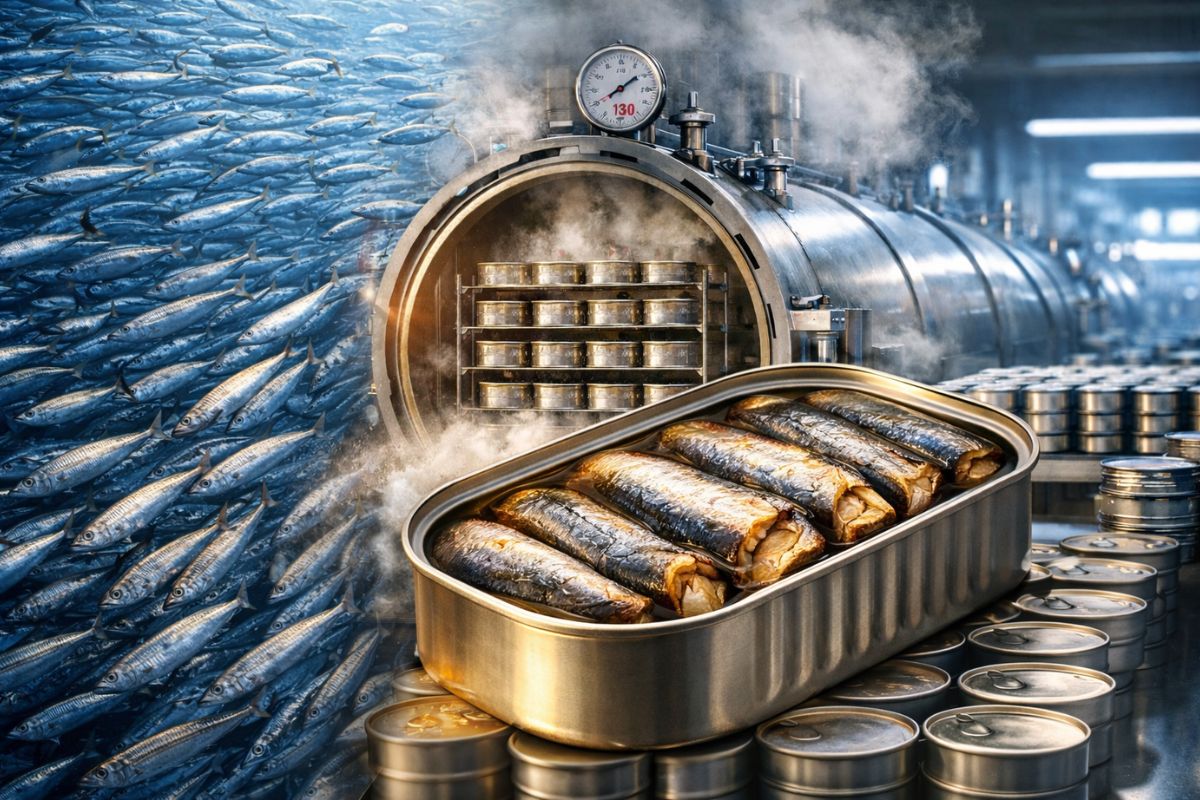
Each Harvest, Millions of Tiny Fish Leave the Ocean at Sunset and, in a Few Hours, Enter a Precise Industrial Process Where the Sardine Becomes a Can Capable of Lasting Years on the Shelf Without Spoiling, Without Refrigeration and Without Chemical Preservatives.
From the open sea to the port, from brine to autoclaves at 130 °C and the lines that produce over 2 million cans per day in Itajaí, the Gomes da Costa factory shows how technology, logistics, and quality control transform an extremely delicate fish into a safe, affordable, nutritious food ready to travel the world.
The Sardine Becomes a Can in a Huge Canned Food Market
Have you ever found a forgotten can of sardines in the pantry, opened it without fear, and noticed that the product remained intact, tasty, and with a fresh smell? Behind this, there is impressive engineering.
Every year, over 3 million tons of sardines are caught in the oceans, and a huge portion goes to canning industries that produce billions of cans in oil, olive oil, tomato sauce, water, or brine.
-
With 74% of companies facing difficulties in hiring, technicians and engineers in renewable energy are becoming scarce in Brazil and are essential to support the expansion of solar, wind, and green hydrogen projects.

-
Historic bankruptcy of Centauro shocks the market, and the century-old company puts more than 500,000 products, machines, and complete infrastructure up for online auction.

-
New shoe factory in Ceará is expected to create 400 jobs and strengthen the local economy.

-
No one imagined it, but a mixture of sawdust with a mineral that fights fires surprises scientists with a result that changes the course of fire-resistant construction.

The sardine has conquered the world because it combines three rare factors in a single food: it is cheap, highly nutritious, and easy to store.
A can can cross continents and stay in storage for months or years, reaching the final consumer still safe for consumption. In Brazil, the epicenter of this chain is on the coast of Santa Catarina.
In Itajaí, the Gomes da Costa factory is one of the largest canned sardine operations on the planet and has the capacity to produce over 2 million cans a day, a volume that is only possible because the entire process in which the sardine becomes a can works like an extremely precise gear.
From School to Net: Night Fishing and Purse Seining

The journey in which the sardine becomes a can begins far from the shelves, still in the open sea. Fishing usually occurs late in the afternoon and throughout the night, a time when schools rise to the surface to feed on plankton.
At this moment, millions of sardines move as if they were a single organism, forming true living clouds beneath the water’s surface.
To capture these schools without wasting time, the industrial fleet primarily uses the purse seine. The boat identifies the patch of fish, navigates around it, and casts a huge circular net that closes the perimeter and keeps the entire school surrounded.
As the net is pulled, the sardines become more and more concentrated until they can be safely removed.
In the past, this step almost entirely depended on the visual experience of fishermen, who followed seagulls and small alterations on the surface.
Today, sonars and radars emit sound pulses that return upon encountering the schools, literally allowing them to see under the water, estimating the size, depth, and density of the group of fish.
It is this combination of traditional knowledge with technology that guarantees the first step so that, a few hours later, the sardine can become a can in an industrial environment.
From Port to Factory: A Race Against the Clock for Freshness
After capture, time starts counting directly against the quality of the fish. That’s why sardines are removed from the net as quickly as possible, with smaller nets or even suction pumps that take the fish directly to tanks on board.
These tanks are loaded with ice or chilled water because preservation begins there, still on the boat.
In industrial operations, the return to port usually occurs within 24 hours of capture. When the vessel docks, unloading is almost choreographed.
The sardines are unloaded in large volumes, immediately covered with ice, and sent to refrigerated trucks that transport them to the canning factories.
In many cases, the fish reaches the production line just hours after leaving the sea, maintaining a level of freshness that will make all the difference later on.
Canning factories process, on average, about 1 million sardines per day, and this scale is only sustained because the flow of arrival is constant and highly organized. In some plants, the interval between capture and the start of processing is no more than 5 hours.
It is this precise logistics that prepares the ground for the stage where the sardine becomes a can, already in a completely controlled environment.
Inside the Factory: Cooling, Cleaning, and Mass Evisceration

When the refrigerated truck arrives at the industrial unit, the total focus is on preservation. The sardines are unloaded and placed in large containers with cold water, keeping the fish temperature around 5 °C.
This helps preserve the meat, slows bacterial growth, and ensures that the product maintains maximum quality for the following stages.
After this initial cleaning, comes one of the most important stages of the entire line: evisceration, which removes the head and entrails. In addition to improving texture and flavor, this removal is essential for food safety because entrails deteriorate much faster.
In many industries, this process is automated. The sardines move along conveyors in organized rows to machines that, with blades, tweezers, and sensors, cut and clean thousands of fish per hour with millimeter precision.
Even so, the human eye remains indispensable. In some lines, especially in more “premium” products, evisceration is manual.
On stainless steel tables, trained workers make fine cuts with knives or specific scissors, avoiding waste and ensuring a more uniform visual standard. Many factories combine both systems, using automation for volume while manual work serves as fine-tuning.
The goal, in all cases, is to deliver a clean, intact sardine ready for the next crucial step in the journey where the sardine becomes a can: the brine bath.
Brine, Texture, and Preparation for Heat
After the evisceration, the sardines immerse in brine tanks, a carefully controlled solution of water and salt. They remain there for about 30 minutes, enough time for the salt to penetrate evenly.
This stage does much more than just salt the fish. The brine firms the meat, improves texture, and aids in initial preservation, even before cooking, all without masking the natural flavor of the sardine.
Upon leaving the solution, the fish are arranged on metal grills designed to keep them slightly inclined and quickly undergo a wash to remove excess salt from the surface.
This fine-tuning is essential. Too much salt destroys flavor and too little compromises preservation. Only after achieving this balance do the sardines proceed to the heat that determines if they will reach the shelf in perfect shape.
Cooking and Autoclaves at 130 °C: The Point Where the Sardine Becomes a Can Secure for Years
The next step is cooking, which can happen in two main ways, depending on the product line. In many cases, cleaned and brined sardines are placed on grills and pass through industrial steam ovens, in closed chambers where steam circulates in a controlled manner.
The temperature ranges between 100 °C and 120 °C, and the process lasts, on average, 10 to 20 minutes, leaving the fish pre-cooked and ready to enter the can.
In other production models, even more efficient for large volumes, the sardine enters raw directly into the can, along with the preserving liquid, which can be vegetable oil, olive oil, brine, or tomato sauce.
The cans are hermetically sealed and go to gigantic equipment called industrial autoclaves.
Inside the autoclaves, thermal sterilization occurs with steam under high pressure, at temperatures that can reach 130 °C, for periods ranging from 30 to 90 minutes, depending on the size of the package and the type of sauce.
It is at this moment that, definitively, the sardine becomes a can safe: the fish cooks completely in its own liquid and all microorganisms capable of causing contamination are eliminated.
There is also a third method, where the cans are placed upside down during thermal treatment.
As the steam cooks, the liquid and the natural fat of the fish drain, helping to adjust texture and appearance before the final stage. In any of the methods, the goal is identical: to deliver a properly cooked sardine, stable, and ready to last a long time in the consumer’s pantry.
Canning, Preserving Liquids, and Hermetic Sealing
With the sardines cooked or pre-cooked, the actual canning stage begins, which defines the final appearance and flavor of the product.
The fish are carefully positioned inside the cans, either by machines that organize everything in a standardized manner or by teams that make manual arrangements when a more uniform appearance is needed.
Subsequently, the preserving liquids are added, varying according to the product. Oil and olive oil help preserve moisture and make the meat tenderer, while brine maintains a more neutral flavor profile, highlighting the natural taste of the sardine.
Tomato sauce adds acidity, flavor complexity, and also contributes to preservation.
The amount of liquid is rigorously measured. It cannot be too little or too much, as this affects everything from flavor to safety and the weight declared on the label.
Only after this adjustment do the cans proceed to the automatic sealers, where the lid is pressed against the body of the can, forming a hermetic seal that creates an oxygen-free environment inside. Without oxygen, there is no oxidation, and the growth of microorganisms is prevented.
It is this set of factors that transforms the packaging into a true protective capsule. Once properly closed, nothing enters and nothing exits, allowing the sardine to be stored for long periods without the need for refrigeration and without artificial additives.
Second Pass Through the Autoclave, Inspection, and Shelf


Even after being sealed, the cans go back to the industrial autoclaves for a final stage of high-temperature and pressure sterilization. This “thermal reinforcement” ensures that any resistant microorganism is completely eliminated.
Subsequently, the cans undergo a gradual cooling process, also controlled, to avoid thermal shock, swelling, and deformations in the sealing.
Only then do the cans proceed to the inspection and quality control area. Samples from each batch are opened in the laboratory, where technicians assess the internal vacuum, the integrity of the seal, the visual aspect, the odor, the texture, and the weight of the contents. Any sign of failure leads to a review of the entire batch.
If approved, the cans go to labeling, where they receive information about the type of sauce, ingredients, expiration date, origin, and nutritional data.
They are then packaged into boxes, organized on pallets, and sent out in trucks to markets, grocery stores, and kitchens in different regions and countries.
What started as a school in the late afternoon in the ocean is now a canned sardine ready to travel long distances without losing safety or quality.
Why So Much Engineering for Such a Simple Fish
All this sequence in which the sardine becomes a can does not happen by chance. Besides being a cheap and accessible product, canned sardine is very rich nutritionally.
The fish concentrates good amounts of omega-3, which helps protect the heart, improve circulation, and support brain function.
Since it is consumed with bones softened by the thermal process, canned sardine is an excellent source of calcium and phosphorus, contributing to stronger bones and teeth.
The combination with high-quality proteins, vitamin D, iron, and other minerals transforms this apparently simple can into a low-cost nutrition package.
When you put all this together with the ability to last for years on the shelf without refrigeration, it’s easy to understand why this product has become so important in the daily diet of millions of people.
A small fish, a huge process, and a chain that goes from the fisherman in the open sea to the factory in Itajaí, Santa Catarina, where the sardine becomes a can of over 2 million units per day.
And now that you know this whole journey, tell me: after learning how the sardine becomes a can, do you see this product differently on the store shelf?








-

-

-

-

4 pessoas reagiram a isso.