





 Portuguese
  English
  Spanish
  5 min of reading
  0 comments



Practical Guidelines for Foundation and Waterproofing Show How Decisions Made at the Start of the Work Can Reduce Structural and Humidity Risks Over the Years, According to Job Site Experience Presented in a Technical Video Aimed at Those Who Plan to Build Houses with More Than One Floor.
Those who start a construction project thinking only about what appears on the surface, such as walls going up and finishing, often find out too late that the headache lies beneath the floor.
In a guidance video published by the channel Irmãos à Obra Araraquara, the recommendation is clear: the combination of a well-executed foundation, concrete with adequate resistance, and waterproofing in two stages helps reduce the risks of infiltration, humidity, and failures that may arise years later.
The presenter’s speech is direct when addressing the topic as a decision made at the start of the work, rather than a later correction.
-
Created by George Lucas with over $1 billion, a futuristic museum in the shape of a spaceship with 1,500 curved panels is about to open in Los Angeles and will house one of the largest private collections of narrative art in the world.

-
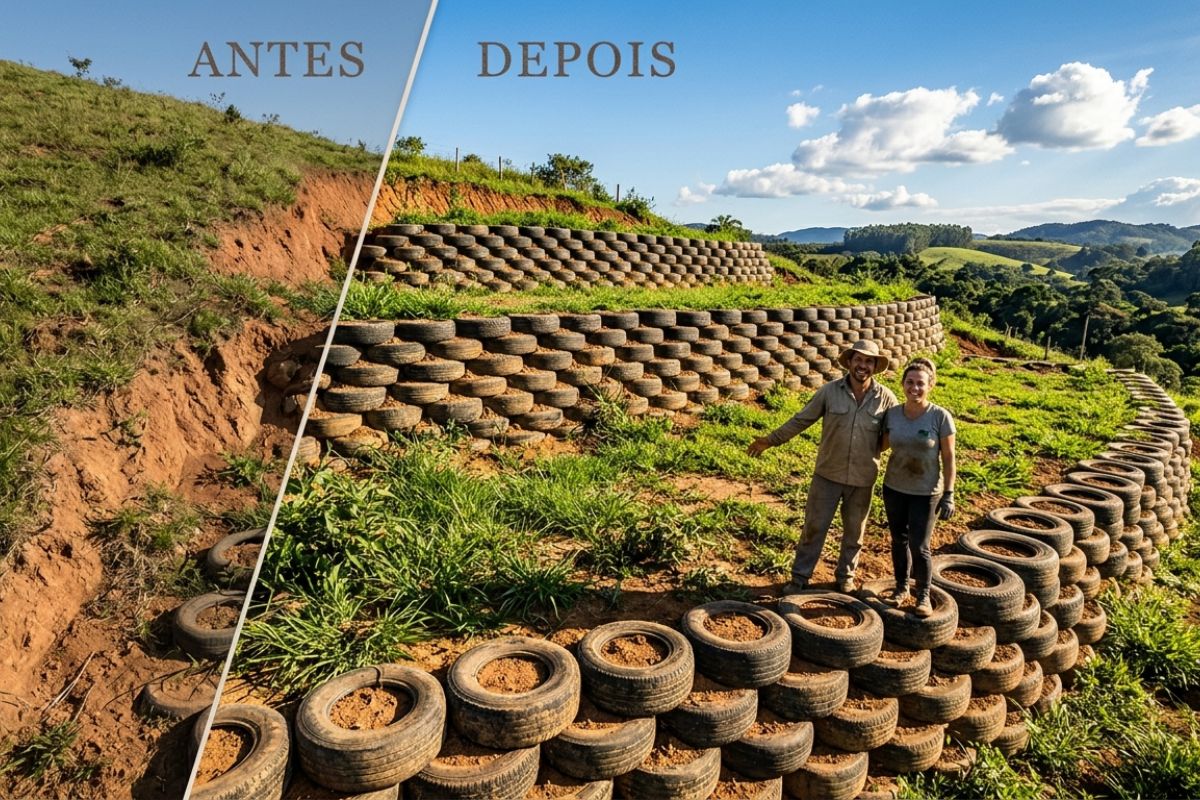
Couple shows how they built a retaining wall on their property using 400 old tires: sloped land turned into plateaus, tires are aligned, filled, and compacted with layers of soil, with grass helping in support and at almost zero cost.
-
Engineer explains drainage during the rainy season: the difference between surface water and deep water, ditches, gutters, and water outlets on the road, as well as drains and drainage mattresses, to prevent erosion, aquaplaning, and flooding at the construction site today.

-
With 55 floors, 177 meters in height, a 15-meter walkway between the twin towers, ventilated facade, and 6,300 m² of leisure space, Ápice Towers already has one tower completed and another nearly at the top.


The tip, according to him, is to “start the work on the right foot,” prioritizing services that often remain hidden but support the entire construction and influence performance against humidity.
Deep Foundation for Houses with a Second Floor
Right from the start, the content defines a specific scenario: houses that will have a second floor.
In this condition, the channel advises the execution of drills with a diameter of 25 centimeters and a depth of 10 meters, associated with capping blocks on the heads of the piles, which serve as part of the foundation and load transfer system.
Subsequently, the video describes the service order, drawing attention to filling the drills with concrete and the moment to position the reinforcements.
In the explanation, first, “fill the concrete drills,” and then the reinforcements are added.
After that, the team discusses the preparation of the reinforcements of the blocks and the columns’ starting points, which are the starting points for the support structure.
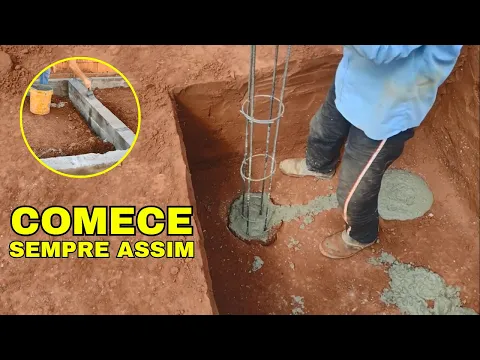

Throughout this stage, the channel maintains focus on the procedure and the sequence of actions, without delving into structural calculations or dimensions beyond what is mentioned in the recording.
Even so, the central message is one of method: execute the foundation carefully, respecting each phase, to reduce the chances of pathologies in the construction.
Concrete FCK25 and Control of the Pouring Stage
After presenting the sequence of the foundation, the video mentions the use of ready-mix concrete with FCK25 resistance.
The material is cited as a “top option for this type of service,” an expression used by the presenter when discussing the pouring process.
In practical terms at the job site, the emphasized point in the recording is the choice of concrete with a defined specification, instead of improvisations or uncontrolled variations.
The explanation does not detail design criteria, technological control, or testing.
Even so, it reinforces that the pouring stage needs to follow a standard compatible with what was planned.
While the video follows the logic of operational tips, the guidance remains on what can be observed: pour in the indicated order, use ready-mix concrete with declared resistance, and ensure that reinforcements and starts are prepared to continue the rest of the structure.
Baldram Beam as the Base of the Building
Upon completing the initial part, the channel reports on the next phase: the execution of the baldram beam formwork.
Next, the placement of the reinforcements “designed for this” occurs, followed by the pouring of these beams.
The video describes the work as a continuous step, connecting the foundation to the base that will receive walls and other elements of the building.
The following day, according to the narration, the formwork is removed.
It is at this moment that the content shifts focus and begins to address the topic that resonates most with the title: protection against humidity from the start of the work.
The transition between structure and waterproofing appears as part of a planning process that begins early, while the job site is clear and access to the foundation is simpler.
Double Waterproofing and Prevention of Future Problems
The main recommendation for protection, according to the video, is the so-called double waterproofing.
The strategy described begins with two coats of tech plus top waterproofing.
After 24 hours, the recommendation is to apply asphalt paint, described as a measure to ensure more comprehensive protection.
When addressing this phase, the channel emphasizes the importance of protection services in civil construction.
At this point, the presenter gives a direct warning to the audience: “no skimping on this stage.”
The argument is not aesthetic but functional.
The waterproofing tends to be hidden, but it directly influences the chances of rising humidity, infiltration, and pathological manifestations that often take time to appear.
Still, the content does not delve into alternative brands, technical standards, or testing methods.
The focus remains on the procedure adopted by the team in the case presented.
Construction Planning Beyond Finishing
The video concludes with the expectation of practical utility.
According to the presenter, the guidance seeks to help those building to avoid future problems related to foundations and humidity.
In a conversational tone with the audience, he also invites viewers to subscribe to the channel and activate notifications, highlighting that there is new content weekly.
Even with simple language, the message remains aligned with the central theme.
A well-planned start to construction is one that prioritizes invisible steps, yet critical for the performance of the building over time.
If most humidity problems arise when the finishing is already completed and the house is in use, why do so many constructions still leave waterproofing as a last-minute decision?









-

-

-

-

10 pessoas reagiram a isso.