





 Portuguese
  English
  Spanish
  3 min of reading
  0 comments


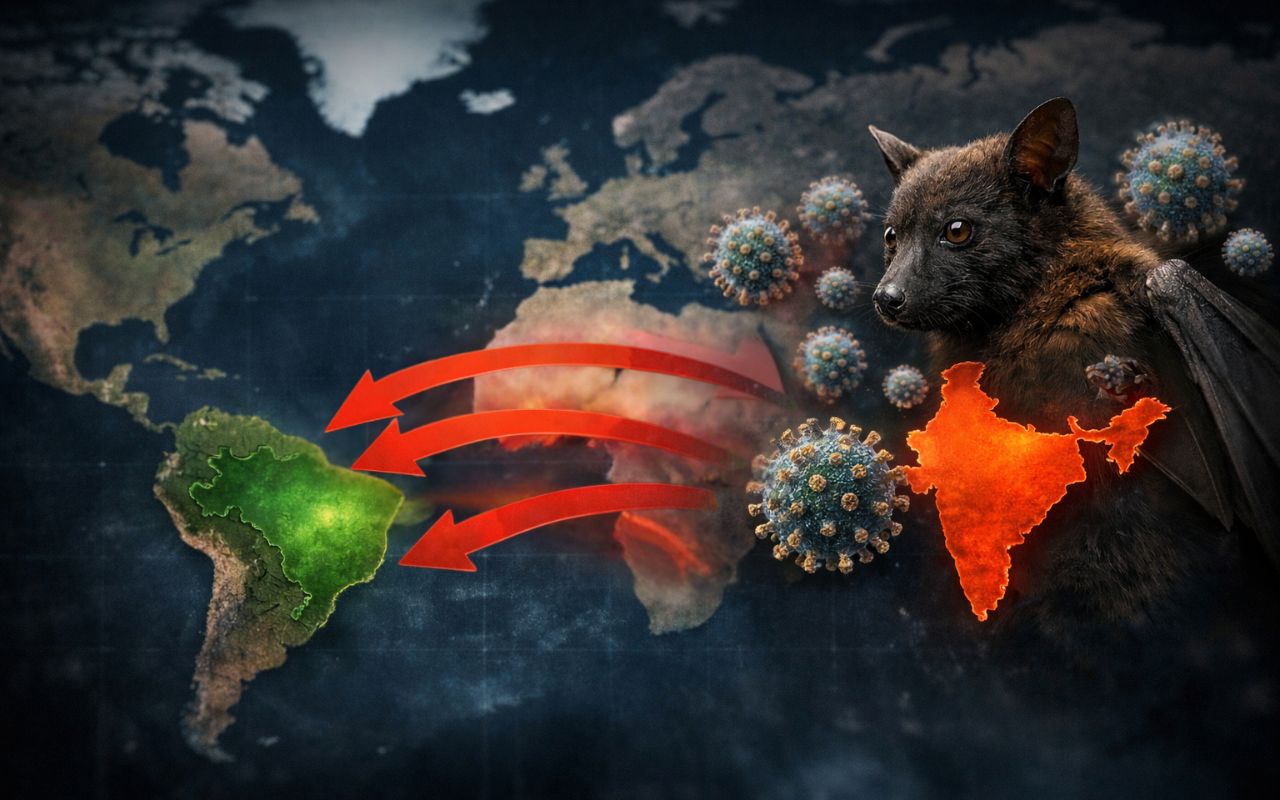
Nipah Virus Is Identified In India In 2026 And Alarms Authorities For Being A Virus Without A Vaccine, With High Lethality And Epidemic Risk.
The confirmation of new cases of the Nipah Virus in India, released on January 13, reignited the alert from health authorities and the World Health Organization (WHO).
The Indian Ministry of Health reported that two people tested positive in the state of West Bengal, a region that has begun to adopt enhanced surveillance protocols.
The reason for concern is clear: it is a virus without a cure, without a vaccine, and with high potential for spread.
-
Brazilian Navy reaches a new level by taking over an airport with a 1,600-meter runway used by 1,800 military personnel and autonomous attack drone testing.

-
The Himalayas continue to grow to this day, with tectonic plates advancing 5 cm per year, mountains rising up to 10 mm annually, and the 2015 earthquake that killed 9,000 people may have increased the risk of an even larger seismic mega-event.

-
At an altitude of 400 km by astronauts from the International Space Station, Paris transforms at night into a golden mesh so precise that it reveals the outline of the Seine River, avenues, and entire neighborhoods like a luminous map drawn over the Earth.

-
iPhone 17 reaches historic low price with 256 GB, 120 Hz display, and drops to R$ 5,703 on Shopee, featuring A19 chip, dual 48 MP cameras, battery life of up to 30 hours, and advanced AI features.


Classified by the WHO as a priority virus, Nipah is closely monitored due to its history of severe outbreaks and high mortality rate.
Therefore, any new reports attract international attention and reinforce the need for swift responses.
Why Is The Nipah Virus Considered A Global Threat?
The Nipah Virus is on the list of pathogens with the potential to cause epidemics. One of the factors that increases this risk is its ability to transmit through various routes, including direct contact between people, which is uncommon in many zoonotic viruses.
Additionally, the absence of specific treatments limits medical options.
Thus, prevention and early isolation of cases become the main control strategies adopted in India.
Origin Of The Nipah Virus And Transmission Methods
Nipah is a zoonotic virus, meaning its origin is linked to transmission from animals to humans.
Fruit bats, which feed on fruits, are considered the primary natural reservoirs of the virus.
These animals can contaminate food with saliva or secretions. In certain contexts, other species can also act as intermediate hosts, increasing the possibilities of human infection.
The first documented outbreak occurred in Malaysia, when rural workers contracted the virus after contact with infected pigs.
Since then, sporadic cases have been recorded in countries in South and Southeast Asia, including India.
Prolonged Incubation Makes Tracing Difficult
Another aspect that challenges health authorities is the incubation period of the Nipah Virus.
According to the WHO, symptoms typically appear between 4 and 14 days after infection.
However, there have been records in which this interval reached 45 days, complicating the identification of the source of infection and the interruption of transmission chains.


Symptoms Vary And Can Evolve Quickly
The initial signs of infection with the Nipah Virus tend to be nonspecific, making early diagnosis difficult.
Fever, headache, nausea, and vomiting may occur in the first few days.
As the disease progresses, the virus can affect the central nervous system, causing encephalitis, seizures, and changes in the level of consciousness.
In some patients, respiratory complications, such as pneumonia, also arise, worsening the clinical picture.
Diagnosis Requires Quickness And Specialized Structure
Identifying the Nipah Virus depends on specific laboratory tests.
The accuracy of the results can vary based on factors such as the type of sample collected, the timing of collection, and the transportation time to laboratories.
These variables make diagnosis a challenge, especially in regions with lower infrastructure, which reinforces the need for constant surveillance in India.
Treatment Still Limited To Symptom Control
Currently, there is no specific treatment for the Nipah Virus. Vaccines are in research stages but have not yet been released for use.
Medical care focuses on relieving symptoms and supporting severe complications, such as seizures and respiratory problems.
In previous outbreaks, some antivirals were used experimentally, without definitive scientific evidence.
Is There A Risk Of The Nipah Virus Reaching Brazil?
Experts explain that the Nipah Virus remains geographically restricted to countries where there have been reports, such as India, Malaysia, and Indonesia.
So far, there are no indications of sustained circulation outside this region.
According to them, the risk for Brazil is considered low unless there is a significant evolution in human-to-human transmission on a large scale.
With information from UOL.








-

-

-

8 pessoas reagiram a isso.