





 Portuguese
  English
  Spanish
  4 min of reading
  0 comments


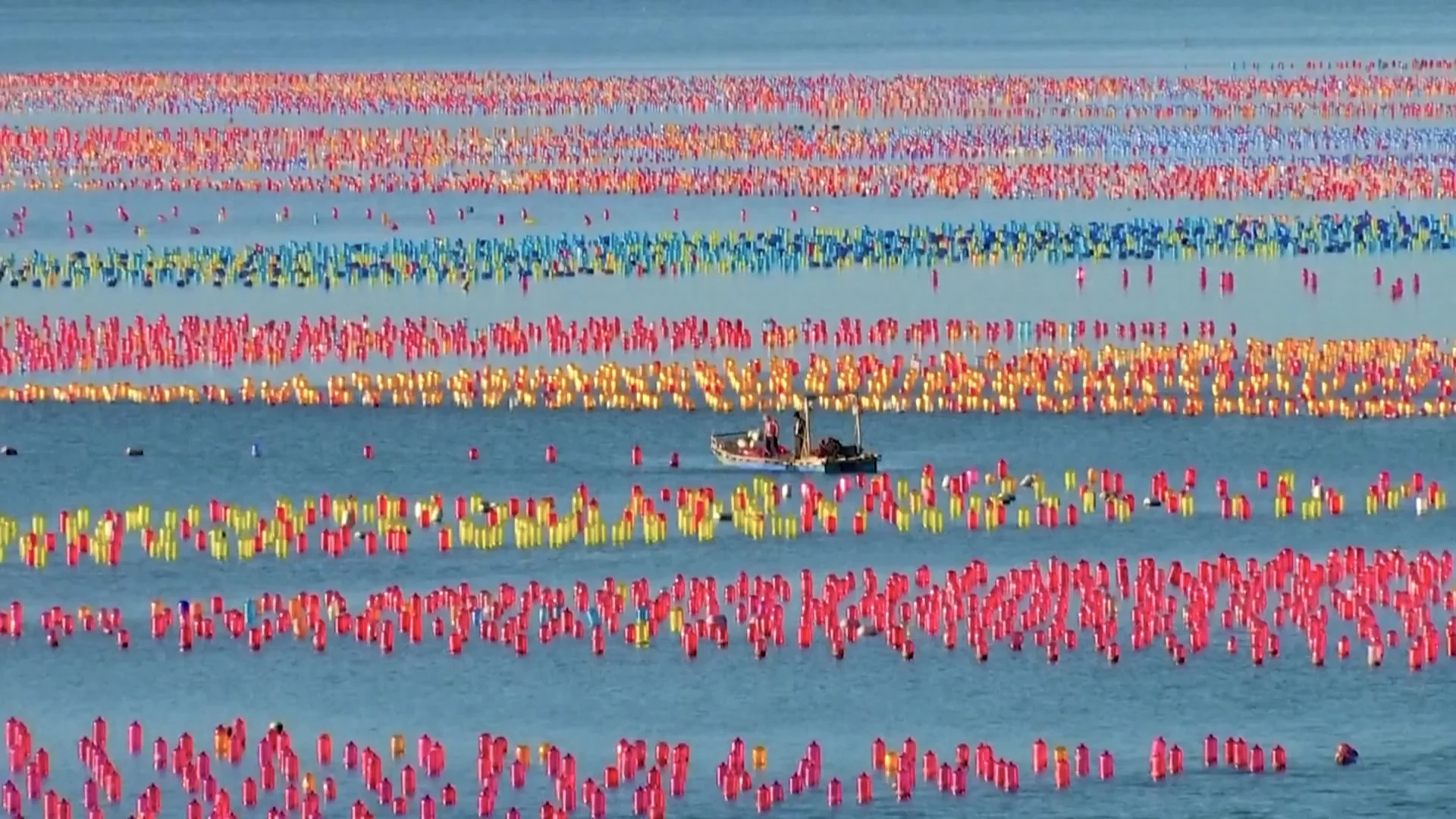
China Dominates Over 80% of Global Oyster Production with Giant Floating Farms and an Industrial System That Transforms the Sea into an Ocean Assembly Line.
In 2023, official data from FAO and the China Fisheries Yearbook confirmed what aquaculture experts have observed for years: China has turned oyster farming into an industrial system on such a large scale that it finds no parallel in any other nation on the planet. There are over 700,000 tons annually, a volume that alone exceeds 80% of all global production and supports a billion-dollar market that supplies restaurants, cosmetics industries, nutritional laboratories, and even calcium supplement manufacturers.
What was once a coastal harvesting craft has become an industrialized model, organized into “floating farms” that extend over kilometers of open sea, where millions of oyster seeds grow simultaneously in systems designed for maximum productivity.
Based on these numbers, what impresses is not only the quantity but also how the country has transformed an apparently fragile sea creature into one of the most efficient pillars of the global ocean economy.
-
The water that almost everyone throws away after cooking potatoes carries nutrients released during the preparation and can be reused to help in the development of plants when used correctly at the base of gardens and pots, at no additional cost and without changing the routine.

-
The sea water temperature rose from 28 to 34 degrees in Santa Catarina and killed up to 90% of the oysters: producers who planted over 1 million seeds lost practically everything and say that if it happens again, production is doomed to end.

-
An Indian tree that grows in the Brazilian Northeast produces an oil capable of acting against more than 200 species of pests and interrupting the insect cycle, gaining ground as a natural alternative in soybean, cotton, and vegetable crops.

-
The rise in oil prices in the Middle East is already affecting Brazilian sugar: mills in the Central-South are seeing their margins shrink just as ethanol gains strength.

The Industrial System That Transformed the Sea into an Oyster Factory Park
The coastal region of Fujian Province and the Bohai Bay, in the north of the country, concentrates the largest oyster farming operations on the planet.
There, the sea is filled with floats, cables, buoys, suspended nets, and wooden platforms, forming true “ocean meshes” that, seen from above, resemble industrial plants spread across the water’s surface.


Within this system, each step is precisely controlled:
Massive Seed Production:
Specialized hatcheries produce billions of oyster larvae each year, selected for fast growth, strong shells, and higher survival rates.
Growth in Floating Farms:
The larvae attach to collectors and spend months feeding naturally on the phytoplankton present in the water, while the floating structures serve as support and protection.
Accelerated Fattening:
The farms are strategically placed in nutrient-rich ocean currents, which reduces the fattening time and increases the natural conversion rate — without the use of feed.
Large-Scale Harvesting:
Specialized boats navigate the platforms, lifting tons of collectors per day and sending them directly to coastal processing centers.
The pace is continuous. Just like in industrial shrimp farming, there is a constant operational flow, but in the case of oysters, engineering is fully integrated into the marine environment, which reduces costs and multiplies productivity.
Why China Dominates the Global Market
The Chinese dominance is not just a result of maritime abundance; it is the outcome of strategy, logistics, and technology. There are four factors that explain the absolute leadership:
• Extensive Coastline with Suitable Areas:
With 14,000 kilometers of coastline, the country has ideal conditions for extensive farming.
• Complete Industrial Chain:
In addition to producing raw oysters, China leads the manufacturing of calcium capsules, protein powder, marine collagen, and nutritional by-products derived from the shells.
• Low Operational Cost:
As there is no need for feed, production becomes cheaper than that of shrimp, fish, or any other shellfish.
• Technology and Continuous Monitoring:
Sensors monitor salinity, temperature, and water quality, allowing for precise adjustments and reducing losses.
This combination allows the country to supply practically the entire Southeast Asia, as well as expand exports to the USA, Europe, and the Middle East.
Global Economic Impact
Industrial oyster production today drives a value chain estimated in billion dollars. In China alone, specialists from the Ministry of Agriculture estimate that the sector employs hundreds of thousands of workers, including fishermen, platform operators, processing, logistics, and sales staff.
In addition, intensive oyster farming has an important environmental role: each adult oyster can filter up to 200 liters of water per day, helping to maintain the quality of coastal zones, one of the reasons why international projects try to replicate the model in other countries.
The Ocean Assembly Line
At the height of the season, it is possible to see rows of boats sailing at dawn among kilometers of floating platforms, harvesting oysters at an accelerated pace. The logistics resemble an automated production line: the oysters are lifted, washed, sorted, packaged, and sent to urban centers in less than 24 hours.
In terms of productivity, few agro-industrial chains in the world can compete with this model.
With global demand for sustainable protein growing, large companies are already investing in new techniques for vertical farming at sea, automated harvesting systems, and floating platforms made from more durable materials.
The trend is for Chinese production to exceed 800,000 tons annually by the end of the decade, further consolidating its position as the largest oyster power in the world.









-

-

-

-

17 pessoas reagiram a isso.