





 Portuguese
  English
  Spanish
  7 min of reading
  18 comments


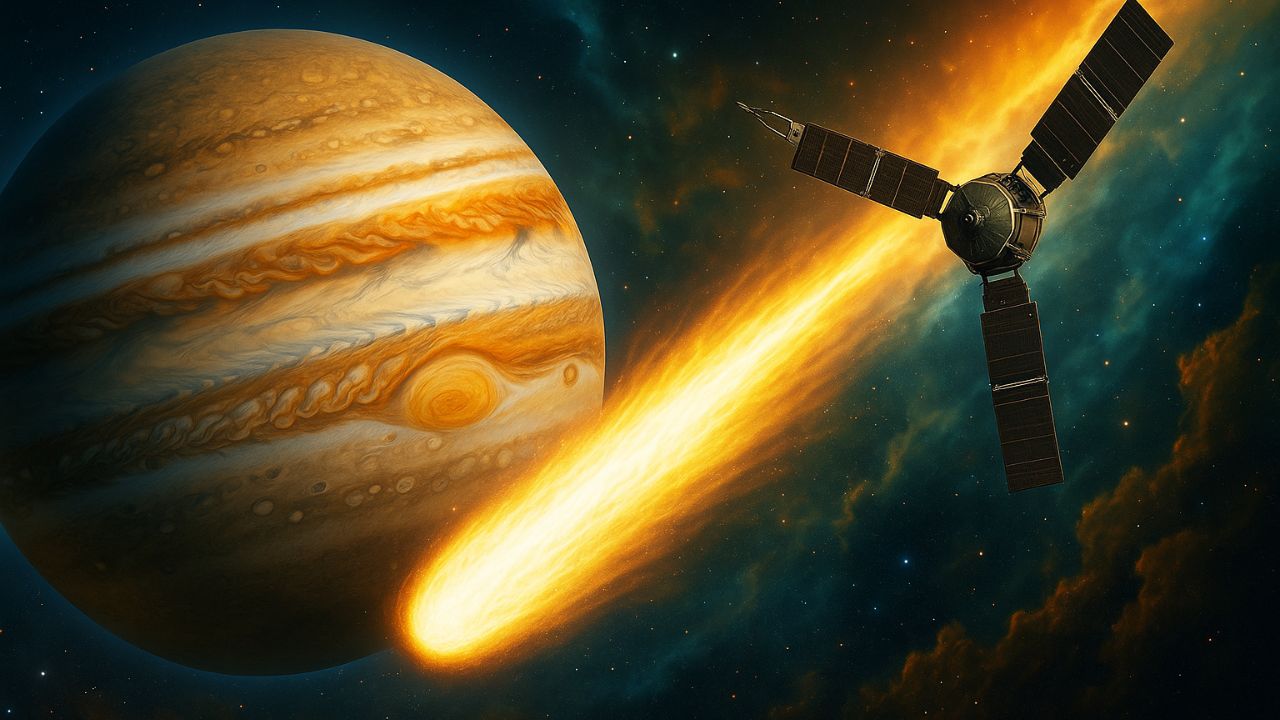


Interstellar Comet 3I/Atlas Changes Course, Passes Near Jupiter in March 2026, is Thrown Out of the Solar System Toward Gemini and Will Still Be Closely Observed by the Juno Probe.
Comets are already special visitors to the sky. When it comes to an interstellar comet, the story gets even rarer. The comet 3I/Atlas has changed its course within the solar system and is now heading toward Jupiter, where the gravity of the gas giant is expected to completely reshape its path. Instead of simply leaving after passing the Sun, it will interact intensely with the largest planet in our system, in an encounter that serves as a practical lesson in celestial mechanics.
Simulations indicate that, after this interaction, 3I/Atlas will follow a hyperbolic escape orbit, being launched out of the solar system toward the constellation of Gemini, on a journey that is expected to take about 100 years to reach that area of the sky. To top it off, the Juno probe will be in a privileged position around Jupiter, ready to observe this visitor that has come from another stellar system and will never return.
What Makes 3I/Atlas Such a Special Comet
First of all, it is important to understand why 3I/Atlas has drawn so much attention from astronomers. It did not originate in our solar system; it is a true interstellar visitor that arrived here from another star. Before being detected, 3I/Atlas traveled through deep space for over a century, coming from the direction of the constellation Sagittarius.
-
The oceans are darkening all over the planet – what is happening?

-
An engineer designs a solar plane to fly on Mars at an altitude of 1,000 meters and a speed of 300 km/h, covering 16,000 kilometers in a Martian year, 900 times the distance traveled by the Ingenuity helicopter in three years on the planet before experiencing a rotor failure, and NASA is already funding the feasibility study.
-
A new phenomenon of contactless magnetic friction intrigues scientists and questions a theory that has been valid since the 17th century.

-
An impressive phenomenon in Northern Brazil causes rivers of different colors to flow side by side, revealing secrets about sediments, currents, and biodiversity.

When it passed by the Sun, the initial expectation was that the comet would simply continue its journey outward, on a relatively predictable exit path. However, the presence of Jupiter changed the game. The largest planet in the solar system has such a strong gravitational field that it can significantly disturb the trajectory of objects that come too close to its region of influence.
In the case of 3I/Atlas, this means that the path it would take to leave the solar system will not be the same as astronomers initially imagined. The exit angle, speed, and final direction of the comet are being readjusted by Jupiter’s gravity in real time.
Hill Radius and Jupiter’s Gravitational Influence


A recent study, conducted by researchers from a physics research lab in India, highlights a key point in this story. According to the published calculations, 3I/Atlas is expected to pass very close to the so-called Hill radius of Jupiter, the region where the planet’s gravity dominates the surrounding area and exerts more influence than the Sun on nearby bodies.
Within this sphere of influence, Jupiter can dramatically pull, accelerate, and divert trajectories. The study points out that the comet will also experience minor perturbations caused by Mars, but nothing comparable to the effect of the gas giant. This is because 3I/Atlas passes much closer to Jupiter than to Mars, making the gravitational “jerk” from Mars almost irrelevant in this story.
In practice, it is Jupiter that takes on the main role in changing the course. The gravity of the planet not only distorts the comet’s original path but also redefines the final direction of its escape from the solar system.
The Decisive Encounter in March 2026
The most sensitive moment of this gravitational dance has a set date. Between March 9 and 22, 2026, 3I/Atlas will pass about 0.5 astronomical units from Jupiter, a distance that may seem large, but is more than enough for the planet to take control of the situation on a cosmic scale.
During this approach, the comet fully enters Jupiter’s gravitational influence sphere. From then on, the trajectory of 3I/Atlas transforms. The combined effect of pull, acceleration, and diversion is so intense that:
- The comet stops following just the exit route it would have taken after the encounter with the Sun
- 3I/Atlas will begin to follow a hyperbolic orbit, a definitive escape trajectory, with no chance of returning to the solar system
- The final direction of this orbit points toward the constellation of Gemini
Astronomers estimate that the comet will take about 100 years to reach that area of the sky. In other words, what happens in a few days in March 2026 will determine the path of an interstellar traveler for the coming decades.
From Sagittarius to Gemini: The Long Journey of 3I/Atlas
One of the most fascinating aspects of this story is to perceive the scale of time involved. Before entering the solar system, 3I/Atlas was coming from the direction of the constellation Sagittarius and had already been crossing space for over a century. It traversed the interstellar void like a solitary tourist until it was finally detected by us.
After passing by the Sun and interacting with Jupiter, the comet will not remain “trapped” here. Instead, 3I/Atlas will be launched in a completely different direction, toward the constellation of Gemini. This symbolic one-way journey between different regions of the sky shows how the gravity of planets can redirect objects coming from far away.
It is as if the solar system gave a small “nudge” to this traveler, changing its itinerary forever. 3I/Atlas arrives as a temporary visitor and departs as a witness to Jupiter’s power over everything that comes too close.
The Juno Probe as a Privileged Camera for the Encounter
In the midst of all this celestial choreography, science also gains a special bonus. The Juno probe, which is already in polar orbit around Jupiter, will have a privileged position to follow the approach of 3I/Atlas. The expectation is that NASA will direct Juno’s instruments to capture as much of this passage as possible.
With this, the probe can:
- Capture high-resolution images of the comet near Jupiter
- Take spectral measurements that reveal what types of ice and gases 3I/Atlas carries
- Study the coma and, to the extent possible, characteristics of the comet’s nucleus
This combination is extremely rare. Observing an interstellar object so closely, right next to a giant planet, is almost like winning the scientific lottery. Normally, these visitors pass by too quickly and too far away for us to obtain detailed data.
What Science Can Learn from the 3I/Atlas
Every piece of data collected about 3I/Atlas is of immense value to astronomy and astrophysics. By closely analyzing an interstellar comet, scientists can:
- Investigate which ices and volatile molecules are present in this type of object
- Look for signs of organic molecules linked to the chemistry that forms planets and, in some cases, even building blocks of life
- Compare the chemical composition of 3I/Atlas with that of the comets that formed in our own solar system
If the material that comprises 3I/Atlas is similar to that of local comets, it may indicate that the processes of planet formation share common features in different parts of the galaxy. If it is very different, it opens up a new window to understand the diversity of environments where stars and planets are born.
In other words, 3I/Atlas functions as a traveling sample from another stellar system, coming within reach of our instruments for a brief period.
Timeline of the Passage Through the Solar System
To better organize everything happening with 3I/Atlas, it’s worth recapping the sequence of events already predicted by astronomers based on the data released:
- The comet comes from the direction of Sagittarius, crossing space for over 100 years
- It enters the solar system, passes by the Sun, and has its presence identified
- On December 19, 3I/Atlas makes a relevant approach to Earth, opening a window for observations from our planet
- Then it continues its journey toward the region of Jupiter, where the decisive encounter occurs between March 9 and 22, 2026
- Jupiter’s gravity profoundly alters the trajectory of the comet, sending 3I/Atlas into a hyperbolic escape orbit
- From there, the comet moves out of the solar system, toward the constellation of Gemini, on a journey estimated to take about 100 years to reach that area of the sky
Each stage of this timeline represents a different opportunity for data collection, whether with ground telescopes, space observatories, or the Juno probe itself near Jupiter.
A Definitive Farewell in Real Time
Perhaps the most striking detail of this entire story is the definitive nature of the passage. 3I/Atlas is not a comet that returns every few decades, like some periodic visitors we already know. It follows an escape trajectory that guarantees its permanent exit from the solar system after the encounter with Jupiter.
This means that telescopes, probes, and instruments have a single chance to study it up close. Every image, every spectrum, every measure of brightness or variation in the coma counts. It’s science happening in real time, with a visitor that took centuries to find us and that, after departing, will never return.
In the end, 3I/Atlas reminds us that the solar system is not an isolated place. Objects from other stellar systems can cross our path from time to time, bringing clues about how the universe forms and spreads its materials.
And here’s the question for you: do you intend to follow the news about 3I/Atlas in 2026, or do you think that this type of event still receives less public attention than it deserves?








Es un simple comentario, con algunas facetas nuevas, y como los científicos se creen que saben todo, ya lo catalogaban como una nave extraterrestre, que soberbia por favor, los conocimientos sobre el universo son tan pobres mentales, son como bebé en inteligencia.
Bueno somos aun muy pequeños para saber mas del universo,el cometa viejo 100 años para llegar al sistema solar y la especie humana apenas y nos damos tiempo de mirar rara vez el cielo,nosotros aun estamos en la caverna y pocas ve6abrimos la ventana para observar el espacio como en esta ocasión pero que pasará cuando salgamos de casa y viajemos 100 año a donde llegaremos y que áremos ahí y para qué
Somos afortunados, el tener la posibilidad única en nuestras vidas y con la tecnología y la ciencia, conocer qué sucede en nuestros alrededores de nuestro planeta tierra.
A pesar de la divulgación en las redes, existe mucho desconocimiento de la humanidad, de lo q sucede y sucederá en nuestro sistema solar.
Gracias por darnos sus conocimientos y avances al respecto. Soy una persona que en mi existencia y razonalidad me he integrado y cuestionado a cerca de nuestros vecinos interestelar es, algún día no muy lejano se mostrarán y espero q sea con buenas noticias. Claro está con la minipulacion de la información, no nos has dado a conocer q pasa con nuestros amigos alienigena.
Me encanta este tema y lo disfruto mucho por las expectativas que se generan. Nuestras vidas dependen de lo q sucede a nuestros alrededores.