





 Portuguese
  English
  Spanish
  5 min of reading
  0 comments


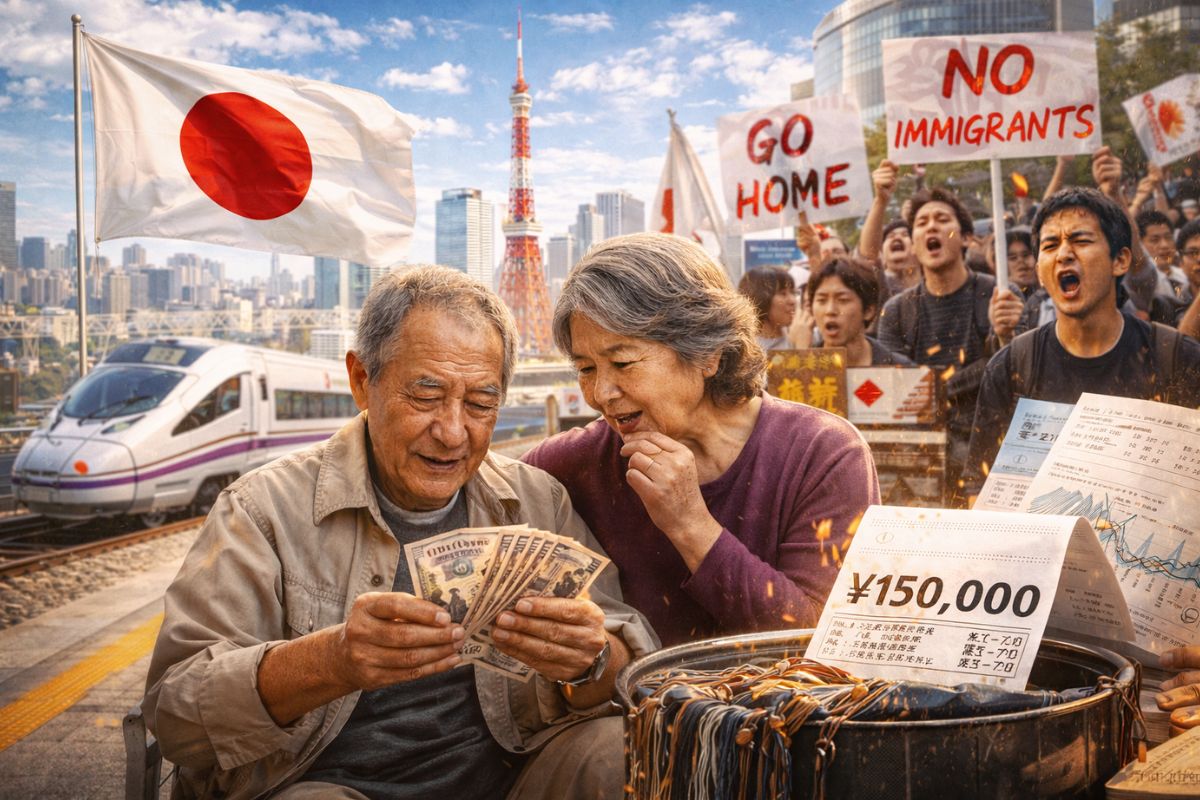
The Seikatsu Hogo Social Benefit, Operated by Municipalities, Can Pay Families of Three People ¥129,000 Outside Tokyo to ¥158,000 in the Capital, About R$ 4.3 Thousand to R$ 5.3 Thousand, and Became the Target of Rumors That Official Data Reduces to 2.9% of Foreigners in the 2025 Election.
The debate about social benefits in Japan gained a new degree of tension when Seikatsu Hogo began to be cited as a last resort response for immigrant elderly in vulnerability. In a country that increasingly depends on foreign workers to sustain economic routines and services, the discussion moved from the technical field to internal political dispute.
In practice, the social benefit operates as municipal social assistance and, for that reason, appears as a symbol of a transitioning Japan: more open to migration due to necessity, but still marked by distrust, cultural barriers and a narrative of rumors. The clash between rumor and official data exposed the extent of xenophobia and also the cost of ignoring the elderly who worked in the country.
What Is Seikatsu Hogo and Why Has It Entered the Center of the Debate
Seikatsu Hogo is a social benefit aimed at people in vulnerable situations in Japan and is operated by municipalities, which check eligibility on a case-by-case basis.
-
“No one will make us change the Pix,” says Lula after the US report.

-
Lula responds directly to Trump and says that Pix is from Brazil and will not change under pressure from anyone, after a report from the United States pointed out the Brazilian payment system as an American trade barrier.

-
Amazon has just announced a new fee on all deliveries, and your online purchases will become more expensive starting April 17, including for those buying from the United States here in Brazil.

-
He sold his share for R$ 4 thousand, saw the company become a giant worth R$ 19 trillion, and missed the opportunity of a lifetime.


The comparison with Bolsa Família arises from its protective nature for those who cannot support themselves, although the Japanese implementation is deeply local and tied to municipal administrative rules.
For immigrant elderly, Seikatsu Hogo becomes especially sensitive because it intersects three fronts at the same time: immediate income needs, language and cultural access difficulties, and a social perception that foreigners would be “taking” public resources.
This is where the social benefit becomes a measure of integration, and not just a mechanism of assistance.
How Much It Pays and How Tokyo Changes the Calculation
In the amounts cited for families of three people, the social benefit can vary from ¥129,000 outside of Tokyo to ¥158,000 in Tokyo, which has been translated as about R$ 4.3 thousand to R$ 5.3 thousand.
The territorial difference reinforces that Seikatsu Hogo is not a national flat payment, but a design that considers real life in the cities and the cost of maintaining a household.
This geographical cut also fuels distortions in public conversation.
When the highest number appears associated with Tokyo, it tends to be used as an emotional trigger against immigrants, especially when talking about elderly and prolonged assistance.
The value, by itself, does not explain eligibility, nor the actual size of the audience served, but it becomes rhetorical ammunition.
Rumors in the 2025 Election and the Clash with Official Data
During the 2025 election, incorrect information circulated claiming that 33% of Seikatsu Hogo beneficiaries would be foreigners.
This type of allegation amplified internal political reaction and reinforced a suspicion discourse against immigrants, even when the social benefit is described as being focused on vulnerability, not nationality.
Official data indicated a participation of 2.9% of foreigners among beneficiaries, according to the Ministry of Health, Labour and Welfare.
The discrepancy between 33% and 2.9% is not a mere statistical detail: it redefines the conversation about social benefits in Japan, shows how rumors can inflame xenophobia, and shifts the focus away from the real problem, which is protection in old age.
Language Barriers, Social Security, and the Vulnerability of Elderly Immigrants
Even when eligibility exists, immigrant elderly face concrete obstacles to accessing the social benefit, such as language and cultural barriers in contact with municipalities and local services.
The result is a paradox: Japan accepts foreign workers to sustain essential sectors, but many of these workers reach old age without stable protection networks.
Another critical point is social security integration.
The described scenario is of immigrants who end up unsupported in old age, partially due to not being fully integrated into the Japanese social security system.
When income disappears and health deteriorates, Seikatsu Hogo appears as a last resort, and this strains politics, because the social benefit begins to be seen as a symbol of “belonging.”
The Work of NPO Smile Arigato and Local Limitations
In everyday life, support networks try to fill gaps that public policies have not yet fully covered.
The NPO Smile Arigato is cited as one of those structures that work to alleviate the difficulties of immigrants and immigrant elderly, especially in moments of acute vulnerability.
But the very reach of these networks faces limits.
There are references to local legal restrictions that impose barriers to action, reducing the response capacity when Seikatsu Hogo is not accessed in time, or when municipal bureaucracy becomes a barrier.
When help depends on exceptions and improvisation, social risk increases, and controversy over social benefits tends to repeat itself.
Silent Economic Impact and What 2026 Puts at Stake in Japan
The controversy does not exist in a vacuum.
Japan is described as increasingly dependent on foreign workers to sustain the economy, and this creates a silent economic impact: migration helps maintain the country’s functioning, but the lack of full integration pushes part of this group into vulnerability in old age.
In 2026, the expectation is for progress in policies that integrate foreign workers into the social fabric, with rights and duties equal to those of Japanese citizens.
If this path is not consolidated, the debate over Seikatsu Hogo will continue to be a political detonator, with immigrants and elderly at its center, and with the social benefit used as a shortcut to discuss identity, fear, and public cost.
The case of Seikatsu Hogo exposes that social benefit, in an aging Japan that needs migration, is not just a budget line, but a choice of social model.
When Official Data Dismiss Rumors, the country faces the uncomfortable question: can the economy depend on foreigners and, at the same time, deny protection when old age arrives?
For you, what should be the limit between public solidarity and eligibility rules in a social benefit, especially when it involves immigrant elderly? If you worked for decades in Japan as an immigrant, would you expect to have access to Seikatsu Hogo, or would you accept being left out for not being a citizen?









-

-

-

4 pessoas reagiram a isso.