





 Portuguese
  English
  Spanish
  5 min of reading
  0 comments


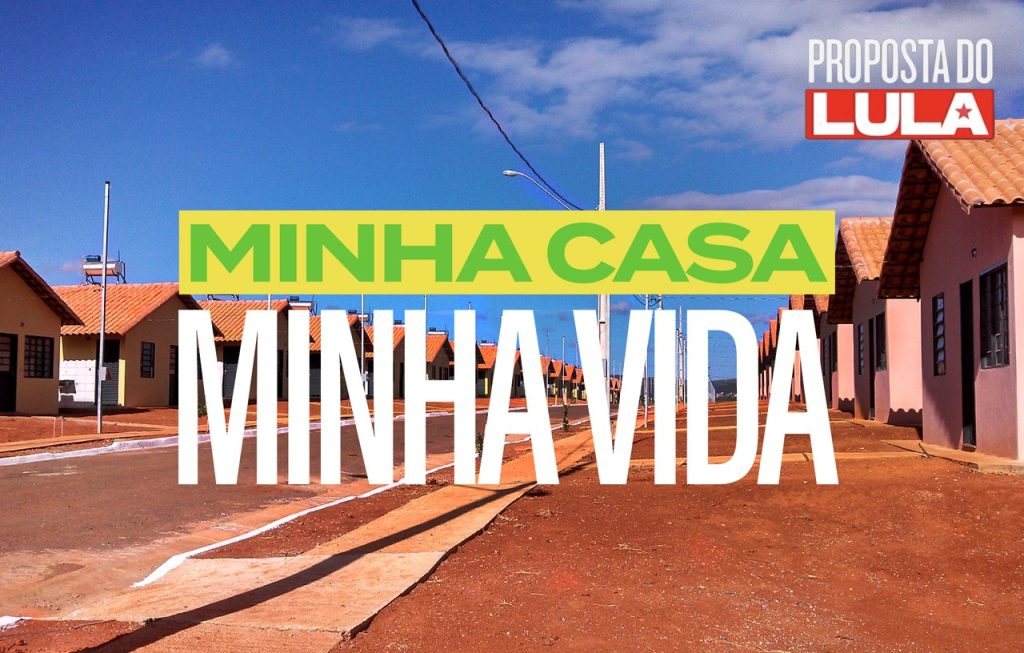
Lula Government Prepares a Revolution in Minha Casa, Minha Vida! Now, Families Earning Up to R$ 12,000 Monthly Will Be Able to Achieve the Dream of Homeownership with an Investment of R$ 15 Billion. The Measure Promises to Transform the Real Estate Market and Relieve the Middle Class, with a Direct Impact on the Economy!
The government of Luiz Inácio Lula da Silva (PT) is studying an expansion of the Minha Casa, Minha Vida housing program.
According to the Folha, the proposal includes the creation of an extended range, aimed at families with a gross monthly income between R$ 8,000 and R$ 12,000.
This group, which is currently outside the reach of housing policy, would benefit from a measure aimed at increasing access to homeownership for the middle class.
-
“No one will make us change the Pix,” says Lula after the US report.

-
Lula responds directly to Trump and says that Pix is from Brazil and will not change under pressure from anyone, after a report from the United States pointed out the Brazilian payment system as an American trade barrier.

-
Amazon has just announced a new fee on all deliveries, and your online purchases will become more expensive starting April 17, including for those buying from the United States here in Brazil.

-
He sold his share for R$ 4 thousand, saw the company become a giant worth R$ 19 trillion, and missed the opportunity of a lifetime.

According to government sources, this action has been discussed since 2023 and could be realized with an injection of R$ 15 billion from the Pre-Salt Social Fund.
These resources were requested from the rapporteur of the 2025 Budget, Senator Angelo Coronel (PSD-BA), to boost financing operations of Minha Casa, Minha Vida.
The goal of this change is to leverage property acquisition by the middle class, which has been facing difficulties due to the shortage of savings resources, which historically has been one of the main sources of cheap financing for the real estate sector.
With this measure, the government aims to ease market conditions, promoting access to homeownership for many families who are among classes C and B.
At a time when President Lula’s popularity is declining, particularly among the middle class, this new range of the housing program may represent a direct response to this group’s demands.
The increase in the scope of Minha Casa, Minha Vida, with its reduced interest rates, would provide relief for these families, as well as a positive effect on those earning above R$ 12,000 monthly, as competition for savings resources would decrease.
Still without a defined model, the government is optimistic about the possibility of implementing the extended range.
Sources close to the discussion claim that the government is determined to facilitate home purchases for families earning up to R$ 12,000 monthly.
The proposal is expected to be officially announced in early April, after Lula’s trip to Japan, scheduled for the end of March.
Although the exact model is still under discussion, the government has been working on defining a ceiling for the value of the property that can be financed.
Currently, in range 3 of the program, which covers families with incomes of R$ 4,700 to R$ 8,000 monthly, the property value limit is R$ 350,000.
For the extended range, the ceiling is expected to be raised to something between R$ 400,000 and R$ 450,000, with the possibility of even higher values, depending on the discussions.
Another point being analyzed is the possibility of allowing the new modality to include the purchase of used properties, which has not yet been officially confirmed.
This flexibility could expand housing options for middle-class families, further increasing the effectiveness of the program.
The implementation of the new range of Minha Casa, Minha Vida will be made possible with resources from the Social Fund, a fund derived from oil intended for various social actions.
Recently, a Provisional Measure issued by President Lula authorized the use of this fund to finance social housing actions.
Although this measure does not have a direct impact on the country’s fiscal rules, it does have a reflection on Brazil’s indebtedness.
On March 14, 2025, the government sent a letter to the budget rapporteur requesting the reallocation of R$ 15 billion from the Social Fund to finance Minha Casa, Minha Vida operations.
Of this total, R$ 14.37 billion would be allocated to meet range 3 of the program, while R$ 630 million would be applied to range 1, which covers families with income up to R$ 2,850 monthly.
This change will allow part of the budget allocated by the FGTS (Employee Severance Indemnity Fund) to the housing program to be released, creating space for the launch of the extended range.
With the transfer of resources from the Social Fund, the government seeks to optimize the use of financial resources and increase the financing capacity of the program.
In addition to the extended range, another proposal being discussed is the creation of a line of credit for home renovations.
Lula mentioned this idea on March 14, 2025, highlighting the possibility of helping families carry out small renovations, such as building a bathroom, an additional room for children, or improvements to the garage.
It is still unclear whether these resources will come from the R$ 15 billion allocated to the housing program or if there will be a search for additional funds in the 2025 Budget.
The government’s main concern at this moment is to address the lack of savings resources, which has negatively impacted real estate credit.
In recent years, Caixa Econômica Federal, the largest credit institution in the country, has been facing difficulties due to the scarcity of savings deposits, which are used to finance properties.
In 2025, the budget for loans funded by the Brazilian Savings and Loan System (SBPE) will be around R$ 60 billion, but Caixa has already established a monthly schedule to release these resources.
Although the measure to use the Social Fund to finance the new range of Minha Casa, Minha Vida has faced some resistance within the government itself,
the final decision was to implement this policy to reduce bottlenecks in real estate credit and ensure access to housing for more families.
Moreover, some areas of the government have considered an expansion in the use of resources from the FAR (Residential Leasing Fund), which receives funds from the Federal Budget for the construction of subsidized housing.
In 2023 and 2024, the FAR received R$ 19 billion, and another R$ 10.7 billion is already planned for 2025.
However, these resources are already committed to the execution of 130,000 housing units, which have an average cost of R$ 164,000.
The expansion of Minha Casa, Minha Vida, with the use of resources from the Social Fund, promises to help a large number of families who, until now, have been excluded from the program.
The measure could also stimulate the recovery of the real estate market, which is experiencing a surge due to increased demand for properties.
Ranges of Minha Casa, Minha Vida Urban
- Range 1 – Family monthly gross income of up to R$ 2,850, with a subsidy of 95%; financing interest rate between 4% and 5% per year.
- Range 2 – Family monthly gross income from R$ 2,850.01 to R$ 4,700, with a subsidy of up to R$ 55,000; financing interest rate between 4.75% and 7% per year.
- Range 3 – Family monthly gross income from R$ 4,700.01 to R$ 8,000; financing interest rate can reach up to 8.16% per year.








Seja o primeiro a reagir!