





 Portuguese
  English
  Spanish
  5 min of reading
  1 comment


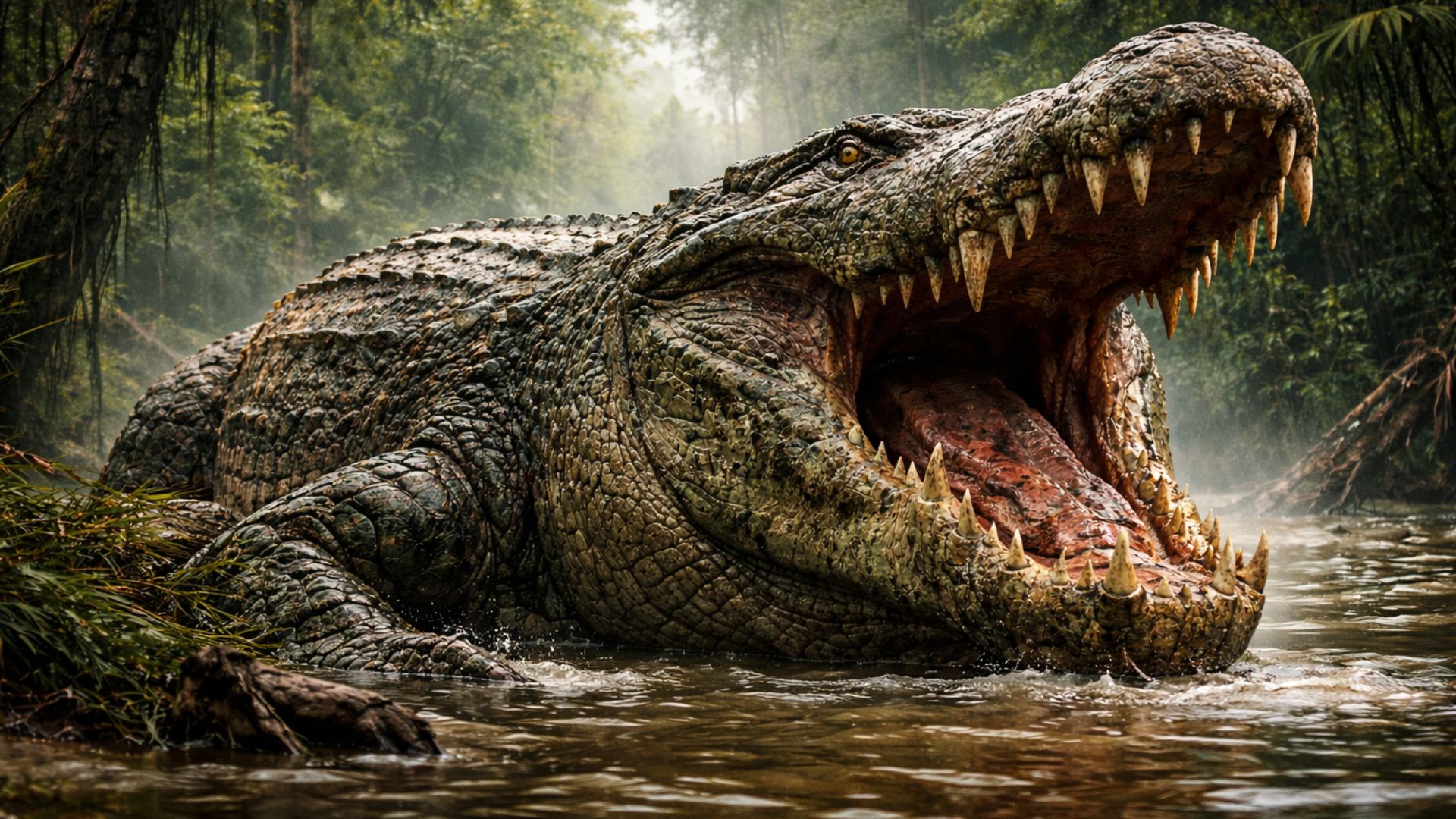


Colossal Predator of the Miocene, Purussaurus Became a Symbol of Proto-Amazonia and Has Surprising Estimates of Size and Bite Based on Fossils from Acre and Widely Cited Scientific Models That Help Understand Its Place in South American Megafauna.
Estimates of Size, Weight, and Bite of Purussaurus brasiliensis
A scientific study published in PLOS ONE estimated that an adult Purussaurus brasiliensis could reach about 12.5 meters in length and approximately 8.4 tons, as well as generate a sustained bite force calculated at 69,000 newtons.
In the same analysis, the authors describe the animal as a top predator in the ecosystem in which it lived, at the end of the Miocene, in environments associated with the proto-Amazon.
The Purussaurus brasiliensis is an extinct crocodylian from the alligator group, known for fossils found in the Amazon region and, in particular, for materials attributed to the Solimões Formation, in the state of Acre.
-
In France, a group of artisans spends 28 years building a medieval castle with 13th-century tools, without machines, without measuring tapes, and with almost zero carbon footprint, and the rediscovered techniques helped in the reconstruction of Notre-Dame.

-
Tourists on Everest were poisoned by guides who mixed substances in food to provoke false symptoms of altitude sickness while helicopter operators and hospitals charged inflated rescue fees to insurance companies.

-
Few people know this, but Neil Armstrong, one of the most famous NASA astronauts in history, survived the Korean War after jumping from the plane during his seventh combat mission aboard the USS Essex aircraft carrier of the United States.

-
Diving with a camera in Lake Furnas reveals a submerged city with an entire street, almost intact houses, a preserved bridge, a wood stove, a Kombi, and even a bus at the bottom of the largest lake in the Southeast.


The combination of very large skulls, robust jaws, and teeth adapted to capturing and crushing prey made the animal one of the symbols of the South American Miocene reptile megafauna, often presented to the public with nicknames highlighting its gigantism.
How the Numbers Were Estimated from Fossils

The estimates supporting the numbers in the 2015 study are based on fossil measurements, especially skulls, and the use of regression equations calibrated with living crocodylians.
Instead of “guessing” the total size from a single bone, the researchers applied known relationships between skull dimensions and body length observed in living species and then extrapolated the result for Purussaurus based on the proportions used in the work.
This is why the article itself treats the values as estimates obtained by comparative method rather than as direct measurements from a complete preserved body.
Fossils in Acre and the Solimões Formation
In the field, Acre frequently appears in discussions about Purussaurus due to significant finds.
In 2019, for example, Federal University of Acre reported the recovery of jaw fragments attributed to the animal along the Acre River in the municipality of Braziléia, noting that the reptile lived in the state over 8 million years ago.
The statement highlights the work of collecting and transporting the material to the campus as part of local efforts for preservation and paleontological research.
In addition to isolated rescues, there are also technical descriptions presented at scientific events.

A paper published in the proceedings of the Brazilian Congress of Paleontology reports a site of the Solimões Formation in Braziléia, Acre, with associated skull and jaw finds of Purussaurus brasiliensis preserved in situ, noting specimens about 1.4 meters in length.
This size of the skull helps explain why the genus became a reference when it comes to giant crocodylians: a skull of this scale alone imposes an out-of-pattern comparison for living reptiles.
Bite Force and Biomechanical Performance
The calculated bite force in the PLOS ONE study is one of the most striking pieces of data because it translates gigantism into functional performance.
In practice, the authors estimated the bite potential based on relationships between body size, musculature, and biomechanical parameters used for modern crocodylians, arriving at the value of 69,000 N as sustained force.
In the article, the data is presented as part of a set of evidence that, combined with the estimated size, supports the idea of a predator capable of exploiting a wide range of prey in the aquatic environment and its margins.
Top Predator in the Proto-Amazon of the Miocene

This “domination” scenario in the Amazon does not mean the existence of a single isolated animal but the presence, at the top of the food chain of that ecosystem, of a giant crocodylian in a landscape of rivers, lakes, and flooded areas in the Miocene.
By treating Purussaurus as a top predator, the study emphasizes that size and strength would expand the possibilities for diet and competition in a context of diverse fauna associated with wetland areas.
The term “proto-Amazon” frequently appears in the literature to refer to these ancient systems of flooded areas and drainages that preceded the current configuration of the basin.
Tooth Marks and Evidence of Predator-Prey Interaction
Other research helps visualize how this type of predator could interact with terrestrial animals near the water.
An article published in Biology Letters described tooth marks on giant sloth (a megalonychid) bones found in the Peruvian Amazon and interpreted the pattern as evidence of an attack consistent with a young Purussaurus, providing an unusual record of predator-prey interaction in the wetlands of proto-Amazonia.
The study’s own abstract emphasizes the “instantaneous” nature of this type of fossilized evidence to infer dietary habits and behavior based on preserved marks.
Caution in Reconstructing the Size of Giant Crocodylians

Even with impressive numbers, the reconstruction of the size of Purussaurus brasiliensis requires caution in interpretation.
The same literature that publishes the estimates also acknowledges that fossils of giant crocodylians tend to be fragmentary and that different comparison assumptions can yield distinct values for length and mass.
Therefore, when talking about 12.5 meters and 8.4 tons, the most accurate data published is: this is the estimate presented in the specific study, derived from the method and measurements chosen by the authors in that work.
The public’s interest in prehistoric “super predators” is often fueled by comparisons with living animals, but the fossil record also allows for a type of more objective comparison: the scale of the bone itself.
A skull in the range of 1.4 meters, described in material associated with the Solimões Formation, is a strong visual element as it does not depend on illustration to suggest vastness.
When this type of evidence is connected to quantitative analyses, such as bite force and body mass calculations, the story gains a measurable component that helps explain why Purussaurus continues to be cited among the largest known crocodylians.






Ainda tem esse bicho lá no Acre… São chamados de lagartixas.