





 Portuguese
  English
  Spanish
 4 min of reading
  0 comments


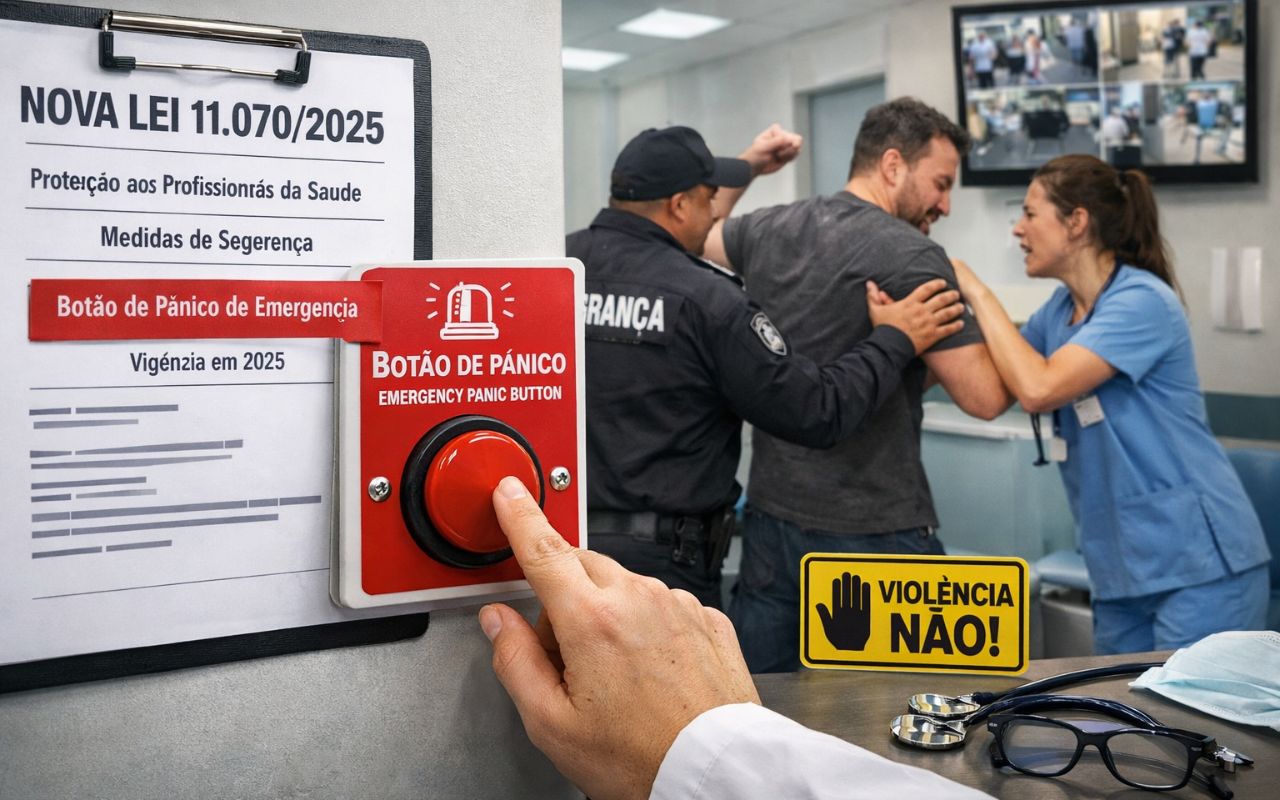
New Law of RJ Establishes Panic Button in Hospitals and Clinics to Combat Violence Against Health Professionals. Know How It Works and Who Will Be Protected.
Working in hospitals and clinics in Rio de Janeiro now requires a new type of institutional protection. With the sanction of a law by governor Cláudio Castro, public, private, and contracted health units will be required to have a panic button.
The regulation was published in the Official Gazette on Friday (19) and arises amid an increase in assaults against professionals who directly serve the public.
The proposal is simple but strategic: to enable doctors, nurses, technicians, nursing assistants, guards, and other workers to quickly alert the police in risky situations.
-
The noise law will no longer be in effect at 10 PM starting in June with a new rule valid during the 2026 World Cup.

-
The Chamber opens a debate on driver’s licenses at 16 years old as part of a reform that includes around 270 proposals to change the Brazilian Traffic Code and may redesign rules for licensing, enforcement, and circulation in the country.

-
The new Civil Code could revolutionize marriages in Brazil with “express divorce” and changes that could exclude spouses from inheritance.

-
Banco do Brasil sues famous influencer for million-dollar debt and intensifies debate on delinquency, risks of seizure, and direct impact on Gkay’s credibility.


Thus, the State aims to reduce response time to threats and make the hospital environment safer.
Why Did the Panic Button Become a Priority in Rio?
The creation of the new law did not happen by chance. Cases of violence within health units have become recurring and have become part of the routine for many professionals.
According to state deputy Guilherme Delaroli (PL), author of the project that led to the regulation, the situation has exceeded acceptable limits.
“Unfortunately, these situations are not isolated. Assaults are part of the daily life of these professionals,” he stated.
In light of this scenario, the panic button emerges as a direct response to a structural problem that affects both the physical and emotional health of workers.
What Does the Panic Button Law Say?
The measure was officially named Law 11.070/2025, resulting from Bill 1.975/2023.
The text determines that health establishments install a system capable of immediately alerting the Military Police of the State of Rio de Janeiro (PMERJ).
This alert will be made through the Integrated Command and Control Center (CICC).
The alert sent by the panic button must inform the exact location of the incident, as well as notify the internal security of the unit.
In practice, this means that the call for help will not depend on phone calls or intermediaries.
What Types of Violence Allow Activating the Button?
The law adopts a broad concept of violence against health professionals.
Episodes that can trigger the panic button are those that cause death, bodily injury, or psychological and psychiatric harm.
Additionally, property damage and threats to the physical integrity or property of the worker also fall under this definition.
Therefore, the device can be used in both completed assaults and situations of imminent risk.
This scope acknowledges that violence in the health environment does not always begin with physical contact.
Data That Reveals the Urgency of the Measure
A survey by the Regional Council of Medicine of the State of Rio de Janeiro (Cremerj) helps to understand the magnitude of the problem.
According to the data, a doctor is assaulted every three days in the state.
About 67% of these assaults occur in the public health system. Women are the primary victims, accounting for 62.5% of the cases recorded in the first half of 2023.

These numbers reinforce the need for preventive actions and help justify the creation of the panic button law.
Who Pays for the Installation of the Panic Button?
The legislation also clarifies where the resources will come from to enable the measure. The installation of the panic button will be funded by the annual budget of the State Health Secretariat.
Additionally, the State Health Fund (FES) may be used to cover expenses related to the installation and maintenance of the systems.
Thus, the government seeks to ensure that the legal requirement does not remain just on paper.
With the enactment of the new law, health professionals will have a direct protection mechanism within the workplace.
The expectation is that a quicker response will help contain conflict situations before they escalate.
Moreover, the mere existence of the panic button may act as a deterrent to violent behaviors.
Safer units tend to provide a better environment for both workers and those seeking care.
In this way, the new law transforms safety into a permanent public policy, recognizing that caring for those who care is also a responsibility of the State.









Seja o primeiro a reagir!