





 Portuguese
  English
  Spanish
  6 min of reading
  0 comments


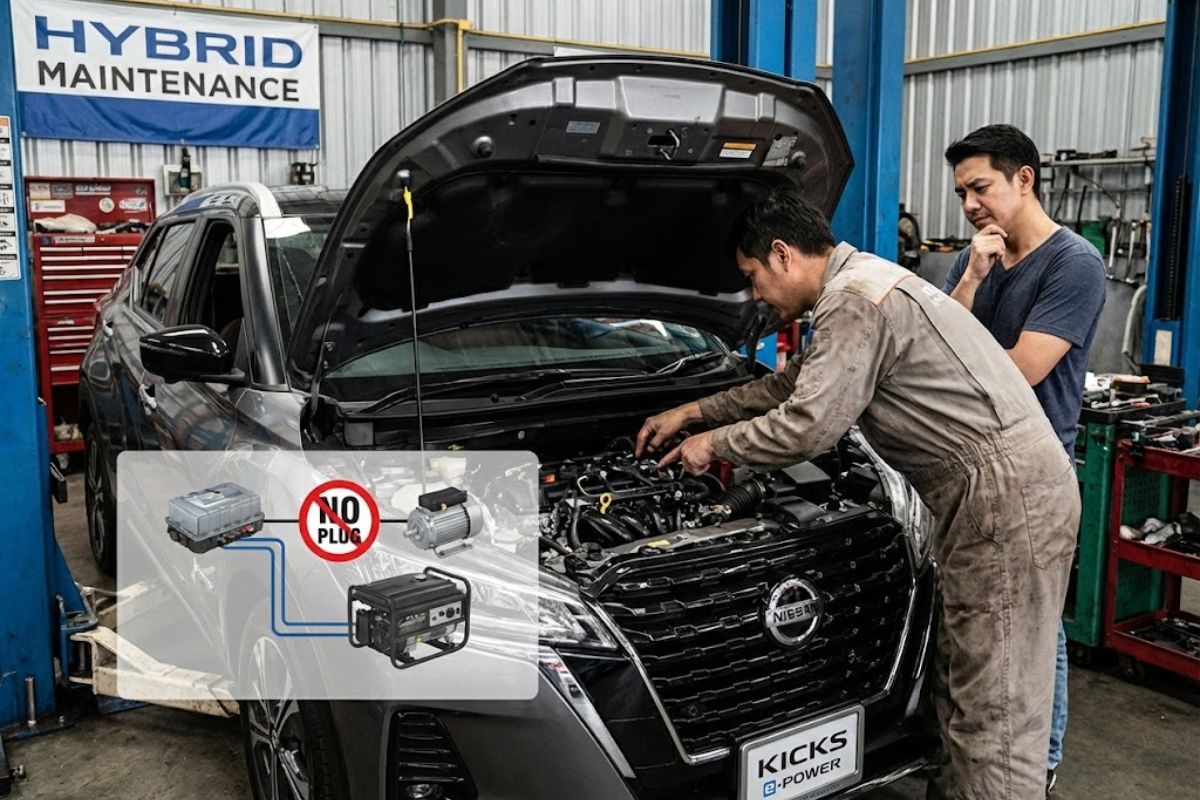
In Nissan E-Power Technology, The Wheels Are Driven Only By The Electric Motor, While A Gasoline Engine Works Behind The Scenes As A Generator, Feeding Battery And System. In Models Like Note, X-Rail And Serena, There Are Engines 1.2 L To 1.5 L And Batteries 1.5 To 2.1 KWh, With Consumption Numbers
The Nissan E-Power has become a curious case in hybrid engineering because it delivers the sensation of an electric car without a plug, but without giving up a gasoline engine functioning as a central part of the system. The practical effect is simple to understand: the driver feels the car “running on electric”, while the energy continues coming from fuel.
What divides drivers and technicians is the “truth behind the silence.” The Nissan E-Power is not a pure electric vehicle and does not follow the better-known conventional hybrid. It uses an architecture in which the electric motor is solely responsible for moving the wheels, and the gasoline engine kicks in to generate energy, recharge the battery, and sustain demand when the throttle is pressed, including moments of noise under heavy load.
What Is Nissan E-Power And Why Does It Seem Electric Without A Plug

The heart of the Nissan E-Power is the idea of electric driving with energy generated on board.
-
Less than a Tera TSI, up to 710 km of range and charging in 9 minutes: the new BYD Song Ultra expands the Chinese brand’s bet on increasingly faster, more technological, and competitively priced electric SUVs.

-
With a 1.0 engine producing 75 hp and costing less than R$ 70,000, Fiat’s car returns to the podium as the cheapest in the country; a temporary promotion for the 2026 Like version reduces the price of the Fiat Mobi.
-
With a mild hybrid system of 48 V, 176 hp and a price of R$ 175,990 in the Sahara version, the new Jeep Renegade changes mostly on the inside, improves slightly in fuel consumption, and remains almost the same car.
-
With a 293.5 cm³ engine and a range of up to 400 km with a 14.1-liter tank, the Honda CB 300F Twister 2026 has up to 24.7 hp, an initial price of R$ 25,150, and already exceeds R$ 29,000 in the Fipe Table.

In the system’s description, it is a powertrain that integrates gasoline engine, battery, generator, and electric motor into a system coordinated by energy usage strategy.
The intended result is a driving experience similar to that of an electric vehicle because, at the end, the torque that reaches the wheels comes from the electric motor.
This changes the feeling of acceleration and response at low speeds, exactly where the “electric” tends to seem most natural in urban traffic.
System Architecture: Gasoline Engine, Generator, Battery, And Electric Motor

The Nissan E-Power brings together four functional components that work in tandem:
Gasoline Engine: does not serve to directly drive the wheels, but rather to produce energy.
Generator: the element that transforms the energy from the gasoline engine into electricity.
Battery: stores energy, but with a capacity lower than that of a pure electric vehicle, forming a reserve for operation and transitions.
Electric Motor: delivers the driving force, moving the wheels all the time.
This arrangement is what sustains the promise of “electric without a plug,” because the recharge comes from the system itself.
At the same time, it makes clear the limit: fuel remains at the center of the supply, only converted into electricity before it becomes motion.
No Mechanical Connection: The Difference That Changes Behavior
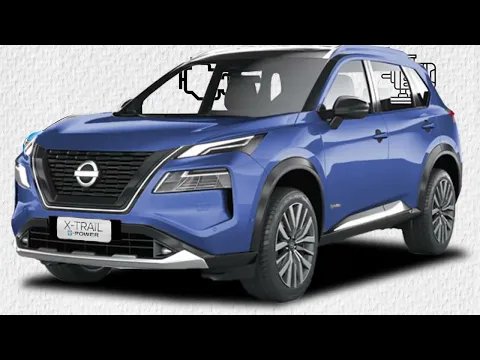

A structural point defines the Nissan E-Power: there is no mechanical connection between the gasoline engine and the wheels.
Instead of a transmission transferring power from the thermal engine to the axle, the system operates without this direct coupling.
In practice, this means that the gasoline engine can be running to generate energy, but the electric motor is what pushes the car.
This is why the driving experience can be described as “more electric” than that of hybrids that alternate traction between the thermal and electric motors as the situation demands.
When It Uses Battery, When It Starts The Engine, And When It Combines The Two
The strategy of the Nissan E-Power was presented in three moments of operation, with automatic alternation:
Start-Up And Low To Medium Power
The electric motor is powered by the battery, creating an experience described as silent. This is the moment when the electric sensation tends to appear most strongly.
Transition To Higher Speed
When the car leaves low-speed mode and demands more energy, the system activates the gasoline engine so it can work while charging the battery and sustaining the supply.
Strong Acceleration And High Load
In situations that require maximum power, such as intense acceleration, the system can use a combination of engine and battery to achieve the power delivery that an electric motor can offer. It is in this type of situation that some drivers notice the “backstage” working and report unexpected noise under heavy load, because the gasoline engine needs to work to maintain generation.
The technical point here is straightforward: the electric sensation exists, but the energy does not come from nowhere. It is managed between battery and combustion generation as needed.
Small Battery And What It Means In Real Usage
In the Nissan E-Power, the battery appears as an essential component, but with lower capacity than that of an electric vehicle, precisely because the main function is not to store energy for long periods but to balance delivery between quiet moments and generation moments.
The natural consequence, within what has been described, is that the battery helps sustain stretches of smooth driving, but the system depends on the gasoline engine to keep the system running without a plug.
This connects with the perception that divides the public: good consumption, but not miraculous, because efficiency will depend on how and when the gasoline engine is activated to generate energy.
Mentioned Models And How Nissan Varies Engines, Batteries, And Power
The presented material also makes it clear that not all Nissan E-Power are the same. The combination of gasoline engine, battery, and electric motor varies depending on the vehicle and the energy need.
Nissan Note E-Power Hatchback
Gasoline engine 1.2 L, 3 cylinders in line, battery 1.5 kW and electric motor 85 kW.
Nissan X-Rail E-Power
Gasoline engine 1.5 L, 3 cylinders in line, battery 2.1 kWh, and electric motor with 150 kW.
Nissan E-Power Minivan
Gasoline engine 1.4 L, 3 cylinders in line, battery 1.7 kWh, and electric motor 120 kW.
These numbers help understand why the experience can vary between models.
A system with 150 kW of electric motor, for example, tends to deliver different responses than one with 85 kW, and the battery also varies in scale.
Published Consumption And Direct Comparison With Other Mentioned Hybrids
The discussion about efficiency appears with numbers associated with some models and comparisons with hybrid competitors, always in km per liter:
Nissan Note E-Power: 30 km/L
Cited comparison: Honda Fit Hybrid 27 km/L, Toyota Aqua 26 km/L.
Nissan X-Rail E-Power: 18 km/L
Cited comparison: Honda CR-V Hybrid 18 km/L, Toyota RAV4 Hybrid 17 km/L.
Nissan Serena E-Power: 20 km/L
Cited comparison: Honda Odyssey Hybrid 14 km/L, Toyota Noah Hybrid 15 km/L.
The message from these numbers is that the Nissan E-Power can be competitive in some areas, but does not become a universal “magic.”
There are cases where it stands out, and there are scenarios where it stands side by side with traditional hybrids.
The Part That Irritates Some And Convinces Others: Hybrid Maintenance And Noise
The Nissan E-Power combines components from two worlds, and this is often perceived as a “double” package to care for: there is a gasoline engine, there is a generator, there is a battery, and there is an electric motor.
Therefore, the topic of complex hybrid maintenance enters the debate as a natural consequence of a powertrain more sophisticated than a purely combustion vehicle.
In practice, the promise of silent driving is linked to the stretch in which the car runs on battery power at low to medium power.
When the demand grows, the system activates the gasoline engine to generate energy and charge the battery, and that is when unexpected noise under heavy load may arise, because the system needs to work to sustain the requested power.
Smart Innovation Or Expensive Middle Ground: Why The Nissan E-Power Divides Drivers
The division stems from a simple question: what does the driver want when thinking about “electric”? If the priority is the sensation of electric traction on the wheels, the Nissan E-Power delivers that as the principle of the system, since the wheels are driven by the electric motor.
If the priority is not to have a gasoline engine running, then the concept clashes with the reality of the project.
In the end, the Nissan E-Power appears as a technical middle ground: electric driving without a plug, with the gasoline engine acting as a generator, a smaller battery than that of an electric vehicle, and a strategy of alternation that prioritizes silence under low load and generation when demand rises. For some, this is smart innovation.
For others, it is an expensive middle ground that still depends on fuel and can surprise with noise during strong acceleration.
Would You Consider The Nissan E-Power The Best Bridge To The Electric Sensation Without A Plug, Or Do You Prefer A Conventional Hybrid And Accept The Trade-Off For Simplicity And Predictability?








Seja o primeiro a reagir!