





 Portuguese
  English
  Spanish
  4 min of reading
  0 comments


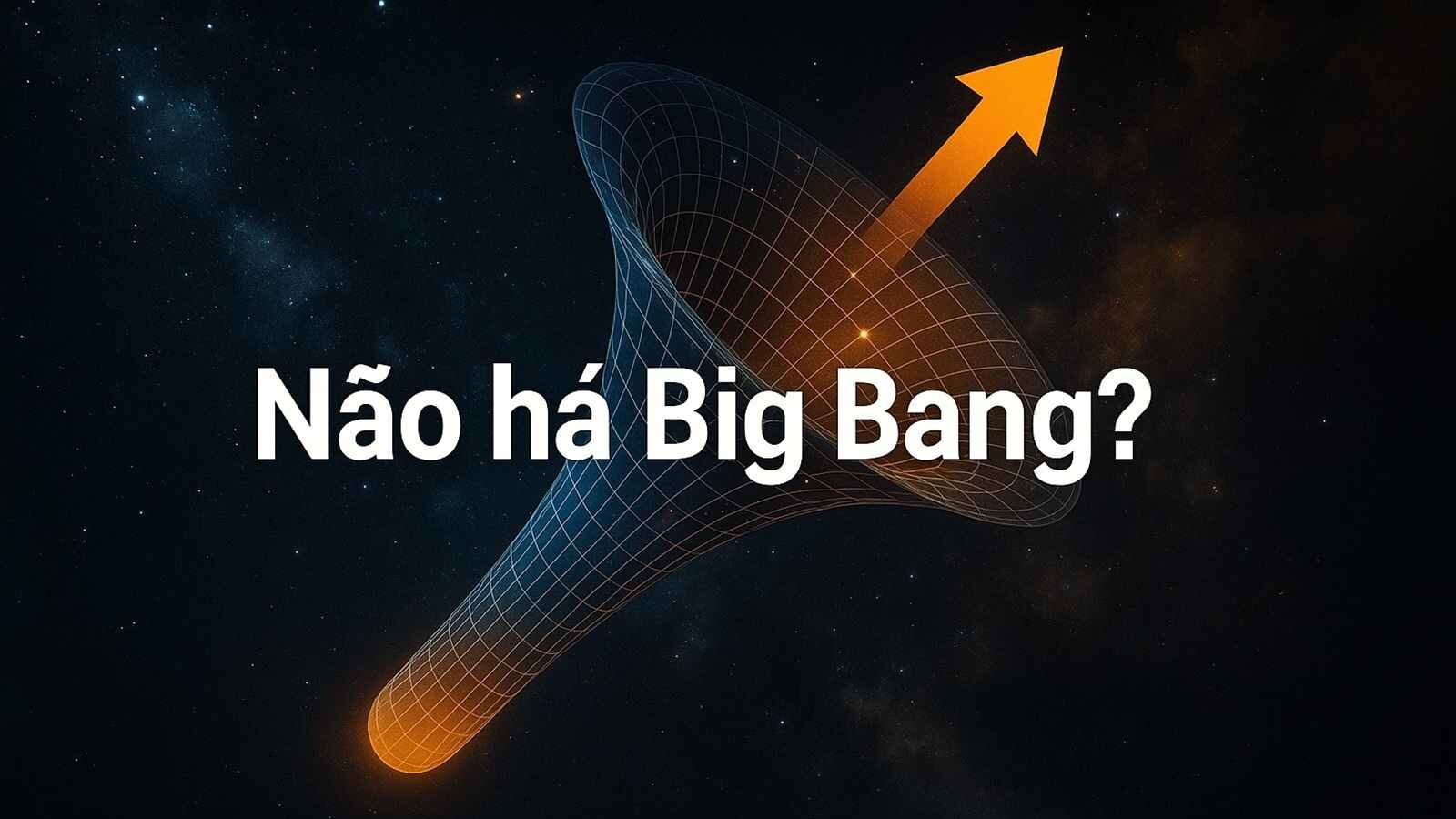
Researchers Present Quantum Model That Eliminates The Singularity Of The Big Bang, Proposes Eternal Universe And Dispens-es Dark Energy To Explain Its Expansion.
The universe may not have had a beginning. This is the conclusion presented by two physicists after applying quantum corrections to Albert Einstein’s general relativity theory. The work, published in the Physics Letters B, suggests that the universe has always existed and did not arise from a singularity known as the Big Bang.
According to traditional calculations of relativity, the age of the universe is 13.8 billion years. The theory accepted so far considers that everything that exists was compressed into an infinitely dense point and, after a great explosion, began to expand.
This initial moment is called the Big Bang singularity.
-
Scientists from USP issue a warning about the air in the countryside after a study indicates that breathing outside of São Paulo may conceal silent risks, with evidence that worries experts about health impacts.

-
The change in weather arrives tomorrow: heavy rains and storms return to the Central-South after a hot week, with a cold front along the coast bringing instability between Santa Catarina, Paraná, and the Southeast, affecting capitals strongly until Thursday.

-
The rapporteur of the critical minerals project said today that Brazil will not create a state-owned mining company, but Lula has already discussed the creation of Terrabras with ministers last Friday, and the United States has already invested 565 million dollars in a Brazilian mining company without waiting for a response from the government.

-
Roads made with recycled plastic, crushed tires, and construction waste are already being applied in several countries, reducing tons of waste in landfills and increasing the durability of the pavement by replacing traditional materials.

The problem, scientists highlight, is that the mathematics of relativity only explains what happened after the explosion.
There are no answers for what occurred before or at the moment of singularity.
The Challenge Of The Singularity
Ahmed Farag Ali, from Benha University and the Zewail City of Science and Technology in Egypt, explains that the singularity represents a flaw. “The laws of physics seem to fail there,” he said in an interview with Phys.org.
Ali and Saurya Das, from the University of Lethbridge in Canada, argue that their model resolves the deadlock. They present a universe without beginning or end.
This means there would be no absolute starting point, nor an inevitable final collapse.
The model combines elements of quantum mechanics with general relativity. The authors claim that, although it is still not a complete theory of quantum gravity, the results are consistent with current observations.
Inspiration From Old Ideas
The proposal did not come out of nowhere. Ali and Das drew on concepts from David Bohm, a theoretical physicist who, in the 1950s, advocated the use of quantum trajectories instead of classical geodesics.
Geodesics are the lines that indicate the shortest path on a curved surface. However, in the universe described by relativity, these lines end up intersecting, and the meeting points mark the emergence of singularities.
Bohm suggested that quantum trajectories could avoid this outcome. Ali and Das applied this idea to the equation created by Indian Amal Kumar Raychaudhuri, which describes the evolution of spacetime. Das was, in fact, a student of Raychaudhuri in the 1990s.
Based on this, the two derived corrected versions of Friedmann’s equations, which describe the expansion of the universe.
A Cosmos Without Final Collapse
The model eliminates not only the Big Bang but also the so-called big crunch. This scenario, predicted by some versions of general relativity, considers that the universe could stop expanding and start shrinking until collapsing into another infinitely dense point.
For Ali and Das, quantum trajectories do not converge, which prevents the formation of these singularities. Instead of a cycle of beginning and end, the universe would have infinite age and remain in expansion.
Moreover, the authors explain that quantum corrections act like a cosmological constant and a radiation term. This dispenses with the need for dark energy to explain the expansion, one of the greatest unknowns in current cosmology.
The Role Of Gravitons
Another important point of the study is the introduction of the idea of a quantum fluid filling the universe. This fluid could be formed by gravitons, hypothetical particles that would mediate the force of gravity.
If they exist, gravitons would be fundamental to building a complete theory of quantum gravity. In a complementary paper, Das and physicist Rajat Bhaduri from McMaster University in Canada, show that gravitons could form a Bose-Einstein condensate. This formation would be possible under the temperature conditions that have always existed in the universe.
This detail further strengthens the model, as it connects known quantum phenomena to a cosmic scale.
Next Steps For Research
The work of Ali and Das does not end the debate. They claim that they still need to refine the model. The next challenge is to consider small perturbations in the universe, such as irregularities and differences in direction.
Despite this, the scientists believe that the conclusions should not change significantly. The main prediction remains firm: the universe would not have started from a single point, but would have existed from the beginning.
Das summed up the importance of the study directly. “It’s gratifying to note that such simple corrections can potentially resolve so many problems at once,” he said.
If confirmed, the model could represent one of the deepest changes in the understanding of the origin of the cosmos, moving away from the idea of an absolute beginning and opening the door for a view of eternity in space and time.








-

Uma pessoa reagiu a isso.