





 Portuguese
  English
  Spanish
  5 min of reading
  1 comment


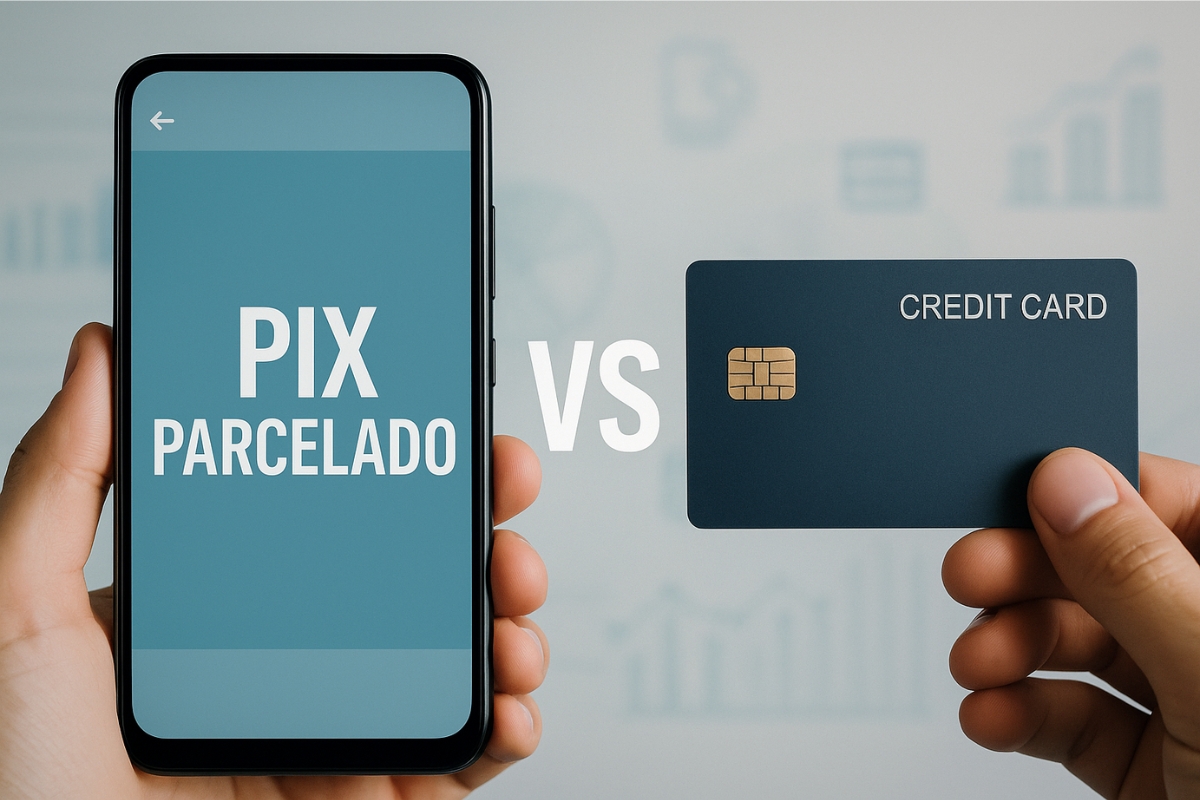


Pix in Credit Grows as an Alternative to Credit Cards, but It May Have a Higher TEC—Check How to Compare Rates Before Choosing Between Installment Pix and Credit Card
The Pix has become part of the Brazilian routine because it is fast, simple, and almost always free. However, for some time now, many banks and fintechs have started to offer something different: the option to pay in installments using credit. This is what appears in the app as Pix in Credit, installment Pix in the app or similar names.
The promise is tempting. You make a Pix now, the store receives it instantly, and you pay in installments later. It seems like a modern version of credit cards. But there’s one detail that makes many people stop and think: in several cases, this installment could be more expensive than installments on a credit card.
Why Installment Pix Has Interest from the Start
The first important thing to understand is that installment Pix is not the same as “normal Pix.” In regular Pix, the money leaves your account immediately. In installment Pix, you are taking out credit from the bank to make that payment.
-
India announces a plan of $3.06 billion to bring aviation to forgotten regions: 100 new airports, $1.07 billion in subsidies, and regional routes guaranteed for 10 years, from 2026 to 2036, away from the centers.

-
Brazil blocked a proposal from the United States at the WTO that would make the exemption from tariffs on digital products like streaming and ebooks permanent, favoring American tech giants at the expense of developing countries.

-
IPTU exemption for seniors in 2026: see how to secure the benefit.

-
The institute that trained the greatest aerospace engineers in Brazil has just opened its first campus outside São Paulo after 75 years: ITA Ceará will have R$ 445 million, new courses in energy and systems, and classes are expected to start in 2027.

This changes everything. Since it’s a credit operation, the bank charges interest from day one. There’s no such thing as “interest-free installments” that many stores offer with credit cards. In other words, with Pix in Credit, there is almost always interest, even when the purchase on a credit card could be split without extra cost.
In simple terms, it’s like taking a quick loan within the app to pay someone via Pix.

Credit Cards Are Sometimes Cheaper
The card behaves differently. In many purchases, especially in retail, the merchant covers the cost of the installment. This happens when the store splits the amount but does not charge interest from the customer because it has already negotiated this with the operator.
In this scenario, the consumer pays exactly the same amount as in a cash payment. For the buyer’s wallet, this is a huge advantage.
On the other hand, installment Pix directly shifts the cost to the customer. The store receives everything immediately, with no discount. You assume the interest. Therefore, when there is the option to split without interest on the card, Pix in Credit tends to fall behind significantly.
Interest Rates Vary Greatly Between Banks
Another point that weighs in is the lack of standardization. The Central Bank decided not to create a single rule for installment Pix at this time. So each institution defines its own rates, number of installments, and limits.
In practice, this opens the door for significant differences. One bank may charge a moderate rate, while another charges much more. And as the service appears within the same universe as Pix, many people believe that it is always cheap, which is not always true.
Some apps show interest rates reminiscent of personal loans. Others are closer to credit card installments. The only way to know is to check the simulation before confirming.
| Characteristic | Installment Pix | Credit Card |
|---|---|---|
| Payment Method | Transfer via Pix with Credit | Payment via physical or digital card |
| Average Interest | 2% to 7% per month (institutions) | 0% to 15% per month (depending on the transaction) |
| Availability | Only at participating banks and fintechs | Accepted in practically every store |
| Payment Term | Generally 3 to 24 months | Generally 2 to 24 months |
| Required Limit | Limit on the card or pre-approved credit | Limit on the card itself |
| Seller’s Receipt | Immediate | Immediate |
| Debt Risk | Medium to High | High (especially in revolving credit) |
When Installment Pix Becomes a Trap
The higher risk occurs when a person does not compare. Imagine someone who wants to split a purchase into 6 installments. At the store, they offer it interest-free. In credit Pix, the bank charges monthly interest.
The result is simple: in the end, the purchase becomes more expensive with Pix. In some cases, the difference easily exceeds dozens or even hundreds of reais, depending on the purchase amount.
There is also another detail. Since installment Pix is credit, there may be IOF and other charges included. Not everyone realizes this at first glance because the payment occurs in a few clicks.
In other words, the simplicity of Pix may hide a higher cost.
But Installment Pix May Be Worth It in Some Cases
Even with interest, Pix in Credit is not always bad. There are situations where it can be useful.
One of them is when you don’t have a card or you are out of available credit and need to make an urgent purchase. Another is when the store does not accept credit card installments but accepts Pix. Pix in Credit becomes an alternative to not lose the purchase.
It can also happen that your bank offers a lower rate than the interest on the card, especially if your card only allows high-interest installments. In large purchases, this can make a difference.
The central point is that there is no universal answer. It depends on the bank’s rate, the card’s condition, and the type of purchase.
What to Watch Before Confirming the Installation
Before hitting “confirm,” it’s worth looking at three basic pieces of information that appear in the simulation.
The first is the final total amount. It shows how much you will pay by summing all the installments.
The second is the monthly interest rate. Even a small number can turn into something big overall.
The third is the CET, the effective total cost. It reveals whether there are IOF or fees included in the installment.
If these pieces of information are not clear, be suspicious and look for another option.
The Central Bank Decision and Its Impact on the Pocket
With the Central Bank’s retreat in regulating installment Pix, the market continues to offer the service, but under private rules. This reinforces the need for consumer attention.
Without a national standard, there is no “official installment Pix” with the same level of transparency for everyone. Thus, the chance of finding high-interest rates on some platforms still exists.
For buyers, the message is clear. Pix in Credit is not regular Pix. It is credit, with costs. It may be practical, may help in emergencies, but it needs to be used like any other installment: with comparison and caution.
In the end, the question to ask is simple. If I split it on the card, is it without interest or with lower interest? If the answer is yes, the card is probably the better choice. If not, then installment Pix may come in as an alternative.









Mais uma arapuca pro brasileiro se endividar Trabalhe em 2 empregos Guarde o salario do 2o emprego e compre a vista Exiga desconto E bem mais inteligente minha gente