





 Portuguese
  English
  Spanish
  4 min of reading
  1 comment


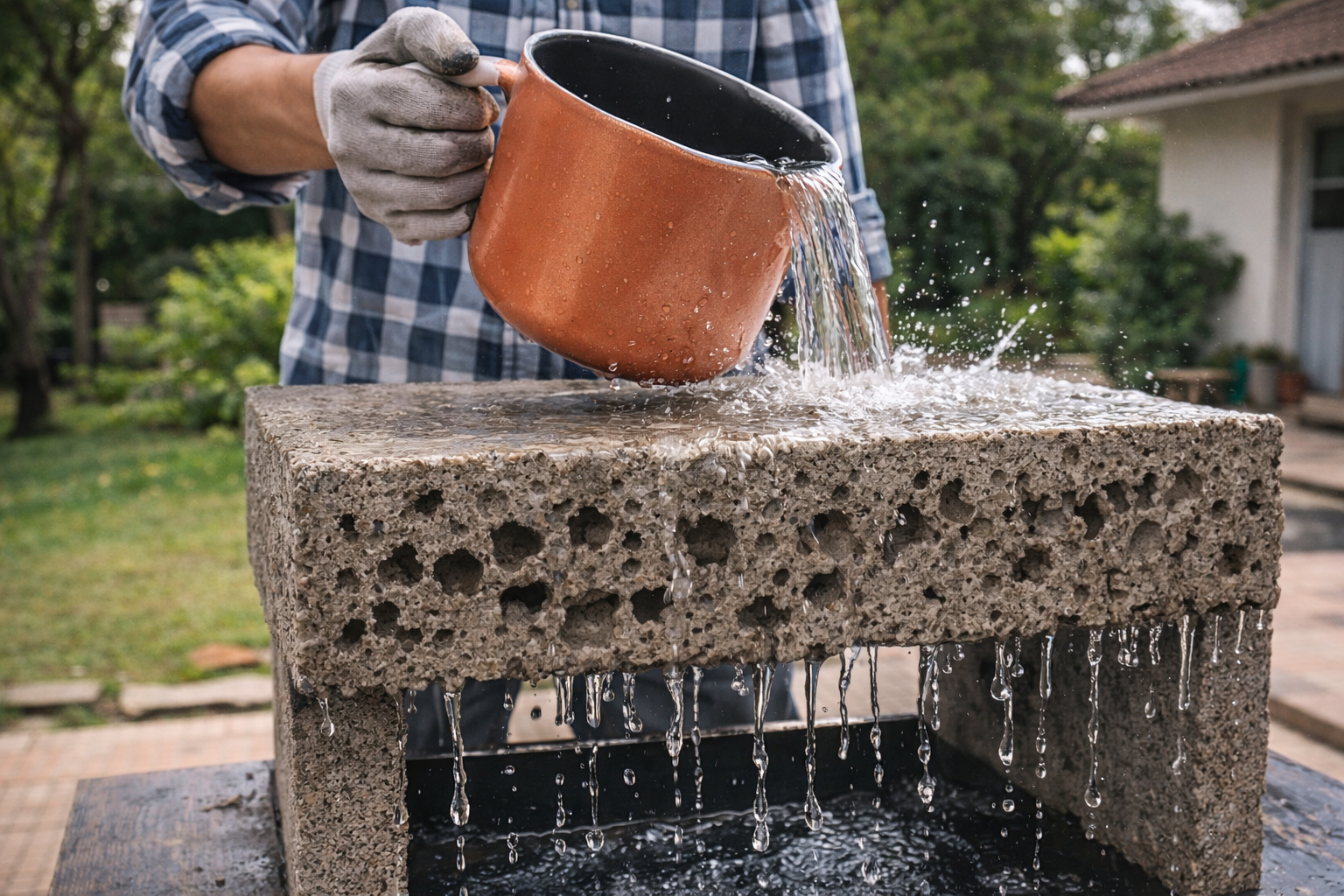


Porous Concrete for Sidewalks Allows Rainwater Infiltration, Reduces Urban Flooding, and Can Cost Up to 40% Less Than Interlocking Block in Residential Paving.
The advancement of urban waterproofing has been identified by technical studies as one of the main factors associated with the increase of flooding in residential areas. Sidewalks, garages, and cemented yards prevent rainwater from infiltrating the soil, overloading public drainage systems.
Within this context, porous concrete — also called permeable concrete or draining pavement — emerges as a technical alternative capable of allowing water infiltration directly into the soil, reducing puddles and contributing to less surface runoff.
Unlike traditional concrete, which has mortar and sand filling all voids, porous concrete is formulated with large aggregates and little or no fine sand, creating a structure with interconnected voids. These voids are precisely what allow water to pass through the pavement.
-
Four friends with over 30 years of friendship built a “mini village” by the banks of a river in Texas to grow old together, with houses of just 32 m² and a shared common space. The Bestie Row project has become a model of alternative living that is starting to spread around the world.

-
The ancient Japanese capital, planned over 1,200 years ago, still withstands earthquakes with colossal wooden temples and palaces, built without concrete or modern steel, by masters who created engineering capable of enduring centuries.

-
The lack of welders, electricians, and operators becomes a structural threat in 2025, with the construction industry and manufacturing already suffering from delays, cost pressures, and labor shortages in Brazil.
-
Brazil and Paraguay are just 46 meters away from a historic union on the bioceanic bridge that promises to revolutionize trade between the Atlantic and the Pacific.


What is Porous Concrete and How Does Permeable Paving Work
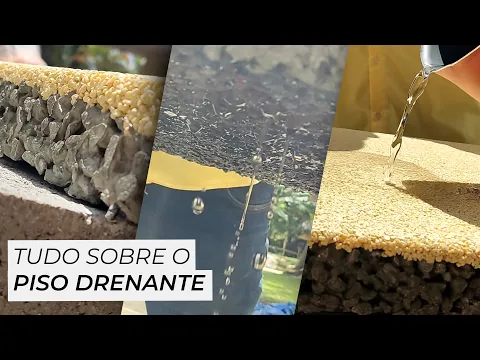
Porous concrete is a type of permeable pavement mainly made up of cement, graded gravel, water, and possibly a plasticizer additive. The absence of fine sand creates a matrix with interconnected pores, allowing water to infiltrate vertically.

The infiltration rate can vary depending on the mixture and compaction, but technical tests indicate that permeable concrete can achieve rates exceeding 100 liters per square meter per minute, depending on the project.
The main function of draining pavement is to allow water to return to the soil instead of flowing into the street.
Draining Pavement for Residential Sidewalks: Practical Application
On sidewalks and residential areas, porous concrete can be used in outdoor walkways, garages, backyards, or circulation areas. The recommended thickness varies depending on the usage. For light traffic, 8 cm to 10 cm may be sufficient. For areas with vehicles, base reinforcement and greater structural thickness may be required. The base typically includes:
- Compacted soil
- Graded gravel layer
- Possible geotextile fabric
The performance of draining pavement depends on both the concrete and the preparation of the base.
Does Porous Concrete Reduce Urban Flooding?
The technical literature on permeable pavements shows that drainage systems contribute to:
- Reduction of surface runoff
- Decrease of peak flow during heavy rains
- Recharge of the groundwater table

By allowing local infiltration, the draining pavement reduces the amount of water directed to storm drains. This does not eliminate large-scale flooding but can reduce the impact on residential areas. In neighborhoods with high waterproofing, each square meter of draining pavement helps relieve the public system.
Comparison Between Porous Concrete and Interlocking Block
The interlocking block can also be permeable when installed with open joints and a draining base. However, there are structural and cost differences. Porous concrete offers:
- Continuous installation (without visible joints)
- Less need for individual pieces
- Faster application in larger areas
On the other hand, interlocking block:
- Allows for spot replacement of blocks
- Requires detailed manual placement
- May have higher material and labor costs
Market estimates indicate that, depending on the region, porous concrete can cost up to 40% less than interlocking pavements of equivalent quality.
Mechanical Strength of Permeable Concrete and Maintenance
One common question is about structural resistance. Although porous concrete has lower strength than traditional structural concrete, it can achieve compressive strengths between 2 MPa and 20 MPa, depending on the mix. For light residential use, this is generally sufficient. The structural design should consider the expected load and type of use.

Over time, fine particles may partially block the pores. Maintenance involves periodic washing with a water jet, possible industrial suction, and controlling the accumulation of surface dirt. When well-maintained, the system preserves its infiltration capacity for years.
Environmental Benefits of Permeable Paving
The use of permeable pavements is mentioned in sustainable urban drainage plans as a tool for managing rainwater. Among the benefits are:
- Reduction of heat islands
- Improvement of infiltrated water quality
- Decrease in surface erosion
Additionally, local infiltration helps maintain soil moisture around. Sustainable urban drainage relies on decentralized solutions like porous concrete.

Technical Limitations of Porous Concrete
Despite the advantages, draining pavement has limitations:
- Does not replace drainage systems in areas prone to severe flooding
- May lose efficiency if installed over impermeable clay soil
- Requires strict control of the mix
Infiltration depends on the permeability of the soil below.
Estimated Cost and Economic Viability
The cost per square meter depends on several factors, such as the price of cement, type of gravel, applied thickness, and labor.
Compared to interlocking pavements of similar standards, porous concrete can present significant savings, especially in larger areas. Financial viability is directly linked to the regional cost of materials.
Porous Concrete as a Technical Alternative for Sidewalks
Porous concrete transforms sidewalks and residential areas into surfaces capable of infiltrating rainwater, reducing surface runoff and contributing to less overload on the urban system.
With a potentially up to 40% lower cost than interlocking blocks, draining pavement presents itself as a viable technical solution when executed with an adequate base and periodic maintenance.
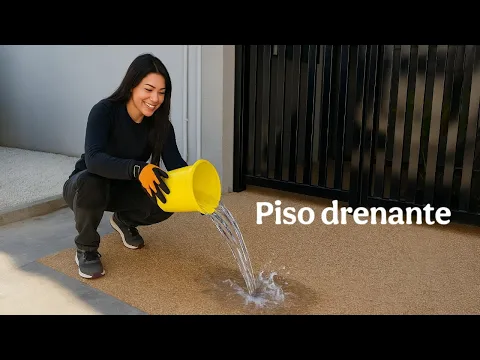
The combination of efficient drainage and cost reduction makes permeable concrete a relevant alternative in contemporary residential paving.








Gostaria de saber se é aconselhavel para garagem que tem também plantio de grama, pois moro em condomínio.