





 Portuguese
  English
  Spanish
  6 min of reading
  3 comments


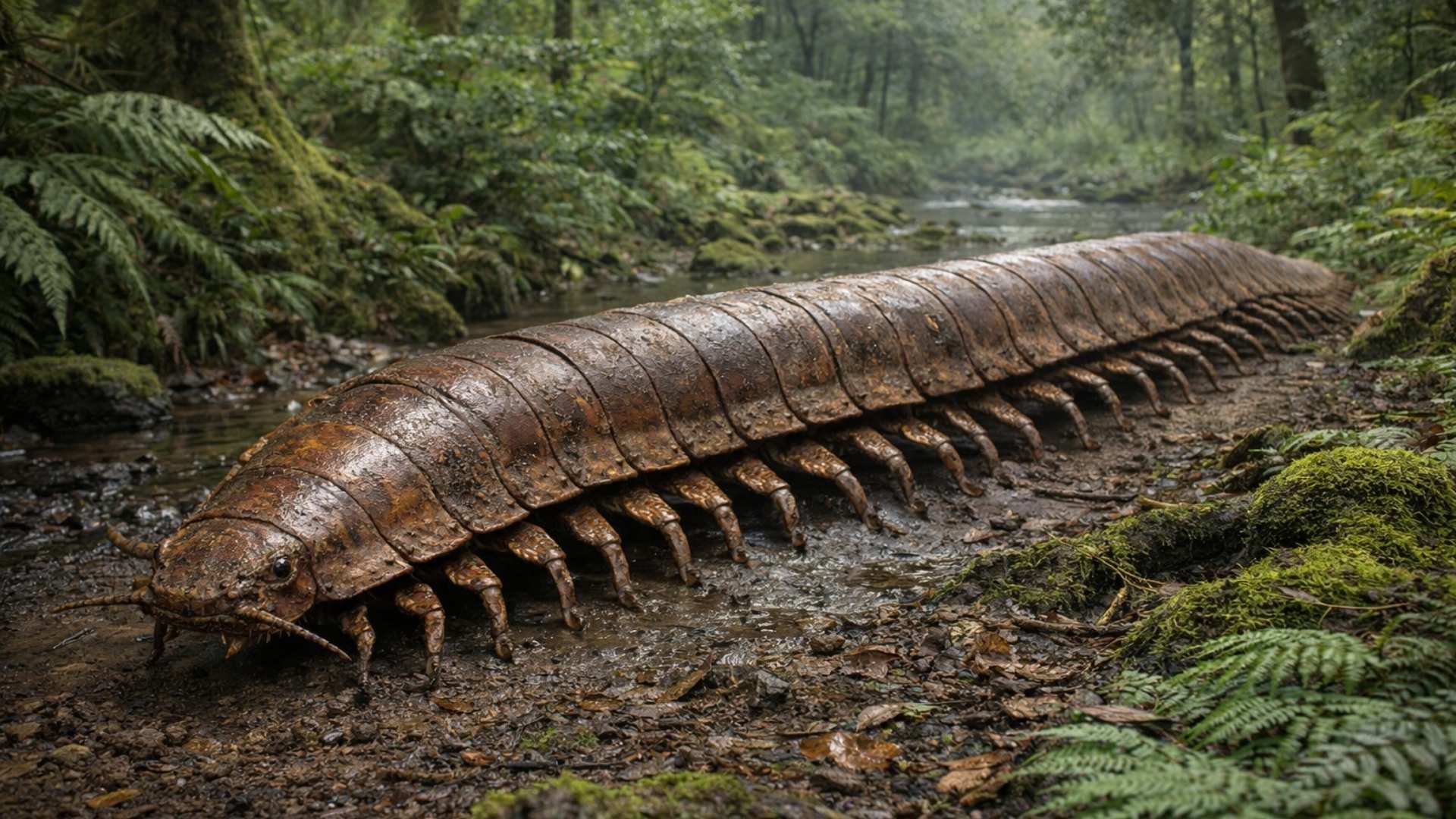


Segmented Body, Rigid Exoskeleton, and Dimensions Reaching 2.6 Meters Place Prehistoric Arthropod from the Carboniferous Period Among the Largest Terrestrial Invertebrates Ever Recorded by Science.
Before dinosaurs became synonymous with gigantism, an elongated, segmented arthropod set a record that still attracts attention in museums, studies, and scientific reports.
The Arthropleura is identified as the largest terrestrial arthropod ever known, with estimates reaching 2.6 meters in length, in addition to a rigid trunk made up of plates and segments that functioned as a protective exoskeleton.
The animal lived during the Carboniferous period, on a planet with ecosystems very different from today’s, and remains at the center of scientific debates precisely because its fossils have, for decades, been found in a fragmented state, limiting the reconstruction of essential parts of its body.
-
Man never set foot on the Moon? 5 scientific proofs confirm that humanity has been there and definitively dismantle conspiracy theories.
-
The Brazilian Army will adopt humanoid robots to test the concept of future combat, says a website, surprising everyone, but later revealing that it was all just an allusion to April Fool’s Day.

-
There is a city in China right next to Hong Kong where people speak Portuguese, the streets have names in Portuguese, and the architecture looks like it came straight out of a historic city in Brazil.

-
Rare frog thought to be extinct after only appearing in fossils reappears, becoming a ‘living relic’ of evolution and gaining a real path to spread after combating introduced predators.

Maximum Size and Available Fossil Records
The size attributed to Arthropleura appears in reconstructions based on body fossils and in comparisons made by researchers from the available material.
In reports based on recent studies, in addition to the maximum length of 2.6 meters, a body mass in the range of several kilograms, around 45 kilograms, is also mentioned, which helps explain how such a long animal could move without the volume of large vertebrates.

Still, the fossil record does not contain a complete specimen at maximum size, and different publications and scientific coverage may present varying numbers when discussing the upper limit of length.
Relationship with Myriapods and Classification Difficulties
Arthropleura is often described as a myriapod similar to modern pill millipedes, due to its long body, evident segmentation, and the pattern of legs distributed along its trunk.
This comparison, however, has long faced an objective difficulty: the rarest part in the fossils of the animal tends to be the head region, which houses structures critical for classifying the group more securely.
In materials published by research teams, the recurring absence of heads in finds has been attributed to the growth mode of arthropods, which undergo molt of the exoskeleton throughout their lives, a process capable of leaving behind parts of the “shell” and favoring the fossilization of trunk segments instead of a fully preserved body.
Recent Fossils and Revelations About the Head
In recent years, a collection of fossils analyzed with modern imaging techniques helped to fill part of this gap.
Researchers reported the description of the anatomy of the head of Arthropleura based on well-preserved specimens recovered from a fossil site in France, in Montceau-les-Mines, a location whose position on the globe was different during the Carboniferous and today provides rare material for studying the species.
From this documentation, more detailed descriptions of antennae, eyes, and mouthparts emerged, elements that, in many groups of arthropods, are decisive for understanding evolutionary relationships and lifestyles.
Confirmation as an Ancestral Diplopod

The descriptions released in science media and publications associated with the topic indicate that the preserved head exhibited characteristics that helped clarify a point that remained open for decades.
Based on anatomical traits and analyses that cross morphological data with comparative information from current groups, Arthropleura has been discussed as an ancestral diplopod, linking the animal to the evolutionary branch that includes modern pill millipedes, and not to current centipedes, which belong to another major group of myriapods.
This topic is relevant because, without the head, the segmented trunk alone could support different interpretations, and the reconstruction of cranial parts reduces the margin of uncertainty.
Rigid Exoskeleton and Body Organization
The body of Arthropleura also stands out for details repeated in scientific reconstructions.
The trunk was divided into successive segments, with legs organized along these sections, in a pattern that differs from many popular modern arthropods in the public imagination, such as spiders and scorpions.
The “armored” appearance attributed to the animal comes from its exoskeleton, a rigid external structure that, in arthropods, serves as support, protection, and muscle attachment, influencing how it moves and behaves on different terrains.
Carboniferous Environment and Favorable Conditions
The environment in which Arthropleura lived is also part of journalistic and scientific interest, as the Carboniferous was marked by extensive forests and a fauna of invertebrates that, in many cases, reached large dimensions.

In promotional texts based on studies, the animal appears associated with forest areas and wet regions, with abundant vegetation, a scenario that would help explain why a robust terrestrial organism with an exoskeleton could find food and shelter on a large scale.
These descriptions often rely on the geological and paleontological context of the period and the type of sediment in which the fossils and molds were preserved.
Feeding and Limits of Scientific Record
Diet is another point treated with caution in recent reconstructions, as it depends on the interpretation of mouthparts and comparisons with current myriapods.
In scientific coverage, the anatomy described for the mouth has been presented as compatible with consuming plant material, such as leaves and bark, and also with a behavior associated with continuous feeding, common in animals that spend long periods ingesting organic matter to sustain their bodies.
At the same time, the very nature of the fossil record imposes limits, as direct and abundant evidence of diet is not broadly mentioned in popular syntheses on the topic, requiring caution when turning interpretations into definitive statements.
Why Arthropleura Still Attracts Attention
The fame of Arthropleura is not sustained merely by its size, but by the contrast with what is observed today on solid ground.
Among current terrestrial arthropods, most species are much smaller, and when a large example arises, such as certain terrestrial crustaceans, it stands out as an exception, not the rule.
In the case of Arthropleura, the association with “the largest terrestrial arthropod ever known” serves as a shortcut to explain why a fossil from this group continues to generate new headlines, especially as techniques like tomography and three-dimensional reconstruction begin to reveal previously missing parts of the body.
Even with recent advances, part of the public’s interest remains linked to the fact that the complete image of the animal depends on fossils that rarely appear preserved in the ideal way.
What is known more confidently comes from body segments, specific pieces, and finds that, when combined, allow increasingly detailed reconstructions, but still do not equate to a complete body found at the maximum size attributed to the species.
This limitation of the record helps explain why different sources may present varying maximum values when discussing the length, even when agreeing on the status of Arthropleura as one of the most impressive giants among terrestrial invertebrates.
If new imaging techniques have already managed to reveal details that had been missing for over a century, what part of the past might still reappear in an apparently common fossil and once again change what is known about the largest terrestrial animals without bones that ever existed?



No ARK ela se alimenta de carne podre e tem sangue e saliva ácidos, que danificam estruturas e armaduras, além de machucar os dinossauros que atacam ela.
O problema com isso é que a Arthropleura viveu centenas de milhões de anos antes dos dinossauros.
Achei muito interessante para difundir as variedades de seres vivos com o esqueleto para fora algo que ajuda na proteção do espécime.