





 Portuguese
  English
  Spanish
  5 min of reading
  1 comment


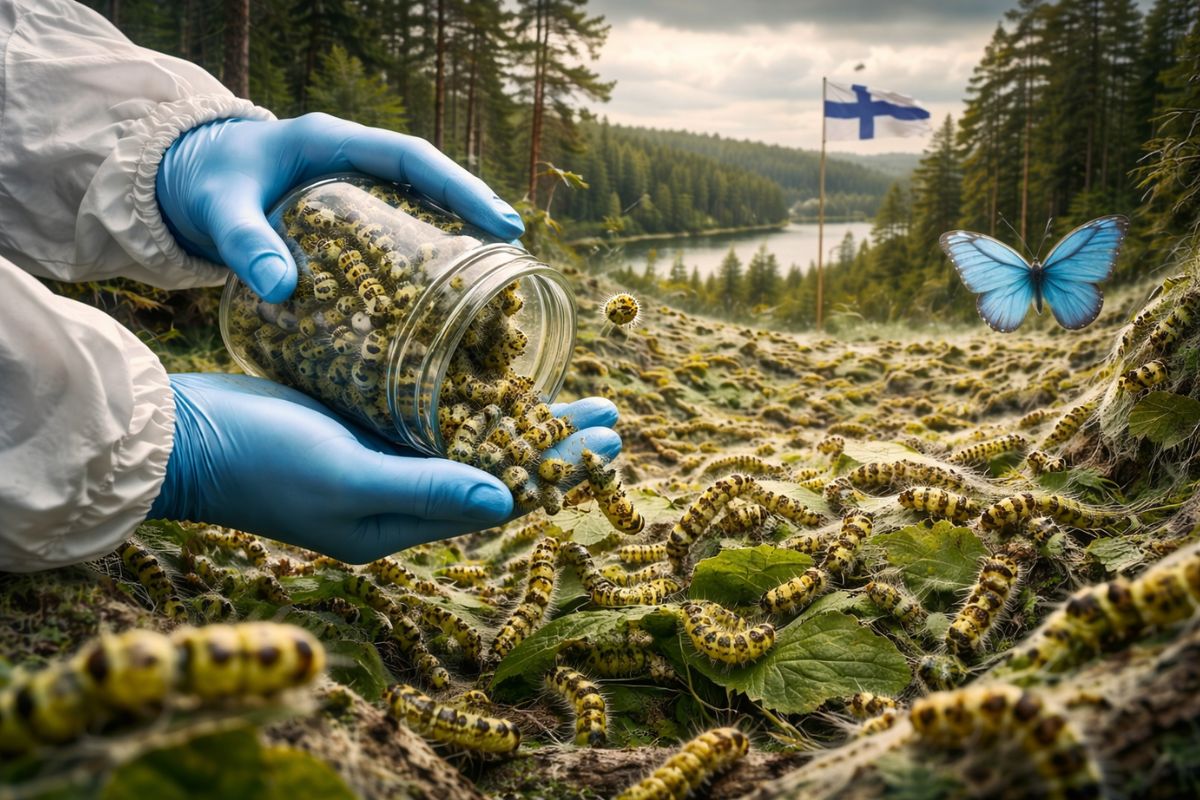


Liberated Caterpillars Were Used as a Scientific Strategy in Finland to Save Butterflies on an Isolated Island but the Experiment Released Multiple Parasites Hyperparasites Hidden Bacteria Unstable Biological Chains and Revealed How Good Intentions Can Generate Deep Imbalances
The liberated caterpillars in Finland were part of a rigorous scientific experiment designed to understand how populations of newly introduced butterflies could survive in a hostile and isolated environment. The initiative seemed controlled, based on classic entomological methods, with local collection and careful manipulation of the insects’ life cycle.
However, what began as a miniature ecological model quickly transformed into a scientific nightmare, when the liberated caterpillars unknowingly carried a whole chain of invisible organisms, capable of turning chrysalises into living tombs and compromising the island’s ecological balance for decades.
The Chosen Island and the Objective of the Experiment

The island of Sottunga, located in the southwest of Finland, is part of a vast archipelago near the Gulf of Bothnia, about forty kilometers from the Swedish coast. Although the archipelago covers approximately six hundred square miles, only thirty-five islands are inhabited, while more than six thousand remain deserted or consist of rocky reefs.
-
With a cost per shot close to zero, the DragonFire laser could change naval warfare in 2027 and provide British ships with nearly unlimited defense against drones.

-
A British startup creates tires that generate electricity in electric vehicles when passing over potholes, speed bumps, and cracks.

-
Scientists have created robots made with living cells that have their own nervous system, swim on their own, explore the environment, and self-organize without any genetic engineering, and now they want to do the same with human cells.

-
Students create a solar-powered ambulance that operates without a plug, without fuel, and still keeps medical equipment running in remote areas.


Sottunga, with about ten square miles and just over one hundred residents, was considered ideal as a natural laboratory. Isolated, sparsely populated, and easy to monitor, it would allow for observing the behavior of a butterfly population without significant human interference, making the use of liberated caterpillars a precise scientific tool.
Why Scientists Opted for Liberated Caterpillars

Adult butterflies are fragile, have short reproductive windows, and extremely rigid life cycles. Transporting them alive almost always results in premature death, mating failure, or inability to lay eggs. Therefore, researchers opted to work with liberated caterpillars, which offered greater experimental control.
In August 1991, seventy-two groups of caterpillars were collected in Finstrom, on the main island of Åland, and transported to Sottunga. The liberated caterpillars were in a state of diapause, a natural metabolic pause that allows survival under adverse conditions. They were artificially maintained in this state, in a cool environment of about five degrees Celsius, to avoid premature metamorphosis and wear during transportation.
The Beginning of the Experiment and the False Sense of Control

After winter, the liberated caterpillars were reactivated in spring and reared under controlled conditions, similar to natural gardens. The goal was simple yet ambitious: to observe how a species that had never lived on that island would spread, reproduce, and withstand isolation over time.
Everything indicated that the experiment was under control. The caterpillars were feeding normally, growing, forming cocoons, and starting the metamorphosis process. Nobody suggested that anything dangerous had been introduced along with them.
The Horror Inside the Chrysalis
The first sign that something was wrong emerged during the pupal stage. Some chrysalises did not produce butterflies. Instead, small yellowish beads appeared along the cocoon. They grew, inflated, and revealed their true nature: parasite larvae.
These organisms had developed inside the liberated caterpillars, silently. The parasitic larvae consumed the host from the inside out, and at the moment of metamorphosis, they completely took over the chrysalis. Instead of a butterfly, a parasitic creature emerged, brutally ending the expected cycle.
The Invisible Chain of Parasites and Hyperparasites
The main invader was a microscopic parasitic wasp, which laid eggs inside the caterpillar still in the early stage. It did not wait for complete metamorphosis. It interrupted the process midway, turning the caterpillar into a living food source for its larvae.
The scientific shock increased when it was discovered that inside these wasps there was another parasite, a hyperparasitic wasp, which fed on the original parasitic wasp. This second species completed its cycle almost simultaneously, creating a synchronized sequence of death: the caterpillar died, the parasitic wasp was destroyed, and the hyperparasite emerged last.
The Invisible Bacteria That Aggravated the Chaos
As if the chain of parasites was not enough, the liberated caterpillars also carried a bacterium called Wolbachia pipientis. Transported by female wasps, this bacterium altered reproductive mechanisms and made the parasitic wasps even more vulnerable to the hyperparasite.
Wolbachia directly interfered with the reproductive system of the insects, potentially causing sterility, death of males while still in the larval stage, and genetic incompatibility. The result was a reproductive collapse at multiple levels, amplifying the instability of the population.
A Natural Laboratory That Almost Got Out of Control
From a scientific standpoint, the scenario was fascinating. A complete ecosystem, with host, parasite, hyperparasite, and bacteria, all on a tiny island. For researchers, it felt like winning the academic lottery.
In practice, however, the liberated caterpillars had opened the door to a real ecological risk. If the set of organisms had been different, or if the introduction occurred on a larger continent, the consequences could have been catastrophic, as has happened in numerous cases of invasive species around the world.
The Extreme Fragility of the Studied Butterflies
The butterfly species used in the experiment was not exotic. It already existed in much of Europe and was common in Finland. The reason it was not present in Sottunga was simple: it does not migrate. This characteristic, paradoxically, made it perfect as a model species.
The butterflies depended exclusively on two specific prairie plants. Any minimal change in the environment, excessive shrub growth, reduced sunlight, or prolonged drought could lead the population to collapse in a single season. The liberated caterpillars lived permanently on the edge of survival.
Extreme Fluctuations and Improbable Survival
The data collected over the years showed abrupt population drops, with numbers nearing zero in certain seasons. Yet, surprisingly, the population persisted for over thirty years.
Genetic diversity remained relatively high, which is rare in isolated populations. This occurred because the initial liberated caterpillars came from a varied genetic pool, creating a robust foundation despite continuous instability.
The Scientific Legacy and the Ecological Alert
Today, Sottunga has become a kind of scientific nursery. Larvae are occasionally collected to reinforce vulnerable populations in other areas. The experiment, despite the initial chaos, did not destroy the local ecosystem.
Still, the lesson is harsh. Moving liberated caterpillars never means moving just caterpillars. Parasites, hyperparasites, bacteria, and pathogens always travel together. In many historical cases, this resulted in environmental collapses, billion-dollar losses, and public health crises.
In light of this detailed history, do you think releasing liberated caterpillars as a conservation strategy is worth the risk, or should this type of experiment be radically rethought?







Seres humanos “brincando de ser” Deus…
Inteligência ( mal usada ) ou pretensão?!