





 Portuguese
  English
  Spanish
  4 min of reading
  1 comment


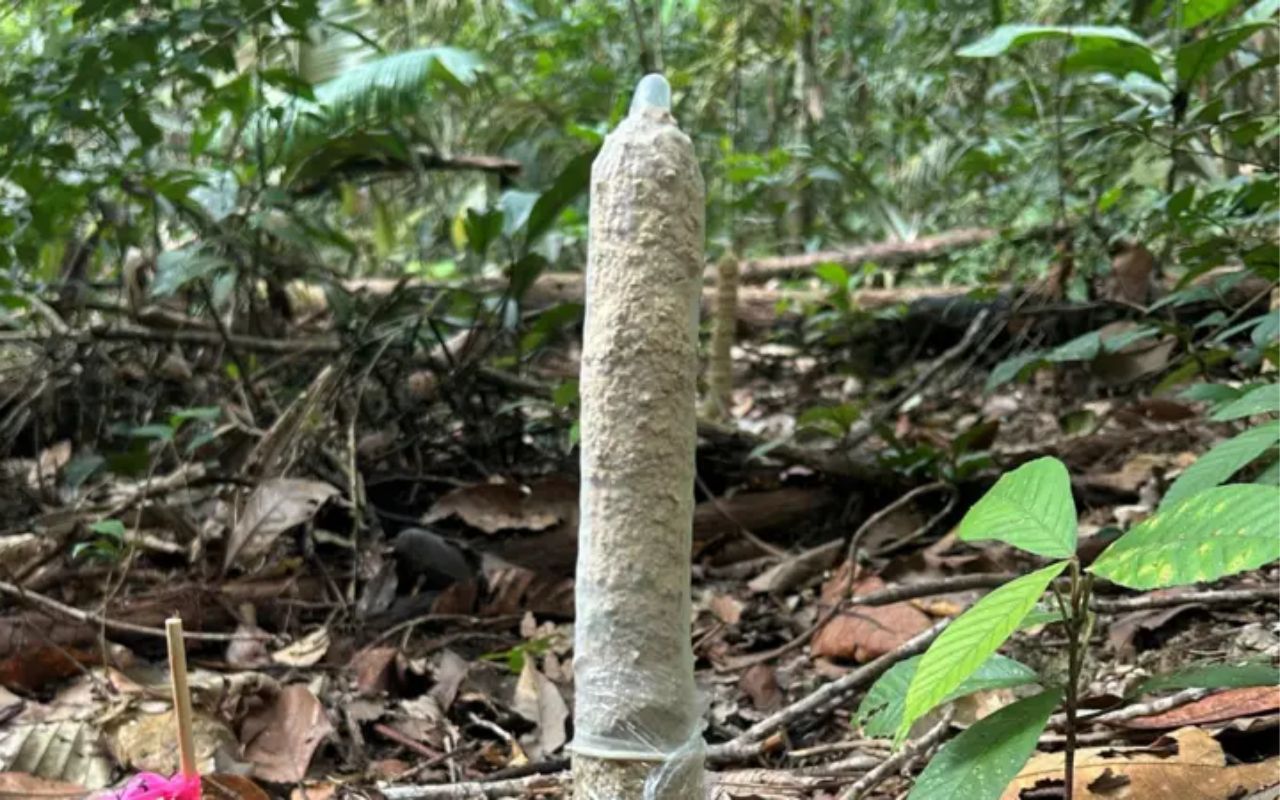


Brazilian Researchers Used Condoms in a Study in the Amazon to Understand Why Cicadas Build Clay Towers with Urine. Study Revealed That the Structures Serve for Breathing and Protection.
A study conducted in the Amazon revealed unprecedented answers about the behavior of the cicadas of the species Guyalna chlorogena, known for building towers made of clay mixed with urine when they emerge from the soil.
The discovery was made by a group of Brazilian researchers who, in a creative way, used condoms to test hypotheses about the function of these structures typical of the tropical forest.
The work was conducted by scientists from the National Institute of Science and Technology SinBiAm (INCT-SinBiAm) and the Quantitative Ecology Training Program at the Serrapilheira Institute.
-
The heatwave in Brazil that hit in March is set to end as a cold front arrives between Good Friday and Easter Sunday, causing a temperature drop of up to 6 degrees and rain in the Central-South region, according to the Easter weather forecast.

-
The U.S. Army has introduced its first new lethal grenade since the Vietnam War: the M111 kills using pressure shock waves that bounce off walls and can explode the enemy’s lungs without producing a single shard.

-
Engineers are replacing pressure valves with hydraulic microturbines within drinking water networks and are generating up to 1,100 MWh per year with in-pipe hydropower technology that harnesses energy previously wasted in urban pipelines.
-
Elon Musk focused on Brazil and lowered the price of Starlink, his internet service, but the question remains: is it worth it? An expert provides a detailed analysis of the internet that promises to connect any part of Brazil.


What Are the Towers of Amazon Cicadas
The Amazon cicadas spend most of their lives underground, feeding on the sap from plant roots.
As they approach adulthood, these insects emerge from the soil and build small towers made of a mixture of clay and urine.
According to researcher Pedro Pequeno from INCT-SinBiAm, these towers are built gradually, night after night, until they are complete.
Although common in areas of the Amazon, their real function remained a mystery for a long time, sparking scientists’ curiosity.
Curiosity Became a Scientific Study Topic
During a field activity at the Serrapilheira Institute, a group of young researchers encountered several of these towers near Manaus (AM).
The scene, described as “a village of small constructions emerging from the ground,” caught the attention of biologist Marina Méga, a doctoral student at UFRJ.
Intrigued, the scientists decided to investigate the purpose of these structures, raising two main hypotheses.
The first was that the towers served as a protection barrier, reducing the risk of predation while the cicadas underwent metamorphosis. The second hypothesis proposed that the towers acted as breathing channels, helping insects survive in low-oxygen soils.
How the Study Used Condoms to Test the Theory
To confirm the hypotheses, the group resorted to an unconventional idea: using condoms as a tool for observation.
The shape of the towers inspired the scientists to cover them with condoms to check if there was gas exchange with the environment.

The result surprised everyone. When the towers were covered, the condoms began to inflate with carbon dioxide released from inside, confirming the presence of natural ventilation.
“The condom started to inflate, and we saw that there was some kind of gas exchange. We were ecstatic. We started celebrating, singing. In short, we had this moment of great happiness. It was a victory because we were in an inhospitable environment, with relatively few resources,” reported Marina Méga.
After the first test, the team ordered 40 condoms to repeat the experiment and ensure the validity of the results.
The researchers also tested whether the towers acted as protection against predators using ant bait.
At the end of the tests, they discovered that both hypotheses were correct: the towers help cicadas breathe and also provide shelter during the most vulnerable stage of metamorphosis.
The Largest Cicada Towers Ever Recorded
Among the findings, one stood out for its size: one of the towers found in the forest reached 47 centimeters in height, considered the largest ever recorded in the world.
According to Pedro Pequeno, structures of this kind typically do not exceed 10 or 12 centimeters in other regions.
However, those in the Amazon can reach almost half a meter, a feat that reinforces the uniqueness of the local fauna and the adaptability of these insects.
Results and Importance of the Study
The results of the study on Amazon cicadas are expected to be published soon in a scientific article.
According to the researchers, understanding the function of these constructions can help to better understand biological mechanisms of ventilation and thermal control.
“Understanding the functions of biological structures is useful because a large part of what we do in the world is imitating biological structures. Often we, researchers, are trying to imitate the natural process that already exists in an extremely efficient way. If we can understand how the cicada towers work, it could have numerous implications for gas exchange, thermal control, for example.
This research shows how scientific curiosity and creativity can come together to unravel natural phenomena.
With simple methods and careful observation, the researchers were able to decipher one of the mysteries of the tropical forest — proving that, even amidst the complexity of the Amazon, innovative answers can arise from the most unusual ideas.
Source: BBC





Parabéns pela iniciativa as cigarras agradecem 💯👏