





 Portuguese
  English
  Spanish
 5 min of reading
  0 comments


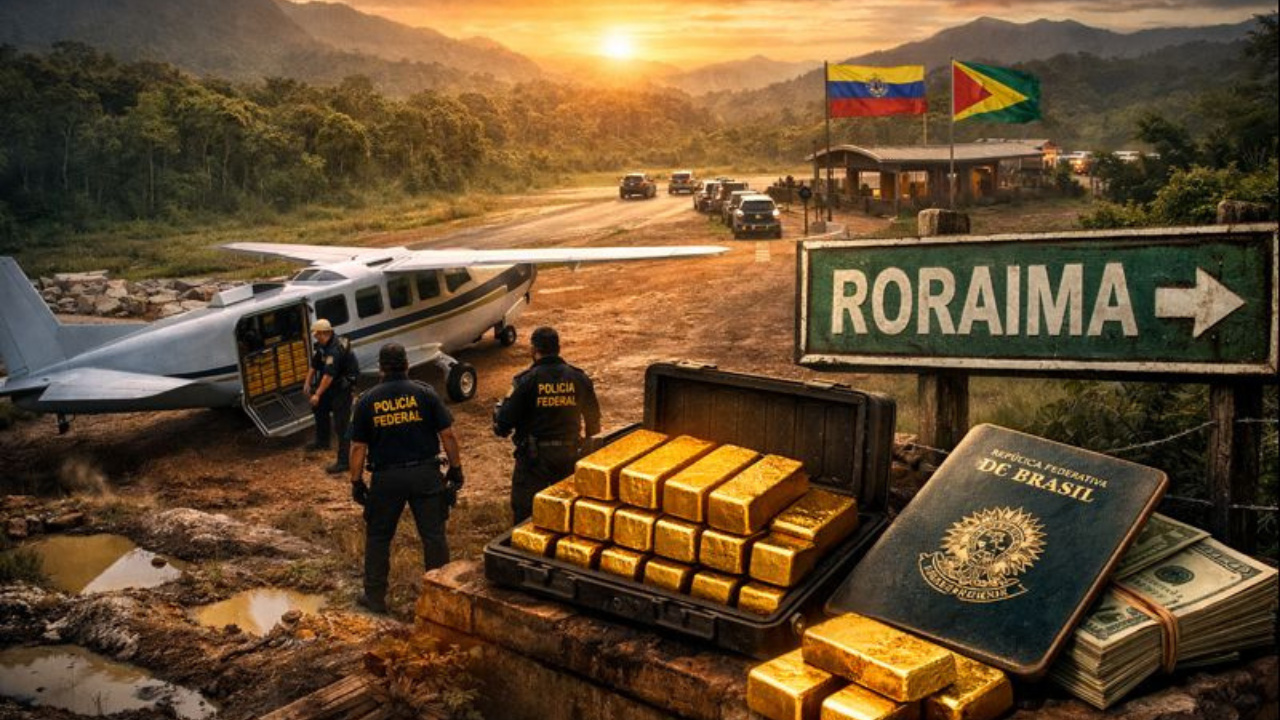
Roraima Became A Key Point For Gold Smuggling, With Illegal Loads Heading To Neighboring Countries Via Clandestine Routes.
The advance of illegal gold in Brazil took on a new shape in December 2025, when federal authorities identified a strategic shift in the smuggling of the metal.
From that moment, Roraima started to act as a key exit point for gold to the outside world.
This finding arose after significant seizures carried out by the Federal Police (PF) and the Federal Highway Police (PRF), both in Boa Vista and on the state’s highways.
-
After China, it’s now the turn of the USA to ‘secure’ a share of Brazil’s natural resources: the country buys critical rare earths for R$ 3 billion and enters the center of the global technology dispute.
-
Rare earths are in everything, from cell phones to bullet trains, and what almost no one realizes is why they have become the target of such a delicate global war.

-
Brazil extracts 26.3 million tons of ore from what was previously treated as waste, transforming residues into wealth, producing over 3 million tons of sand, and demonstrating how national mining is relearning to generate value.
-
A $3.5 billion megaproject in Latin America pumps desalinated seawater at 1,050 liters per second over 194 km to keep a copper supermine in the Andes operational for another 20 years.

Until then, illegally extracted gold was sent to other centers in the country.
Now, however, criminal organizations have started to direct the metal straight to international routes.
This movement occurs, mainly, due to the historic appreciation of gold in the global market and, at the same time, the intensified repression of illegal mining in Brazilian territory.
The Seizure That Exposed The New Clandestine Route
The most emblematic episode occurred on December 2, 2025.
On that occasion, during an aerial monitoring operation, federal agents identified an aircraft that abruptly changed its flight plan and landed at Boa Vista International Airport.
Subsequently, the teams conducted an approach and found 51 kilograms of illegal gold, without an invoice or any proof of origin.
According to the PF, at that moment, the load was worth around R$ 36 million.
Still, this value could be even higher, considering the recent spike in the price of gold in the international market.
During the testimony, the occupants of the aircraft stated that the material had been loaded in Itaituba, Pará, one of the main outposts for illegal mining in the Amazon.
Moreover, they confirmed that similar flights had previously occurred en route to Roraima.
Roraima Takes On A Central Role In Gold Smuggling
With this seizure, investigators reinforced a perception that was already consolidating.
Roraima began to function as a true logistic corridor for the clandestine export of gold.
For decades, illegally extracted metal, especially from the Yanomami Indigenous Land, was sent to other states.
In those locations, “document laundering” schemes attempted to give legal appearance to the product before export.
Now, however, this flow has reversed.
“We identified a clear change in the route of gold.
Currently, the metal extracted from other regions of the country is routed to Roraima, which serves as a transit point to other countries,” said PF delegate Caio Luchini.
The numbers confirm this trend. PRF data shows that between 2024 and 2025, the volume of gold seized on Roraima’s roads increased by 368%.
Thus, the total jumped from 22.3 kilograms to 104.5 kilograms.
In addition, this number does not include large seizures carried out by the PF at the end of 2025, indicating that the real volume could be significantly higher.
Strategic Borders And Unequal Oversight
In light of this scenario, the main hypothesis of the authorities points to the use of routes that cross Venezuela and Guyana.
This choice occurs, especially due to geographic proximity, less rigorous oversight, and the existence of a clandestine infrastructure established during the peak of illegal mining in Yanomami Land.
In this context, makeshift landing strips, supply networks, and experienced pilots form the logistical base of the scheme.
In addition, the situation in neighboring countries facilitates the outflow of gold.
In Guyana, mining is legalized, making it difficult to differentiate between legal and smuggled gold.
Meanwhile in Venezuela, reports indicate that most of the production occurs illegally.
Mining Tradition And The History Of Illegal Gold
Roraima has a historical relationship with artisanal mining.
In fact, the Miner Monument in Boa Vista symbolizes decades of migration in search of gold.
However, investigations by the PF and the Federal Public Ministry revealed that a significant portion of illegal gold has supplied markets in Europe, Asia, and the United States.
For years, schemes have falsified documents to “legalize” the metal.
In practice, criminal organizations linked gold to non-existent mining permits or permits located hundreds of kilometers away.
“We identified the shipment of gold to states like São Paulo, Pará, and Rondônia. In those locations, document laundering took place,” recalls Luchini.
Why Did The Route Change Now?
According to the PF, three main factors explain this change. First, the intensification of operations against illegal mining after the Yanomami humanitarian crisis in 2023 drastically reduced extraction in the region.
Second, the requirement for electronic invoices for transactions involving gold made fraud more difficult. Finally, the Federal Supreme Court abolished the presumption of good faith in purchasing the metal.
“With these measures, it became much more difficult to launder gold in Brazil,” explains Larissa Rodrigues from the Choices Institute.
As a direct consequence, official exports fell by 31% between 2022 and 2025, according to data from the Ministry of Development, Industry, Commerce, and Services (MDIC).
Gold Appreciation And The Risk Of New Escalation
Alongside this, the appreciation of gold has further increased the risk of smuggling expansion.
The metal exceeded the mark of US$ 5,000 per ounce, driven by global instability scenarios.
In these circumstances, investors treat gold as a safe asset, increasing demand.
“Whenever the price rises, the stimulus for illegal extraction also grows,” warns Rodrigues.
For this reason, experts assess that pressure on border regions, such as Roraima, is likely to increase.
Meanwhile, security forces seek to anticipate organized crime’s adaptations.
“The territory is vast, and the personnel is limited. Still, we use intelligence and risk analysis to act,” said the PRF. Thus, the struggle between oversight and organized crime continues to shape, year after year, the new paths of illegal gold in Brazil.
See more at: Gold: The New Smuggling Route In Brazil That Supplies The International Market – BBC News Brasil








Seja o primeiro a reagir!