





 Portuguese
  English
  Spanish
  5 min of reading
  7 comments


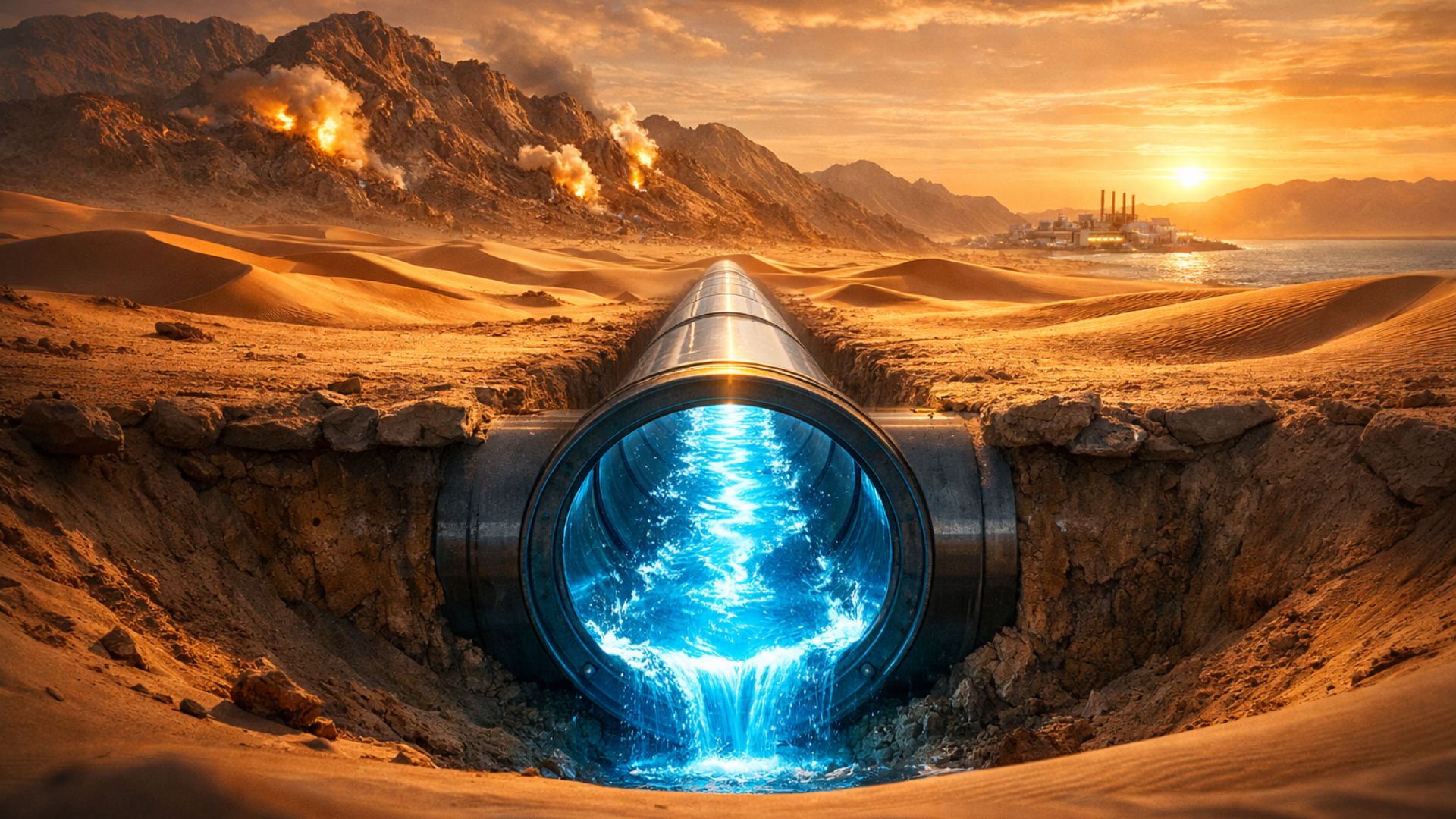


Record-Breaking Underground Network Connects Desalination, Dams, and Aquifers to Secure Water in One of the Driest Countries in the World, with Large-Scale Projects, High Energy Costs, and Environmental Goals That Expand the Debate About Water Security in Desert Regions.
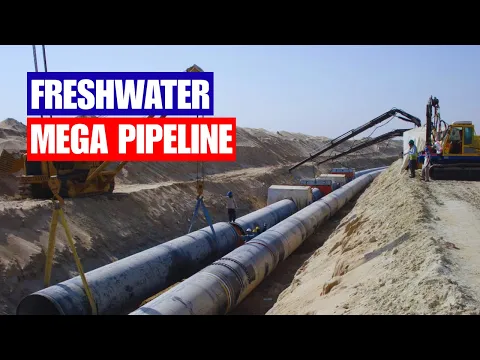
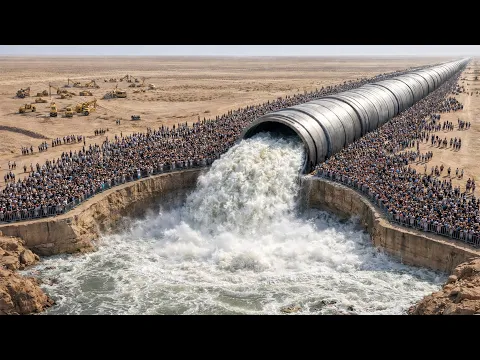
Saudi Arabia has expanded, over the past few decades, a network of pipelines that functions as an artificial nationwide water transportation system.
The structure, primarily composed of underground pipelines, transports water produced from the sea to regions far from the coast and integrates the country’s strategy to ensure supply in one of the driest environments on the planet.
In November 2023, the system was recognized by the Guinness World Records as the largest water transmission network in the world, with 14,217 kilometers verified.
-
Scientists have finally discovered where the plastic that disappeared from the oceans went, and the answer is frightening: it fragmented into such tiny particles that they became invisible and now there are 27 million tons of nanoplastic just in the North Atlantic.
-
The Artemis II mission will take the Orion capsule back to the vicinity of the Moon with four astronauts, a private bathroom with a curtain, a system adapted for men and women, and a level of comfort that highlights how the Apollo era operated at the rawest limits of space exploration.
-
Giant structures on the seabed precisely control oil and reveal how high-tech underwater valves work.
-
China has just tested a giant drone the size of a fighter jet with a wingspan of 25 meters that carries 6 tons, flies for 12 hours, and the most frightening part: it can launch entire swarms of smaller drones directly from the air.


The initiative addresses a structural problem.
The Saudi territory has no permanent rivers or natural freshwater lakes, and rainfalls occur irregularly and concentrated.
Under these conditions, water security depends almost entirely on infrastructure built by humans, capable of capturing, storing, treating, and transporting water with the least possible losses.
Dams and Flood Capture in the Desert

Most of the surface water available in the country appears episodically, in rapid floods that traverse dry river beds known as wadis.
To retain these volumes, the government has invested in building hundreds of dams spread across the territory.
Data cited in technical reports and academic studies indicate that Saudi Arabia has about 522 dams, with a total storage capacity of around 2.3 billion cubic meters.
These structures serve multiple purposes: reducing damage caused by floods, storing water for later use, and contributing to the recharge of shallow aquifers.
The concentration of these works varies according to the rainfall regime.
Regions in the southwest and areas near Mecca contain a significant portion of the dams, as they receive slightly higher volumes of precipitation.
Nonetheless, experts point out that surface storage is not sufficient to meet the growing demand from urban, industrial, and agricultural areas.
Aquifers and the Use of Non-Renewable Resources

For decades, the Saudi supply has also relied heavily on groundwater.
Geological research indicates the presence of large volumes accumulated underground, formed during wetter periods of the geological past of the Arabian Peninsula.
The challenge, according to hydrological studies, is that only a portion of this stock is renewable under current climatic conditions.
Widely cited estimates indicate that the safe annual recharge of aquifers is around 2.8 billion cubic meters per year, while historical withdrawals have exceeded this level.
Information released by the Saudi statistical authority shows that, even with a recent reduction, the extraction of non-renewable groundwater still reaches tens of billions of cubic meters per year, with significant use in the agricultural sector.
Water resource experts warn that this type of exploitation, when not compensated by natural recharge, reduces reserves accumulated over thousands of years.
The “Invisible River” of Underground Pipelines
With clear limits on the use of aquifers and irregular rainfall, the country has begun to invest more intensively in producing water from the sea and its distribution on a continental scale.
The result was the expansion of a transmission network that connects the coast to urban centers inland, such as Riyadh, as well as industrial areas and regions with high population flow.
The Guinness World Records recognition refers to a system of 14,217 kilometers of pipelines, primarily operated by the state-owned Saline Water Conversion Corporation.

The decision to install much of these pipelines underground is associated with technical factors.
In regions where summer temperatures often exceed 50 °C, exposed water tends to evaporate quickly, increasing operational losses.
Moreover, burying the pipelines reduces contamination risks, protects the infrastructure from sandstorms, and helps maintain the pressure needed for transport over long distances.
Nonetheless, the implementation of the system required complex interventions, such as deep excavations, drilling through rocky terrains, and, in some sections, the use of controlled explosions to traverse mountainous massifs.
Industrial-Scale Desalination
The water that travels through this network does not go directly from the sea to the taps.
Before that, it passes through desalination plants responsible for removing salts and other impurities.
Saudi Arabia is now one of the largest global producers of desalinated water, according to data from international organizations and sector records.
Guinness World Records recognizes Saline Water Conversion Corporation as the largest desalination company in the world by operational volume.
Among the most cited complexes is Ras Al Khair, on the coast of the Persian Gulf, with a verified daily capacity of 1,036,000 cubic meters.
The record for the highest installed capacity at a single complex is attributed to Shoaiba, on the Red Sea, with nearly 3 million cubic meters per day, as verified in December 2023.
Industry analysts point out that desalination involves high costs and significant energy consumption.
Another recurring point in environmental studies is the disposal of brine, a highly concentrated salt waste that needs to be managed to reduce impacts on marine ecosystems.
Environmental Goals and Reforestation in the Desert
In parallel with the expansion of water infrastructure, the Saudi government has announced large-scale environmental goals.
Under the Saudi Green Initiative, the country has declared its aim to plant 10 billion trees over the next decades and expand protected areas.
The stated goal is to achieve about 30% of the territory under some form of protection.
According to official documents, the plan aims for the rehabilitation of approximately 74 million hectares.
Authorities claim that increasing vegetation cover may help reduce dust, improve air quality, and alleviate heat islands in urban areas.
Researchers, however, emphasize that the effectiveness of these actions depends on factors such as the species used, water availability, seedling survival, and continuous monitoring.
By integrating dams, aquifers, desalination, and an extensive transmission network, Saudi Arabia is betting on engineering solutions to ensure water where it does not naturally occur.
In a global scenario of water stress and rising temperatures, to what extent can models based on large-scale desalination and the transportation of water over thousands of kilometers be replicated by other countries?






As pessoas nao se contentam com o que tem e apesar de sermos um país rico existem milhões vivendo de forma degradante enquanto uma minoria ostenta . O pior é mentalidade de alguns que ainda idolatram isso.
Exelente desarrollo para el bien general
Brasil poderia resolver a seca do nordeste da mesma maneira, mas é uma roubalheira de dinheiro desenfreada e imoral.
O problema do Brasil não é a corrupção. Se não houvesse os corruptos, haveria os bombardeios como em qualquer outro país. O caminho que foi traçado é esse, para todos.