





 Portuguese
  English
  Spanish
  6 min of reading
  0 comments


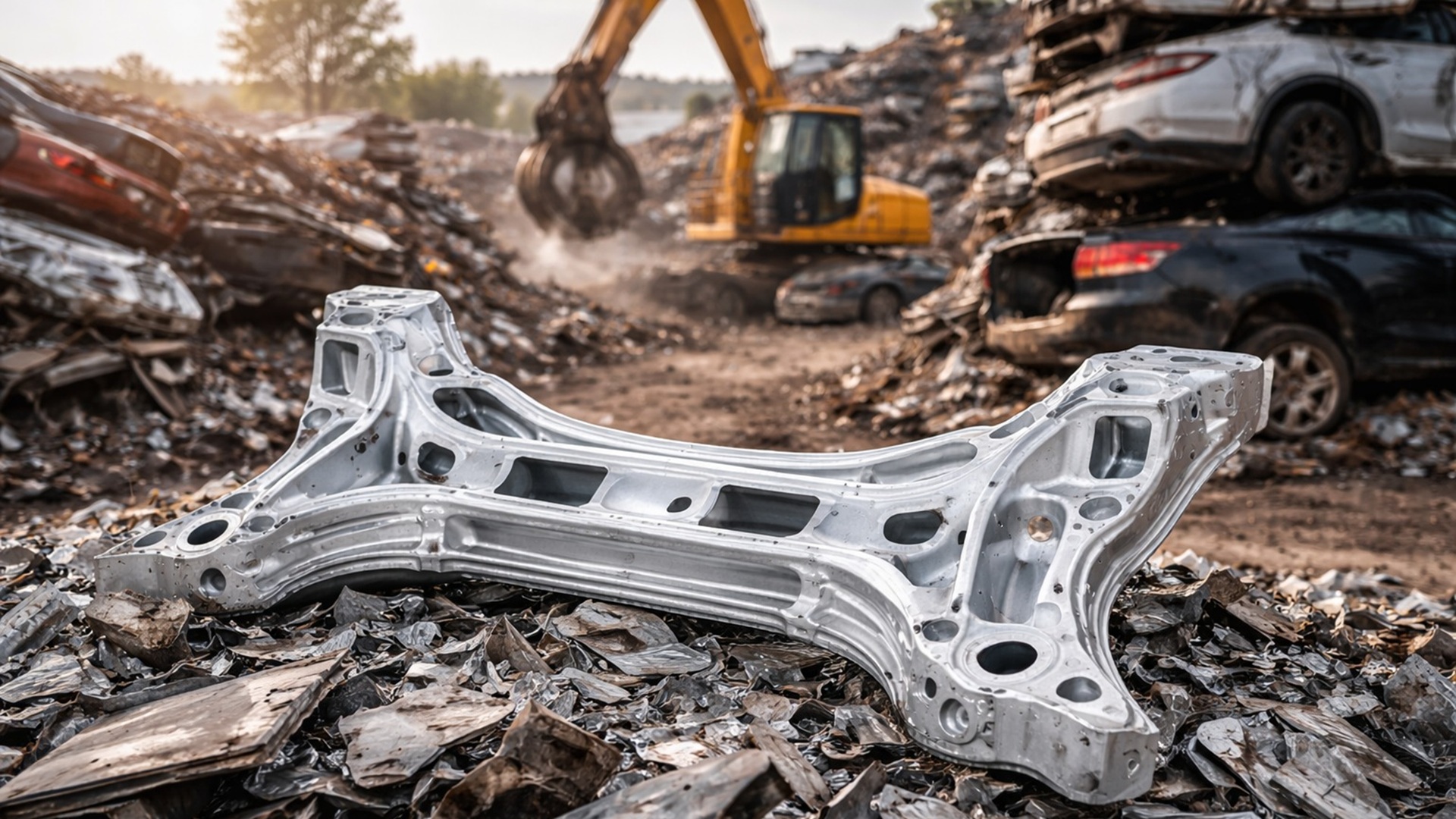
Developed by the Oak Ridge National Laboratory in just 15 months, the RidgeAlloy alloy allows for the transformation of contaminated aluminum automotive scrap into reliable structural components, in light of the forecast of up to 350,000 tons annually of discarded sheets in North America starting in the 2030s
The Oak Ridge National Laboratory developed, in 15 months, the RidgeAlloy alloy, capable of transforming contaminated aluminum automotive scrap into reliable structural material, in light of the forecast of up to 350,000 tons annually of discarded sheets in North America and the energy and industrial impact of this reuse.
A New Alloy for an Impending Problem in the Automotive Industry
Researchers at the Oak Ridge National Laboratory, affiliated with the U.S. Department of Energy, developed the RidgeAlloy alloy to address the expected increase in aluminum body scrap over the next decade.
Much of this scrap has high levels of impurities, which makes its direct use in high-performance automotive components impossible and significantly reduces its economic value in the domestic market.
-
Less than a Tera TSI, up to 710 km of range and charging in 9 minutes: the new BYD Song Ultra expands the Chinese brand’s bet on increasingly faster, more technological, and competitively priced electric SUVs.

-
With a 1.0 engine producing 75 hp and costing less than R$ 70,000, Fiat’s car returns to the podium as the cheapest in the country; a temporary promotion for the 2026 Like version reduces the price of the Fiat Mobi.

-
With a mild hybrid system of 48 V, 176 hp and a price of R$ 175,990 in the Sahara version, the new Jeep Renegade changes mostly on the inside, improves slightly in fuel consumption, and remains almost the same car.

-
With a 293.5 cm³ engine and a range of up to 400 km with a 14.1-liter tank, the Honda CB 300F Twister 2026 has up to 24.7 hp, an initial price of R$ 25,150, and already exceeds R$ 29,000 in the Fipe Table.


The RidgeAlloy was designed to allow low-quality post-consumer aluminum to be converted into suitable material for the production of strong and reliable structural parts, creating a domestic supply chain with greater added value.
Aluminum is on the list of critical materials by the Department of Energy due to its essential role in large-scale energy generation, transportation, storage, and conservation technologies.
Accelerated Development and Focused Design Strategy
The new alloy is produced from the melting of post-consumer aluminum scrap and its remelting into a formulation that meets industrial standards for strength, ductility, and performance in collisions.
According to Allen Haynes, director of the Lightweight Metals Program at ORNL, the team progressed from theoretical concept to real-scale demonstration in just 15 months, a pace described as unprecedented in the development of complex structural alloys.
This speed was made possible by ORNL’s long history in aluminum alloy research and the application of a focused design strategy, which reduced trial-and-error cycles.
The process demonstrated that it is feasible to quickly adapt a metallic formulation to deal with typical chemical variations of automotive scrap, even in the face of unpredictable compositions.
The Growing Challenge of Aluminum Vehicle Scrap
Vehicles with high aluminum content began to gain traction in the American market around 2015, with models like the Ford F-150 among the first produced in large volume.
By the early 2030s, many of these vehicles will reach the end of their life cycles, generating up to 350,000 tons annually of aluminum sheet scrap in North America alone.
Without an appropriate technological solution, much of this material tends to be downgraded for low-value applications, such as simple cast parts, or exported, resulting in an economic loss for the domestic industry.
Alex Plotkowski, leader of the Coupled Computational Physics Group at ORNL, explains that post-consumer aluminum can be reused in non-structural applications, but does not meet the strength requirements necessary for bodywork and critical components.
Contamination and Dependence on Primary Aluminum
The main technical obstacle lies in the contamination of recycled material during the shredding process of vehicles, when scrap absorbs iron from fasteners and other mixed components.
These impurities result in unstable and fragile chemical compositions, incompatible with commercial structural alloys used in modern vehicles.
As a consequence, most high-strength automotive parts continue to rely on primary aluminum, produced from raw ore and with high energy consumption.
This scenario reinforces the dependence on imports and increases environmental and industrial costs, in a context of rising internal scrap supply.
From Scrap to the National Supply Chain
Although primary aluminum is mostly imported, the United States has one of the most advanced infrastructures in the world for vehicle shredding and metal scrap recovery.
According to Amit Shyam, leader of the Alloy Behavior and Design Group at ORNL, using remelted scrap instead of primary aluminum can reduce the energy needed to process a part by up to 95%.
To make this reuse feasible on a structural scale, the team resorted to high-performance computing, conducting over two million calculations to predict optimal alloy compositions.
These calculations allowed for adjustments to specific properties, such as mechanical strength and ductility, even in the presence of high levels of iron and silicon.
Advanced Tools and Experimental Validation
In addition to computational modeling, researchers used material characterization and neutron diffraction at ORNL’s Spallation Neutron Source, a user facility of the Department of Energy.
The neutrons allowed for the observation of internal structures and atomic-scale changes without damaging the material, enabling an understanding of how specific impurities affect the behavior of the alloy.
After defining the ideal composition, RidgeAlloy was tested in a real industrial environment, confirming the viability of the approach outside the laboratory.
The company Trialco Aluminum, part of the PSW Group, in Chicago, provided recycled ingots melted from body sheet scrap, adapted to the specifications of the new alloy.
Industrial Tests and First Cast Parts
The ingots were sent to Falcon Lakeside Manufacturing in Michigan, where they were successfully cast into automotive parts via pressure casting.
The part chosen for the test was of medium size and moderate complexity, serving as a proof of concept for more ambitious applications in the future.
Plotkowski stated that the ultimate goal is to cast larger parts, possibly large components for the automotive industry, but this represents only the first step.
The produced parts confirmed that RidgeAlloy maintains adequate performance even when manufactured with recycled mixtures containing higher levels of iron and silicon.
Properties and Structural Applications
Composed of aluminum, magnesium, silicon, iron, and manganese, RidgeAlloy combines mechanical strength, corrosion resistance, and ductility.
These properties allow for the production of structural cast parts for floors, chassis components, and other critical vehicle elements.
The innovation alters the value logic of sorting and reusing body sheet scrap in North America, elevating the economic potential of recycled material.
The advancement also reduces the need for primary aluminum, decreasing energy costs and pressures on global supply chains, with relevant industrial impact.
Projected Impact for the Next Decade
By the early 2030s, RidgeAlloy could enable the production of recycled structural parts in volumes equivalent to at least half of the annual primary aluminum production in the United States.
This volume represents a significant shift in the energy and industrial balance of the sector, with reduced energy consumption, lower costs, and strengthening of the national supply chain.
Allen Haynes stated that the technology allows recovering the value of an impending wave of high-quality recycled alloys destined for the automotive industry.
According to him, this broad effect on the supply chain was the impact intended by the team from the beginning of the project.
Expansion to Other Industrial Sectors
In addition to the automotive industry, RidgeAlloy shows potential for applications in industrial machinery, agricultural equipment, and the aerospace sector.
Other possible uses include mobile power generation equipment, all-terrain vehicles like snowmobiles and motorcycles, as well as marine applications like jet skis.
Research funding was provided by the U.S. Department of Energy’s Office of Energy Efficiency and Renewable Energy, through the Lightweight Metals Program of the Vehicle Technologies Office.
The development of RidgeAlloy occurred within the framework of the Lightweight Metals Core Program of the Vehicle Technologies Office, with a multidisciplinary team from ORNL dedicated to innovation in lightweight structural materials.









-

-

-

-

6 pessoas reagiram a isso.