





 Portuguese
  English
  Spanish
  5 min of reading
  1 comment


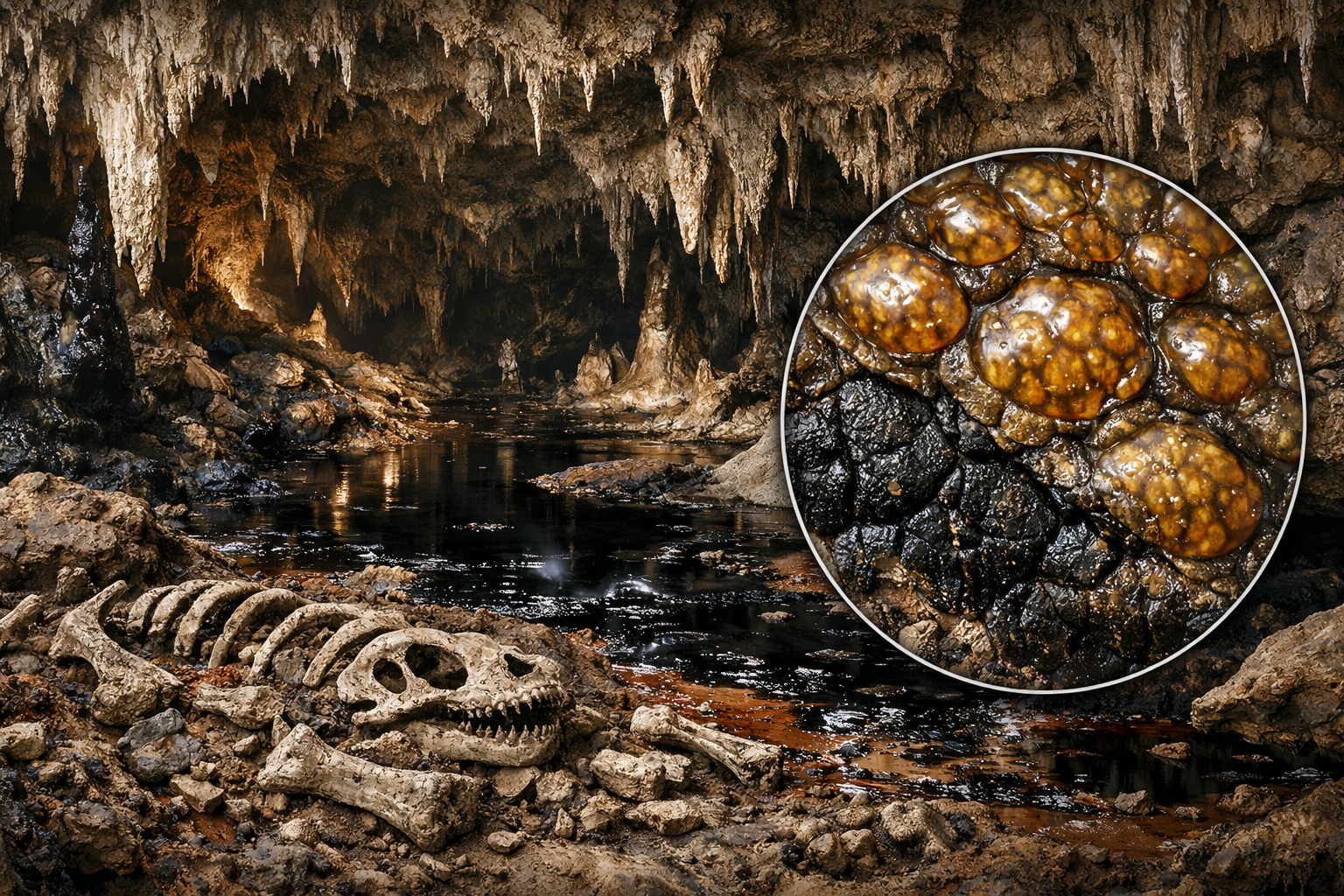


Nearly 300 million years ago, a small reptile crossed a system of limestone caves in what is now southwestern Oklahoma, United States. At first glance, this episode would not have left any significant mark on the geological record. However, against all odds, a microscopic fragment of the skin of this animal, smaller than a fingernail and thinner than a human hair, survived deep time and is now helping scientists understand how vertebrate life managed, for the first time, to establish itself permanently on land.
The information was disclosed by researchers in a study published in the scientific journal Current Biology, based on analyses conducted in the famous cave system Richards Spur, one of the most important paleontological sites in the world for the study of the first terrestrial vertebrates. According to the authors, the material found represents the oldest known amniote epidermis, dated between 289 and 286 million years, surpassing by more than 20 million years any other fossil of terrestrial vertebrate skin described to date.
A Cave From The Permian Period That Became A Time Capsule
The Richards Spur cave system is already well-known among paleontologists for preserving one of the richest assemblages of primitive terrestrial tetrapods from the Paleozoic Era. Bones from reptiles and amphibians of this period exhibit dark brown or black coloring, a result of impregnation by natural oil and tar from the geological formation known as Woodford Shale, which is Devonian in age.
-
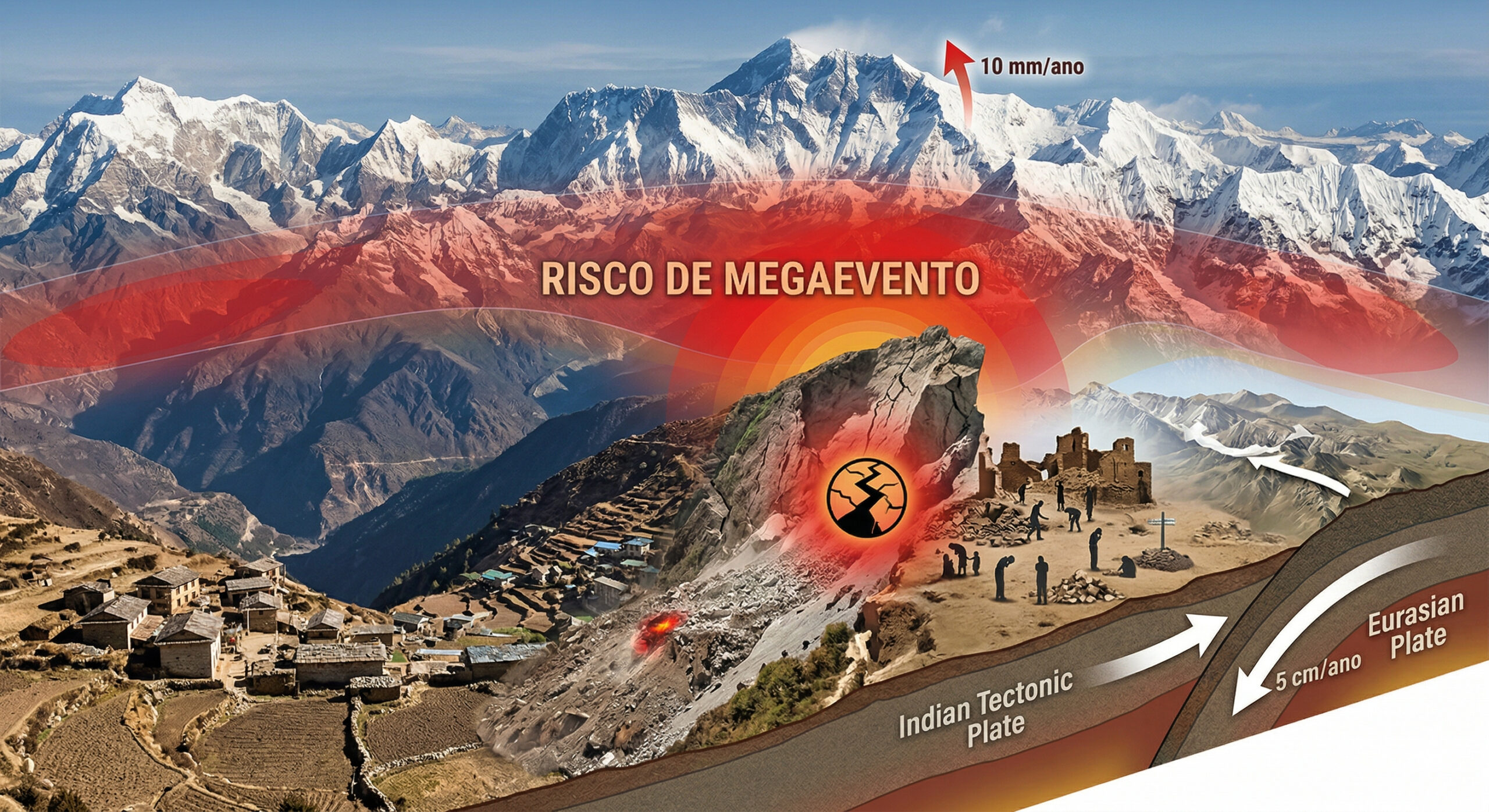
The Himalayas continue to grow to this day, with tectonic plates advancing 5 cm per year, mountains rising up to 10 mm annually, and the 2015 earthquake that killed 9,000 people may have increased the risk of an even larger seismic mega-event.
-
At an altitude of 400 km by astronauts from the International Space Station, Paris transforms at night into a golden mesh so precise that it reveals the outline of the Seine River, avenues, and entire neighborhoods like a luminous map drawn over the Earth.

-
iPhone 17 reaches historic low price with 256 GB, 120 Hz display, and drops to R$ 5,703 on Shopee, featuring A19 chip, dual 48 MP cameras, battery life of up to 30 hours, and advanced AI features.

-
Trip to Mars getting closer: Pulsar Fusion, from the UK, advances with plasma ignition in fusion engine and could drastically reduce space travel time, making crewed missions faster, safer, and economically viable.


These hydrocarbons not only altered the appearance of the fossils but also played a crucial role in their preservation. Within the caves, the groundwater had low oxygen levels, high concentrations of dissolved minerals, and a significant presence of sulfur. Organic remains that fell into or were swept into the system quickly became coated with oil and tar, and were subsequently buried by clay-rich sediments.
This extremely rare combination of anoxic environment, hydrocarbons, and fine sediments drastically reduced decomposition, favored early mineralization, and created ideal conditions for the preservation of extremely fragile soft tissues, such as skin. According to the study, two distinct types of skin preservation were identified: a charred three-dimensional mold, which represents the skin itself, and compression fossils, in which thin layers of carbon preserve the external texture of the epidermis as impressions.
Microscopic Scales That Resemble Modern Crocodiles

Under the microscope, the skin fragment is far from being amorphous. The three-dimensional mold reveals a grainy surface, formed by tuberculated scales, densely packed and non-overlapping. Each of these small protuberances measures only a few tens of micrometers in depth. Between the scales, thin wrinkled ridges emerge, functioning as articulation regions, allowing the skin to flex and grow without tearing.
Moreover, the researchers describe long, linear epidermal bands preserved on the back of a small reptile known as Captorhinus aguti. These bands appear organized in concentric rows along the spine, exactly where one would expect to find robust dorsal scales, serving a protective function.
When analyzed together, the isolated fragments and epidermal bands indicate a surprisingly similar pattern to that of the skin of modern reptiles, especially that of crocodilians. The grainy texture even resembles that of some so-called “dinosaur mummies,” suggesting that this type of scaling was already fully established at the beginning of reptile evolution and underwent few changes over hundreds of millions of years.
The authors argue that this cornified epidermis, equipped with articulation regions, likely represents the ancestral condition of amniotes, a group that includes reptiles, birds, and mammals.
Oil, Chemistry, And The Secret To Extreme Preservation
From a geological perspective, the discovery functions almost like an expert report from deep time. Chemical analyses conducted on bones, stalagmites, and masses of tar from the caves revealed that the hydrocarbons present there have the same chemical signature as the oils from the Woodford Shale, even though this formation is no longer exposed at the surface of the region.
Over millions of years, these hydrocarbons migrated through fractures in the Earth’s crust until they reached the cave system. Once there, they began to coat carcasses and skeletal remains, creating microenvironments poor in oxygen and rich in sulfur. These pockets favored microbial processes that promote early mineralization of soft tissues.
Normally, tissues like skin degrade rapidly, especially in humid environments. In the case of Richards Spur, scientists suggest that occasional periods of partial drying within the caves helped dehydrate the skin, temporarily halting decomposition. Subsequently, rehydration in mineral-rich and hydrocarbon-rich waters allowed the tissue to be permineralized, rather than destroyed.
Why This Ancient Skin Changes Everything About Life On Land
The skin is the largest organ of most vertebrates with limbs. For the first amniotes, it was not just a protective layer but a true life-support system. Unlike amphibians, these animals needed an efficient barrier to retain water, resist solar radiation, withstand abrasion, and still allow for growth and movement.
The Richards Spur material confirms that a relatively waterproof and cornified epidermis, with well-defined scales, already existed at the beginning of amniote diversification. In evolutionary terms, this suggests that the basic plan that gave rise to the scales of reptiles, the feathers of birds, and even the hair follicles of mammals may have originated from this same type of ancestral tissue, through folds and specializations over time.
For the modern audience, accustomed to associating fossils only with bones and teeth, the discovery serves as a powerful reminder: our understanding of ancient ecosystems depends on extremely rare finds capable of preserving organs that almost never survive. When we feel the dry air touch our own skin, we are utilizing an adaptation that began to be shaped in animals very similar to the small reptile that left its microscopic mark in a cave in Oklahoma nearly 300 million years ago.
The discovery was reported in a scientific study published on the website of the journal Current Biology, based on research conducted in the Richards Spur cave system in Oklahoma, according to the authors of the paper.








Click bait… no pics