





 Portuguese
  English
  Spanish
 3 min of reading
  0 comments


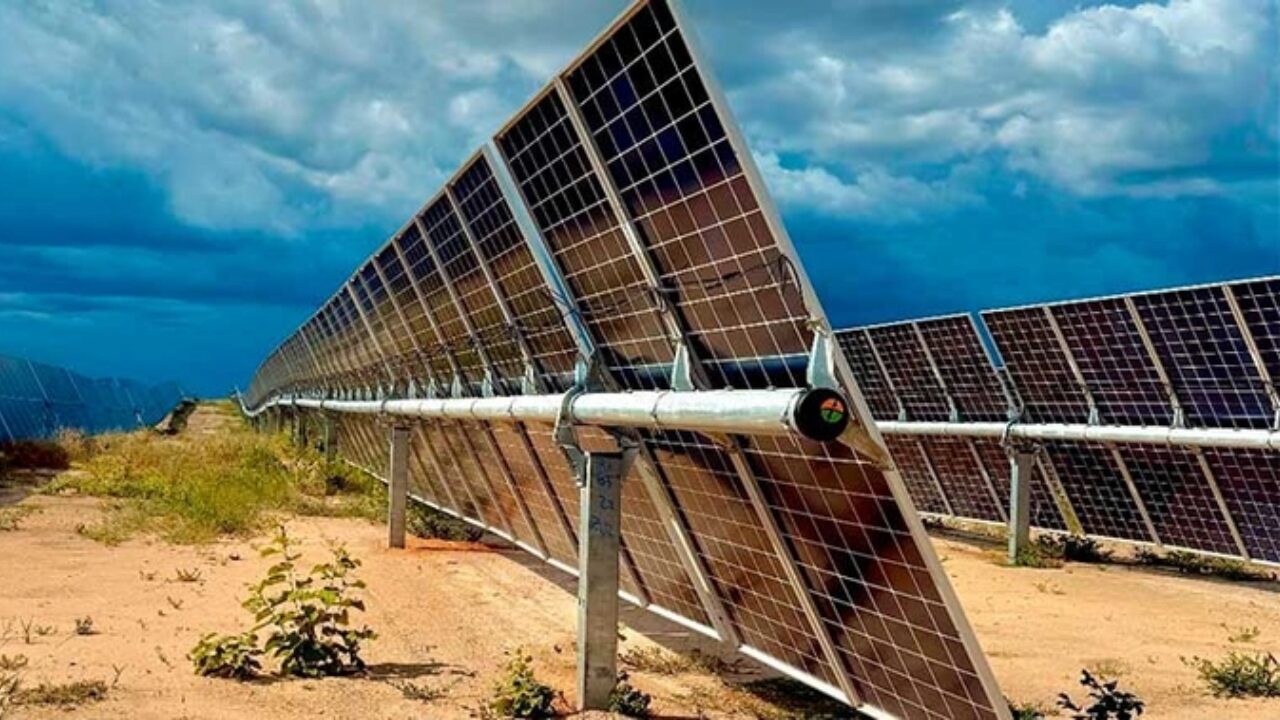
Adaptable Tracker Technology Revolutionizes Construction of Solar Plant in Pernambuco’s Backlands.
Pioneering, innovation, and sustainability define the Serrita Solar Complex, in the backlands of Pernambuco, which has become the first solar plant in Brazil to employ the ground-adaptive solar tracker from Nextracker, the NX Horizon-XTR.
The technological solution allowed not only the overcoming of typical environmental and geological challenges of the semi-arid region but also ensured savings of over US$ 1 million in investments, marking a new level in the execution of clean energy generation projects in the country.
Solar Plant Project with Adaptive Tracker Reduces Costs and Environmental Impact
Located in an area of irregular topography and predominantly rocky soil, the Serrita solar plant had one of its main premises as environmental preservation.
-
Seagri’s headquarters invests in solar energy with Neoenergia Coelba and promises to cut electricity costs, highlighting a strategic advance in sustainability and energy efficiency within state public administration.
-
Solar Pyramid draws attention by converting solar energy into million-dollar savings and repositioning the City Hall of Curitiba as an example of innovation, sustainability, and intelligent use of public resources.
-
Europe records strong euro economy with solar energy in March and sparks curiosity about which country leads growth that redefines the energy market and reduces costs.

-
Piauí reaches a historic milestone in energy transition: State records nearly 160,000 households powered by solar energy and leads growth in the Northeast.

The adaptive tracker technology enabled a 50% reduction in land leveling, which represents a savings of approximately 65 thousand cubic meters in earthworks.
Moreover, there was a 50% reduction in soil disturbance, with positive impacts on local biodiversity and decreased costs with excavation and explosives.
According to Renan Lucas Ganassini, director of renewable projects at Elecnor, “the XTR ground-adaptive tracker from Nextracker brought efficiency and innovation to the Serrita project, contributing significantly to its success. The installation was faster and easier due to the predefined heights of the stakes and the XTR’s capacity to adapt to the natural conditions of the terrain.”
The northeastern backlands region is characterized by an arid climate and the presence of vegetation typical of the caatinga, factors that contribute to the formation of hard and rocky soils.
Layers of dense rock and steep inclines would represent a significant obstacle for traditional solar tracker installation methods.
“In such challenging conditions, traditional methods of solar tracker installation would require substantial excavation, raising costs and increasing regulatory demands,” said Lucas Kauer, engineering manager at Nextracker.
Sustainability and Economy Go Hand in Hand at the Serrita Solar Complex
In addition to the technical and economic gains, the adoption of the NX Horizon-XTR solar tracker had direct impacts on the preservation of the ecosystem.
By reducing land movement, the project minimized the need for reforestation, maintaining essential native vegetation.
Another differentiator was the use of at least 50% national components — such as torque tubes, stakes, and autonomous controllers (SPCs) — meeting the financing criteria of BNDES through the FINAME program.
A Milestone for Future Solar Plant Projects in Brazil
With 68.8 MW of installed capacity, the Serrita Solar Complex represents a significant advancement in the adoption of intelligent technologies in renewable energy.
“As the first project in Brazil to use the NX Horizon-XTR, Serrita sets a precedent for future centralized solar generation projects in the country, demonstrating how innovation and strategic collaboration can make energy generation projects viable effectively and affordably,” concluded Nelson Falcão, senior director of business development at Nextracker.
The Serrita experience paves the way for other solar plants in challenging locations to benefit from solutions such as the adaptable tracker, optimizing performance, reducing costs, and protecting the environment.










-

Uma pessoa reagiu a isso.