





 Portuguese
  English
  Spanish
  3 min of reading
  0 comments


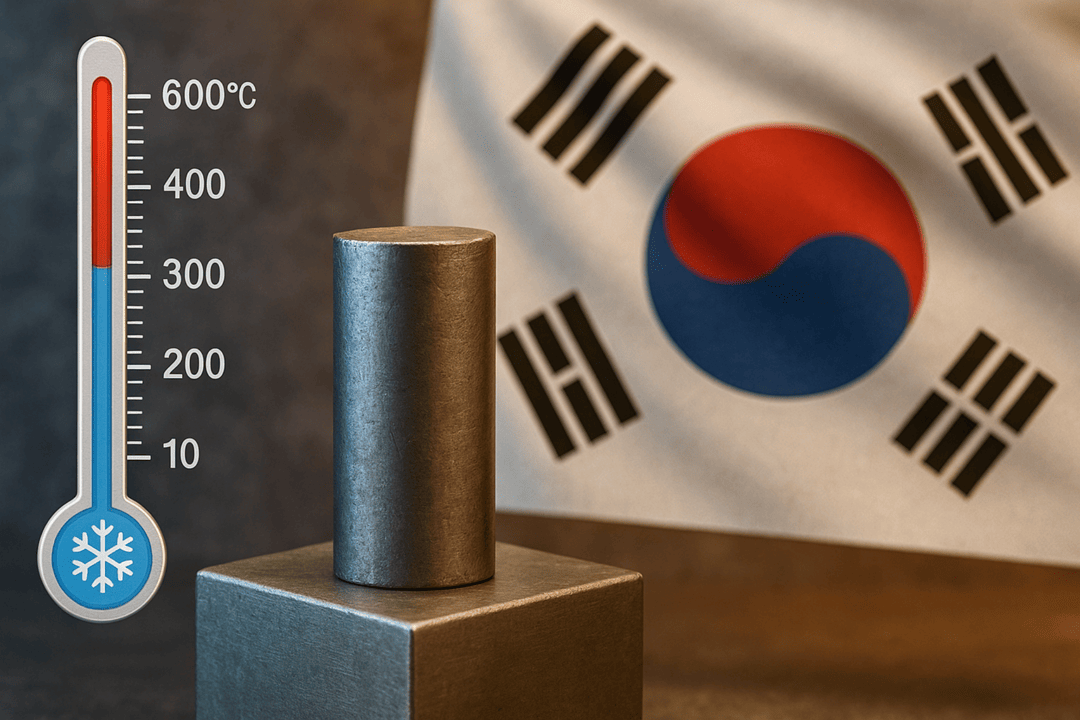
Advanced Material Combines Lightness and Thermal Resistance, Ideal for Extreme Environments and Cutting-Edge Technologies
A group of researchers from Pohang University of Science and Technology (POSTECH), in South Korea, has created a new type of super metal that withstands temperature extremes like never recorded before.
The material, a nickel-based high-entropy alloy (HEA), maintains its strength and flexibility from cryogenic temperatures of −196 °C to scorching 600 °C.
The discovery was announced through an official university statement, highlighting potential applicationss in sectors facing severe thermal conditions, such as aerospace, the automotive industry, and power generation.
-
They seemed like common bones, but scientists were surprised to find a relic over 12,000 years old that dates back to before the Bronze Age.
-
With an almost perfect ring of 70 km visible from space, known as the “Eye of Quebec” and over 100 km in length, the Manicouagan Crater in Canada reveals the colossal mark left by a giant asteroid and has become one of the most impressive formations ever identified on the Earth’s surface.

-
Scientists have found in China dinosaur embryos dating back 190 million years in various stages of development, and the discovery still preserves traces of extremely rare proteins in the bones, something that could change what is known about life before hatching.
-
The CEO of Honor in Spain says that smartphones will change with AI, foldables, and even robot phones; the component crisis is making cheap models more expensive in 2026 and shifting the focus to premium.

Material Adaptable to Extreme Temperatures
The new supermetal has been nicknamed “Hyperadaptor,” referencing its ability to adapt to different temperatures without losing performance.
The research team claims that this thermal resistance makes the material ideal for use in rocket engines, jets, power plant turbines, car exhausts, and industrial ducts.
According to Professor Hyoung Seop Kim, who led the project, the development represents a significant advance in the field of materials. “The Hyperadaptor concept represents a leap in the development of next-generation materials with consistent mechanical behavior, even under extreme conditions,” explained the researcher.
Limitations of Traditional Metals
Conventional metals often exhibit brittleness in the cold or loss of strength when heated.
This limits their application in environments with large temperature variations. For this reason, they are typically optimized to operate within a narrow thermal range.
The new alloy overcomes these limitations by exhibiting nearly constant performance at different extremes. It was designed based on high-entropy alloys, which differ from traditional metals by not having a single dominant element.
Instead, they are composed of five or more elements in similar proportions, leading to a more stable internal structure.
Nanoscale Reinforcements Ensure Performance
The stability of the new material is attributed to the presence of L1₂ nanoscale particles. These structures reinforce the alloy, preventing its deformation.
Scientists explain that these particles are evenly distributed, helping the alloy handle thermal stress efficiently.
“They act as reinforcements that inhibit deformation, while the internal structure of the alloy accommodates the stress through consistent sliding behavior, regardless of temperature,” noted the official POSTECH statement.
For Professor Kim, the results obtained so far demonstrate that the HEA created by the Korean team establishes a new standard for metallic materials. “Our HEA overcomes the limitations of existing alloys and establishes a new class of temperature-insensitive materials,” he stated.
Industry Interest Is Already Evident
The research has attracted attention from strategic sectors. The aerospace industry, for example, constantly seeks materials that can withstand extreme temperature variations during space and hypersonic flights.
The new alloy may provide an effective solution to this challenge.
In the automotive industry, components such as exhaust systems face high temperatures and can benefit from the stability of the new supermetal.
Additionally, sectors such as power generation and pipeline transport also operate under demanding thermal conditions and are natural candidates for using the material.
“The alloy’s ability to maintain stable performance under such conditions could greatly increase safety and efficiency in these demanding environments,” the team highlighted in the statement.
Global Competition in Supermaterials
The development of super-strong materials has been an area of intense study in various parts of the world.
Recently, Chinese researchers created stainless steel that became up to 10,000 times more resistant to fatigue.
In the United States, scientists developed a copper alloy capable of withstanding 800 °C for over 10,000 hours, without losing its mechanical properties.
These advances show a global trend in the search for materials that can revolutionize the performance of industrial systems, vehicles, and structures in extreme environments.
The supermetal developed by the South Korean team enters this scenario as a promising candidate for diverse uses—from the factory floor to space.






Seja o primeiro a reagir!