





 Portuguese
  English
  Spanish
  4 min of reading
  0 comments


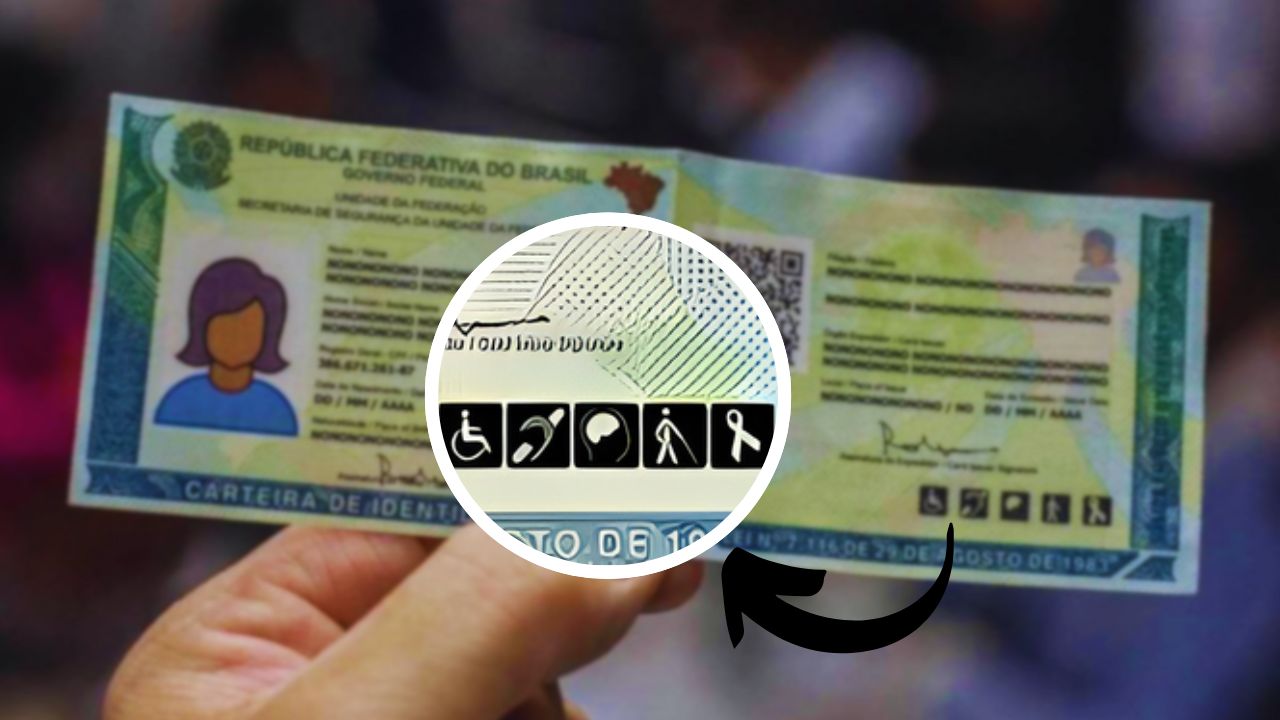
Discover What the Symbols of the New ID Are, Who Can Include Them, How to Request Them, and What Advantages They Ensure for People with Disabilities in the National Document.
The use of symbols on the new ID can transform the way people with disabilities are officially identified in Brazil. Since the National Identity Card (CIN) — also called the new ID — started being issued, citizens with physical, visual, auditory, intellectual disabilities, or Autism Spectrum Disorder (ASD) have had the option to include these letters, icons, or indicators directly on their identity cards.
The measure, which began to gain traction in state agencies and brought more visibility and accessibility to people with disabilities, has practical effects on services, queues, and proofs of rights in public and private services.
What Do the Symbols on the New ID Mean?
The symbols on the new ID represent specific conditions of people with disabilities and can appear alongside their identification data in the document, facilitating the recognition of their needs in different everyday contexts.
-
The noise law will no longer be in effect at 10 PM starting in June with a new rule valid during the 2026 World Cup.

-
The Chamber opens a debate on driver’s licenses at 16 years old as part of a reform that includes around 270 proposals to change the Brazilian Traffic Code and may redesign rules for licensing, enforcement, and circulation in the country.

-
The new Civil Code could revolutionize marriages in Brazil with “express divorce” and changes that could exclude spouses from inheritance.

-
Banco do Brasil sues famous influencer for million-dollar debt and intensifies debate on delinquency, risks of seizure, and direct impact on Gkay’s credibility.

These icons are designed to represent physical, visual, auditory, intellectual disabilities, or those related to Autism Spectrum Disorder (ASD), increasing the visibility of these conditions and ensuring rights provided by law.
For many, this inclusion symbolizes more than a visual mark: it acts as a way to facilitate priority access to services, reduce the need to present multiple documents, and promote social inclusion in everyday situations in offices and services.
Who Has the Right to Symbols on the New ID?
The inclusion of symbols on the new ID is intended for people who prove their condition of disability or special needs through reports and medical examinations.
In these cases, the presence of the icon in the document can help ensure rights such as priority service and accessibility in public or private services, without the need for multiple additional proofs in each situation.
Among the groups that can typically request the inclusion are:
- People with physical disabilities.
- People with visual or auditory disabilities.
- People with intellectual disabilities.
- People diagnosed with ASD (Autism Spectrum Disorder).
This possibility arises from the evolution of the identity card to a more inclusive model that allows differentiated forms of data representation in the national document.


How to Request the Symbols on the New ID (CIN)?
To include the symbols on the new ID, the citizen must follow specific steps in the agencies responsible for issuing the document, usually at the identification institutes in their state:
- Provide medical documentation proving the disability or special condition, including detailed reports, records, and the International Classification of Diseases (ICD). These reports must be issued by a qualified professional and contain complete information about the condition.
- Request the inclusion during the issuance or update of the National Identity Card (CIN) at the state identification office or online services when available. In some states, such as Paraná, the symbol inclusion service can be done online, without the need for in-person attendance.
- Attach the requested documents in the format accepted by the state systems, such as adequately sized images when the request is online.
Some states also facilitate the process by including symbols for autism, visual, auditory, and physical disabilities online, reducing travel and speeding up the issuance of the updated ID.
Regulation and Updates on the New ID
The new national identity model, which standardizes the identification number with the CPF and incorporates information such as symbols, was established based on a modernization of identity documents in Brazil.
It gradually replaces the old ID and seeks to centralize data in a single document recognized throughout the national territory, including both physical and digital versions.
With this standardization, the symbols on the new ID become part of a broader effort for social inclusion, ensuring that essential information is accessible and standardized for all Brazilians.
For people with disabilities, the presence of symbols on the national identity card can make a difference in their daily lives — from service in hospitals and public offices to access to transportation, cultural events, education, and job opportunities with specific policies.
With information from the website ND Mais.









-

-

-

-

-

-

18 pessoas reagiram a isso.