





 Portuguese
  English
  Spanish
 4 min of reading
  0 comments


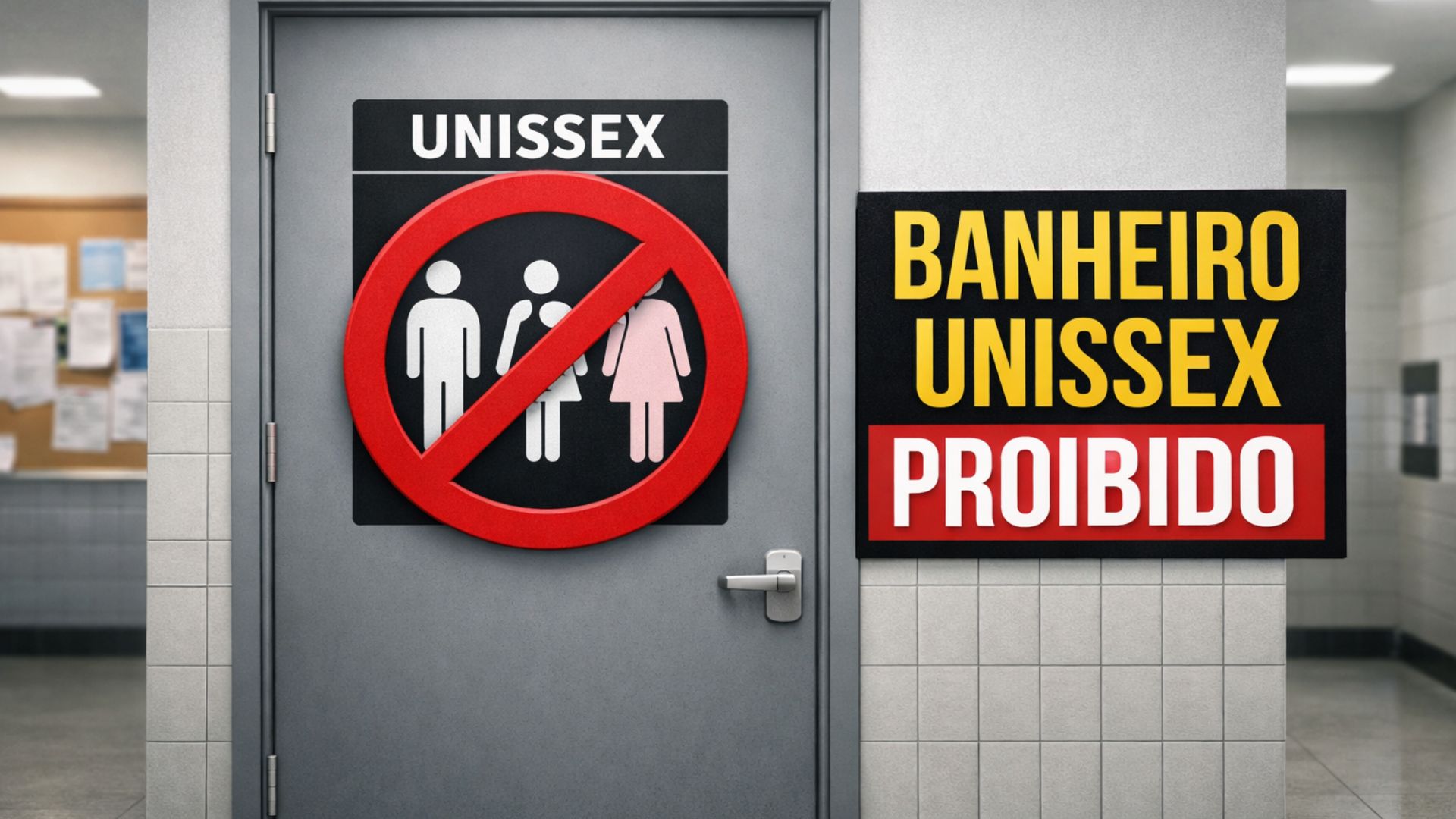
New Law Sanctioned in Santa Catarina Redefines Rules for Bathrooms, Locker Rooms, and Dormitories in Schools and Universities, with Short Adaptation Deadline and Provision for Recurring Fines.
The government of Santa Catarina sanctioned Law No. 19,686, which requires public and private educational institutions in the state to maintain at least one male and one female bathroom, prohibiting the common use of gender-neutral bathrooms.
The rule also applies to locker rooms and dormitories, where they exist, and provides for a fine of R$ 10,000 in case of non-compliance, with the possibility of monthly sanctions until regularization, as stated in the text published in the Official State Gazette on January 22, 2026.
The norm also establishes a deadline of 45 days for the institution to prove compliance and avoid being charged the penalty.
-
The noise law will no longer be in effect at 10 PM starting in June with a new rule valid during the 2026 World Cup.

-
The Chamber opens a debate on driver’s licenses at 16 years old as part of a reform that includes around 270 proposals to change the Brazilian Traffic Code and may redesign rules for licensing, enforcement, and circulation in the country.

-
The new Civil Code could revolutionize marriages in Brazil with “express divorce” and changes that could exclude spouses from inheritance.

-
Banco do Brasil sues famous influencer for million-dollar debt and intensifies debate on delinquency, risks of seizure, and direct impact on Gkay’s credibility.


From the first sanction, the text states that if there is no regularization within the period, new fines may be applied repeatedly and monthly until the issue is satisfactorily resolved with the regulatory body.
What Changes in the Bathrooms of Schools and Universities in SC
According to Law No. 19,686, schools, colleges, and universities with physical units in Santa Catarina must provide at least one bathroom for each sex, male and female.
The legal text prohibits the installation and common use of gender-neutral bathrooms within these institutions, affecting stages from basic education to higher education.
When the institution offers facilities for intimate use beyond restrooms, the prohibition extends.
Article 2 states that in units with locker rooms and/or dormitories, the installation and common use of gender-neutral locker rooms and/or dormitories are also prohibited.
The law comes into effect on the date of publication and provides for regulation by the Executive Branch.
Fine of R$ 10,000 and Deadline of 45 Days for Compliance
The text establishes that deliberate non-compliance with the requirements may result in a monetary fine of R$ 10,000.00.
Regarding the deadline, the norm states that the fine will not be charged when the institution proves compliance with the requirements within 45 days.
It further specifies that, within 45 days from the first sanction, the unit is subject to recurring and monthly sanctions until effective regularization and its respective proof.
Surveillance by Sefaz and Destination of Collected Money
The law assigns the State Department of Finance the responsibility for applying and collecting the penalty.
The text determines that the collected amounts be fully directed to the State Education Fund.
Exception for Individual Bathroom in Private Institution
The law creates a single express exception for the case of private establishments with only one bathroom.
According to the sole paragraph of Article 1, the prohibition does not apply when there is a single bathroom in which each person uses the space individually, with the door closed, preserving privacy, regardless of sex.
In practice, the rule differentiates collective facilities, which must be separated between male and female, from individual restrooms for exclusive use, which can be used by anyone when there is no simultaneous sharing.
Path of the Project in Alesc and What Those Involved Said
The proposal that gave rise to the law was presented in 2021 by state deputy Jessé Lopes (PL) and was processed in the Legislative Assembly of Santa Catarina (Alesc) until it was approved in plenary in December 2025, according to records of media coverage of the sanction.
During the process, the discussion went through committees and received amendments that included, for example, the prohibition related to locker rooms in educational institutions.
Upon sanctioning the norm, Governor Jorginho Mello (PL) stated that the initiative seeks to standardize rules and provide legal security to educational institutions.
In a statement released in reports on the topic, he said: “Our children and youth need an organized, safe school environment with clear rules. This law brings legal security for institutions and peace of mind for families in Santa Catarina.”
The text also faced criticism in the Legislative.
In accounts published regarding the analysis of the project, deputy Marquito (PSOL) was noted as opposed in committee, arguing that the measure “disregards official pedagogical guidelines and institutionalizes discriminatory practices.”
The processing of the topic, involving rules about spaces for intimate use and organization of school environments, generated debates and repercussions at various moments, with records of previous municipal discussions in the state on the subject, according to reports published after the sanction.









Seja o primeiro a reagir!