





 Portuguese
  English
  Spanish
  3 min of reading
  66 comments


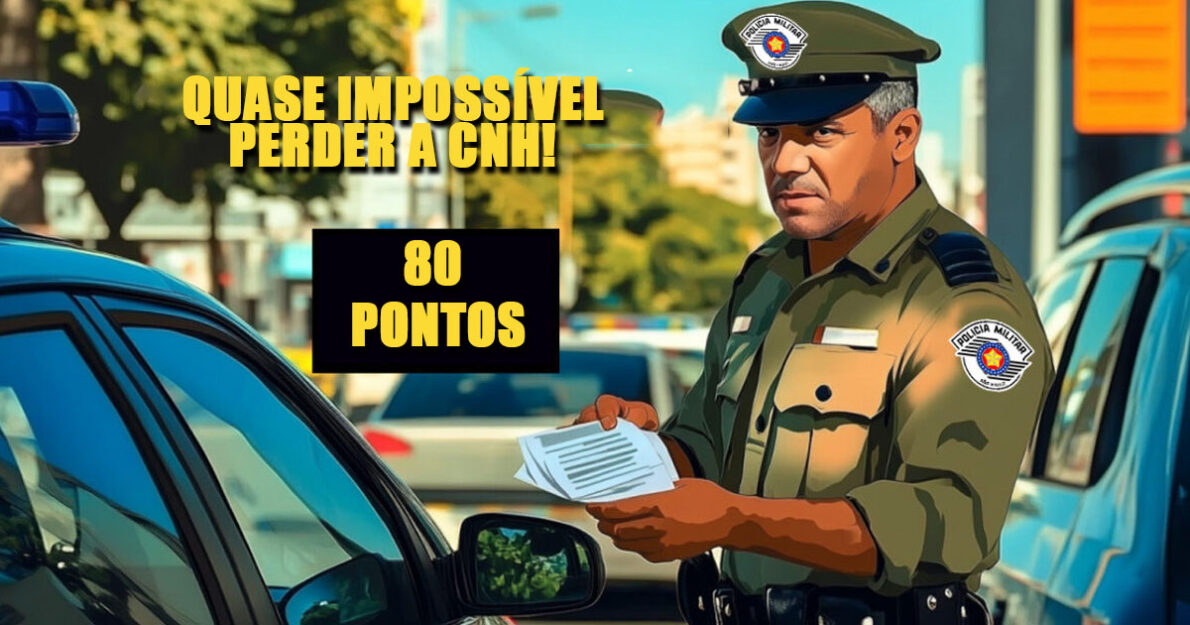

Law That Could Radically Transform Traffic Rules Is Under Discussion. The Measure Promises To Generate Controversy. Understand How This Change Could Affect Thousands Of Drivers And The Future Of Traffic In Brazil.
Imagine a scenario where losing the right to drive becomes a distant, almost impossible reality. This is exactly what a new bill proposes, which promises to shake up Brazilian traffic.
According to Bill 2002/24, presented by Deputy Carla Zambelli (PL-SP), the suspension of the right to drive for professional drivers will only occur when the driver reaches 80 points on their National Driver’s License (CNH) within a 12-month period.
This drastic change contrasts with the current rules established by the Brazilian Traffic Code (CTB), which provide for suspension in much more restrictive situations.
-
Honda performs miracles in fuel consumption with a hatch that marks 13.2 km/l in the city and 15 km/l on the highway, leaving Polo, HB20, 208, and Onix behind and becoming a reference among compact cars without resorting to turbo or hybrid systems.

-
China alone accounts for 70% of trade within the BRICS, while Brazil establishes itself as an essential supplier of food and minerals: understand how the group, which already represents nearly 40% of the world’s GDP, is changing the game.

-
Starting in May, those who do not have registered biometrics will not be able to apply for Bolsa Família, sickness benefits, or unemployment insurance: understand the new rule that changes access to benefits for millions of Brazilians.

-
Six diseases that seem common but can prevent the renewal of the driver’s license for the elderly throughout Brazil and surprise experienced drivers — could any of them affect you without showing clear signs?


Currently, the CTB determines the suspension of the right to drive for any driver who, in the period of one year, accumulates:
- 20 points if there are two or more extremely serious infractions;
- 30 points if there is one extremely serious infraction;
- 40 points when there are no extremely serious infractions.
Recertification Course And The New Reality Of Professional Drivers
Zambelli’s proposal also includes a preventive measure for drivers who accumulate 70 points on their CNH in a 12-month period.
In this situation, the driver may participate in a recertification course, thereby avoiding imminent suspension. As the deputy argues, Brazil’s reality in terms of electronic surveillance has changed significantly since the CTB was established, justifying the need for adaptation.
Radars And The Vulnerability Of Professional Drivers
According to the deputy, the proliferation of radars on the streets, often installed without adequate prior study, puts professional drivers in a vulnerable situation.
She highlights that when the CTB was created, the few existing radars were located in notoriously dangerous areas, where enforcement helped reduce accidents.
Today, however, the reality is quite different, with radars spread everywhere, making it easier for drivers to accumulate the points necessary for license suspension.
Next Steps For The Bill In The Chamber Of Deputies
Bill 2002/24 still needs to go through several stages before becoming law. In the Chamber of Deputies, the text will be analyzed by the Committees on Transport and Traffic, and on Constitution, Justice, and Citizenship, in a conclusive manner. If approved, the bill will proceed to the Senate, where it also needs to be approved before going to presidential sanction.
Reflections On The Future Of Brazilian Traffic And The CNH
The proposal to raise the points limit for CNH suspension certainly raises important questions about traffic safety and the balance between punishment and prevention. Will this change benefit professional drivers without compromising road safety? Or are we facing a dangerous relaxation of traffic laws?







Provavelmente ela não teve amigos ou parente assassinado pelos criminosos a solta no trânsito. Provavelmente ela nunca viu vídeos mostrando do que eles são capazes de fazer e depois posar de vítima. Este é o Brasil. Eterno país do terceiro mundo. Eterno país da impunidade. E por isto os lixos do planeta correm pra cá.
Concordo que existam radares como medida de prevenção em determinadas vias.
Mas é visível o absurdo com a quantidade instalada como medida paliativa por projetos urbanos e vias mau feitos e com visão muito curta para o crescimento das localidades.
Sem se estender muito no comentário que muitos não passam de caça níqueis.
Eu mesmo faço um trajeto que passa por Capivari próximo a Tubarão, dois radares no sentido norte próximo de uma passarela em que a via é separada por blocos de cimento para divisão e contenção com grades por cima dos mesmos onde existem esses dois radares com distância de aproximadamente 200 metros um do outro, puro caça níquel.
Imaginem isso pelo resto do Brasil?. É uma arrecadação e tanto.
Acho justo, pois na atual situação só um lado ganha metendo a mso no bolso do brasileiro a todo momento!