





 Portuguese
  English
  Spanish
  5 min of reading
  82 comments


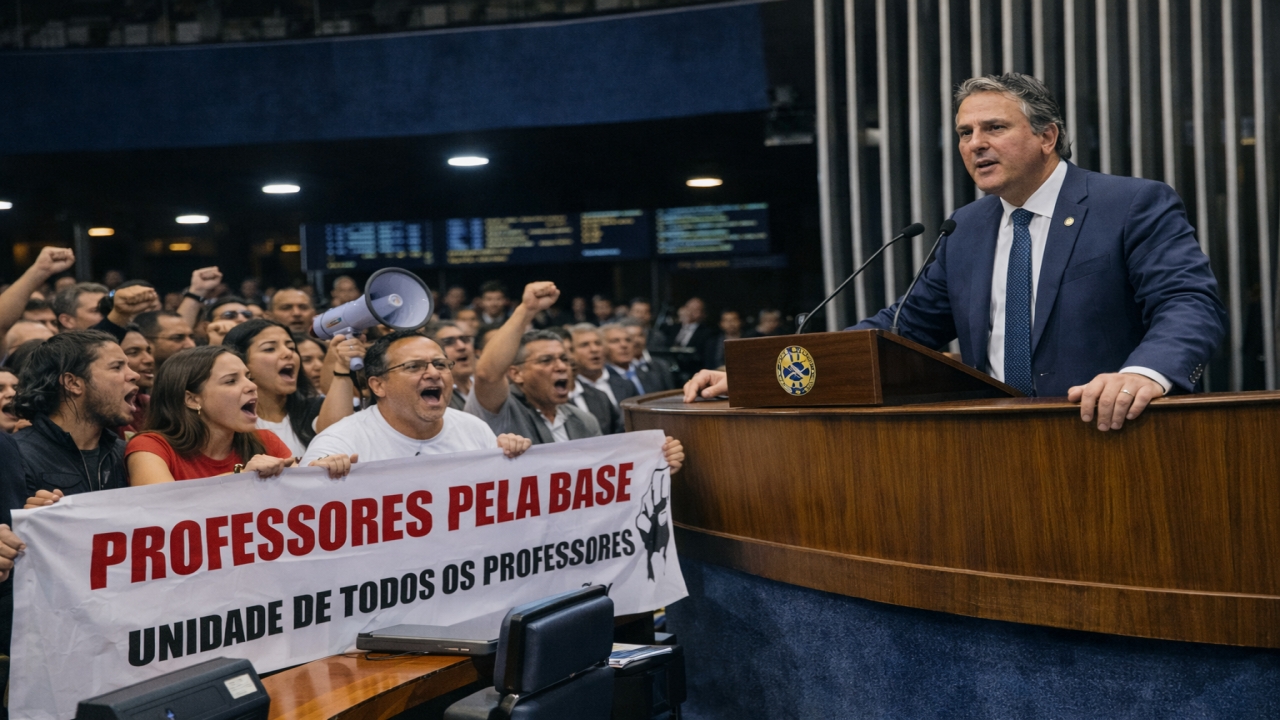


The MEC – Ministry of Education, promised to announce the new salary of teachers by January 15, but did not meet the deadline and created tension over the minimum wage for teaching 2026. Understand the impasse of the salary adjustment, the inflation, the Fundeb, the national wage and why the topic became a hot issue in the Senate.
New Salary for Teachers 2026 Stalled, MEC promised date and did not deliver! The new salary of teachers in 2026 became a matter of national urgency for a simple reason: theMEC (Ministry of Education) did not meet the deadline it set itself. Minister Camilo Santana indicated that the announcement of the salary adjustment for the minimum wage for teaching would be released by January 15, but the calendar turned, and to this day, January 18, 2026, the Government has not yet disclosed the new official percentage or the final formula.
The result was immediate: teachers, unions, and public managers went into “maximum alert” mode. And rightly so. Without a defined number, there is no real planning for payroll, careers, municipal and state budgets, and the tension only increases.
National Minimum Wage Is Not a Favor: There Is a Law and There Are Rules
The national minimum wage for teachers does not depend on political “goodwill.” It is guaranteed by Law No. 11.738/2008, known as the Minimum Wage Law.
-
“No one will make us change the Pix,” says Lula after the US report.

-
Lula responds directly to Trump and says that Pix is from Brazil and will not change under pressure from anyone, after a report from the United States pointed out the Brazilian payment system as an American trade barrier.

-
Amazon has just announced a new fee on all deliveries, and your online purchases will become more expensive starting April 17, including for those buying from the United States here in Brazil.

-
He sold his share for R$ 4 thousand, saw the company become a giant worth R$ 19 trillion, and missed the opportunity of a lifetime.


Today, the minimum wage is R$ 4,867.77 for a workload of 40 hours per week. This number is the starting point of the debate since any adjustment affects millions of contracts and the entire remuneration structure in public networks.
The Problem: Under the Current Rule, the Adjustment Would Be R$ 18
The crisis erupted because, following the current rule, the adjustment of the minimum wage for teaching for 2026 would be very low. The most talked-about projection was 0.37%, which would raise the minimum wage to around R$ 4,885.87, an increase just above R$ 18 per month.
This type of adjustment not only irritates the category but also fuels an old sentiment: that teaching work is always being pushed aside.
Inflation Enters the Conversation and Increases the Demand for Teacher Appreciation
Another point that weighed on the pressure was the inflation. Official data point to accumulated inflation of 4.26%. And this is precisely why Minister Camilo Santana indicated that the adjustment would not just be a “bare minimum” replacement, but a real increase above inflation.
If the adjustment remained at least at the inflationary level, the minimum wage would exceed R$ 5,000. However, without an official announcement, the promise hung in the air, and apprehension turned into outrage among many groups of teachers.
Fundeb at the Center of the Impasse: The Current Formula Became the Target
What holds everything back is the current calculation model linked to Fundeb. The annual adjustment traditionally uses the Annual Value per Student (VAAF) as a reference.
The problem is that this indicator can fluctuate widely: in some years, it spikes, in others, it stalls. And when it stalls, the teacher pays the price.
The Government’s “Plan” Behind the Scenes: Adjustment of 6.25% and New Rule
With the pressure mounting and the risk of a shameful adjustment gaining strength, the Government began to work on a solution: changing the calculation of the minimum wage.
The proposal being discussed in the Monitoring Forum of the minimum wage, coordinated by the MEC, is a hybrid criterion:
annual recomposition by INPC + 50% of the average real growth of Fundeb revenues (VAAF) over the past five years.
With preliminary data up to November 2025, the estimate pointed to an adjustment of around 6.25%, which could rise slightly with the December inflation.
If this index is confirmed, the minimum wage would go from R$ 4,867.77 to approximately R$ 5,160.84. This number changes everything: the “crumb adjustment” is out, and a real appreciation of teachers — at least on paper — comes in.
Provisional Measure by the End of January: Why Congress Gets Involved
The Government’s intention is to formalize the change through a Provisional Measure (MP) by the end of January. And this is where the reason the topic became a hot issue in Congress comes in: the MP has immediate effect, but it needs to be approved by the Chamber and the Congress to avoid losing validity.
The maximum processing time is 120 days. If it is not voted in time, the MP expires. In other words: it’s not just about “announcing the minimum wage.” It’s a political and technical dispute with the clock ticking.
States and Municipalities Hit the Brakes: “Who Pays This Bill?”
On the other side, states and municipalities, which are the direct responsible parties for paying salaries, monitor everything with tension.
They do not deny the importance of the adjustment. The problem is the financial impact. Municipalities claim fiscal difficulties and argue that the Union should provide more assistance, as many municipalities cannot absorb successive increases without cutting investments in infrastructure, materials, and services of their own networks.
And this is precisely where the discussion gets heavy: how to ensure a worthy adjustment for teachers without breaking local finances?
The Delay of the MEC Became a Symbol of Disrespect and Lack of Transparency with the Category
What ignited in January 2026 was this:
- under the old rule, the adjustment could be low and generate real loss;
- the Government signaled a change and real gain;
- the MEC promised a date (01/15) and did not fulfill it (by 01/18);
- behind the scenes, the alternative was a hybrid model via MP with an adjustment close to 6.25%;
- this pushes the debate to Brasília and, inevitably, to Congress.
So, do you think that the MEC and the Government will fulfill the promise of valuing teachers, or is this delay the beginning of yet another pushback? Leave a comment with your opinion and share this article with other teachers and managers to further the debate.









Bom dia não é fácil acrescentar algum valor no nosso orçamento doméstico, avalia o MEC sendo uma cascata de estados e municípios eu sou prof n interior da Bahia e prefeitura n deu aumento 2025 e me pagava no desdobramento de 40hs R$1.600 como o MEC e governo manda obriga gestores públicos cumprirem o valor se eles alegam n ter o valor é MEC X municípios fia uma guerra de braço UFC
Sou professor. Votei em Lula em 2022. Mas, este ano, não voto nele. Depois que ele entrou no governo, o piso salarial dos professores só caiu.
Falando abobrinha colega leia meu comentário acima
Se o salário dos políticos não teria essa seleuma toda né