





 Portuguese
  English
  Spanish
  4 min of reading
  0 comments



NIST Atomic Clock Reaches Precision of 19 Decimal Places and Ushers in a New Era in Time Measurement with Zeptoseconds. Understand How the Most Accurate Optical Clock in the World Works.
The science of time has just reached a new level. Researchers from the National Institute of Standards and Technology (NIST) have broken a historic metrological record by building the most precise atomic clock ever recorded, with a time measurement refined to 19 decimal places. This achievement places humanity on the scale of zeptoseconds, an advancement that redefines the limits of time measurement and paves the way for a new official definition of the second in the International System of Units (SI).
This level of precision is equivalent to measuring intervals as short as 550 zeptoseconds (0.00000000000000000055 s) — a scale one thousand times smaller than the already tiny attosecond (10⁻¹⁸ s). With this, the clock based on aluminum ions surpasses all previous technologies, including cesium-based models, which still uphold the official definition of time.
The Quantum Optical Clock Revolution
The new record holder belongs to the class of quantum optical clocks, devices that use light-based oscillators instead of microwaves, as is the case with traditional atomic clocks. Specifically, it uses a pair of aluminum and magnesium ions, trapped in an electromagnetic trap and kept under control by highly precise lasers.
-
The oceans are darkening all over the planet – what is happening?

-
An engineer designs a solar plane to fly on Mars at an altitude of 1,000 meters and a speed of 300 km/h, covering 16,000 kilometers in a Martian year, 900 times the distance traveled by the Ingenuity helicopter in three years on the planet before experiencing a rotor failure, and NASA is already funding the feasibility study.

-
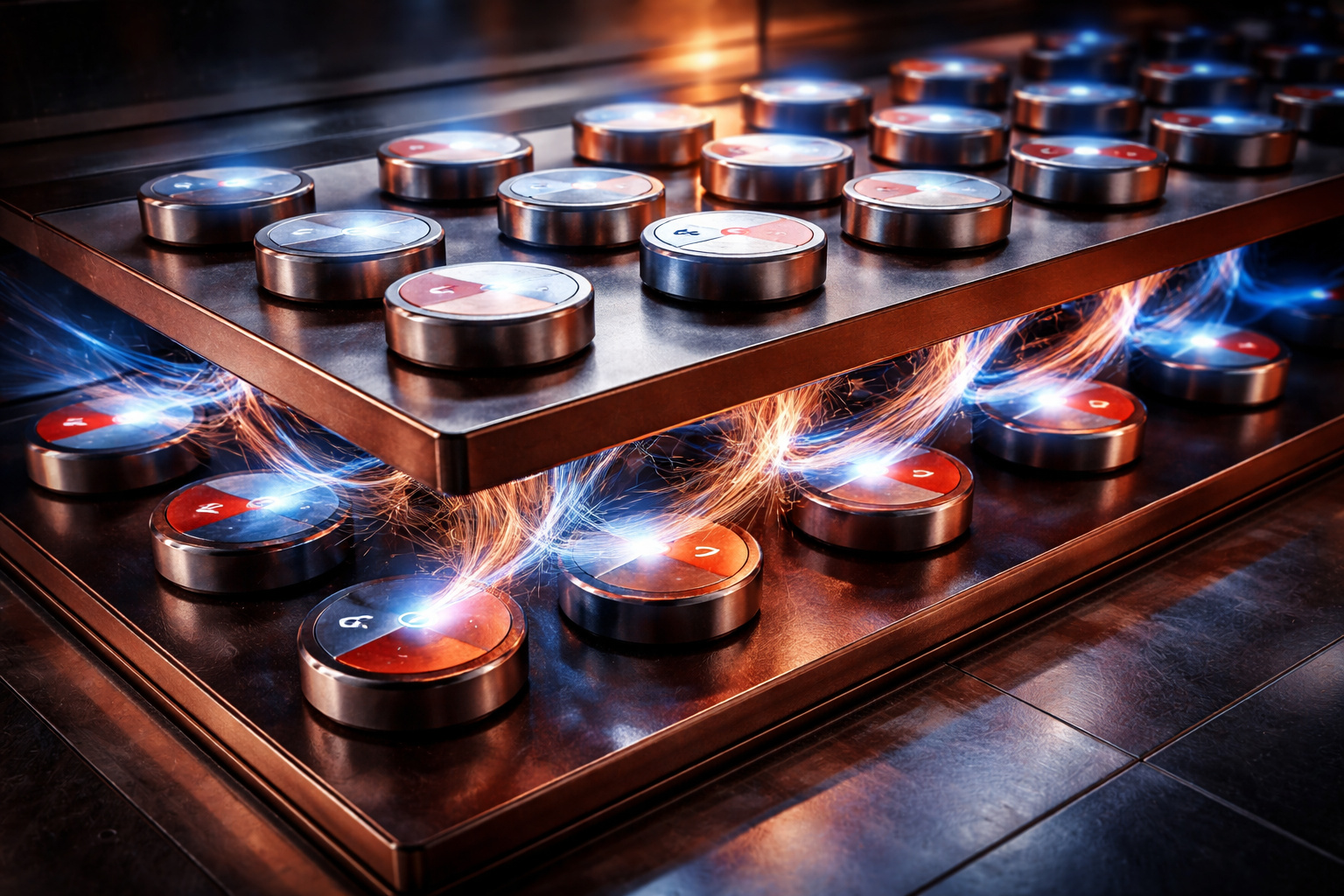
A new phenomenon of contactless magnetic friction intrigues scientists and questions a theory that has been valid since the 17th century.
-
An impressive phenomenon in Northern Brazil causes rivers of different colors to flow side by side, revealing secrets about sediments, currents, and biodiversity.


The secret lies in combining the exceptional stability qualities of aluminum — which is highly resistant to environmental interference — with the ease of manipulation of magnesium.
As aluminum is extremely difficult to probe directly, scientists employ a technique called quantum logic spectroscopy: the magnesium ion “translates” the ticks of the aluminum ion, allowing them to be read indirectly through synchronized movements of the two atoms.
This innovative approach has led the clock to achieve 41% more precision than the previous record holder and 2.6 times more stability than any other ion clock tested.
What Does It Mean to Measure Time with 19 Decimal Places?
To put it into perspective: the current definition of the second, based on the vibration of cesium atoms, has a precision of about 1 part in 10¹⁶. The new NIST aluminum-magnesium optical clock achieved 1 part in 10¹⁹, meaning that if it operated for 30 billion years (more than double the age of the universe), it would still have an error of less than 1 second.
The implication of this is not only technical but conceptual: with this precision, the redefinition of the second in the SI becomes not only possible but necessary. Institutions like the BIPM (International Bureau of Weights and Measures) are already studying the replacement of the current definition with one based on optical clocks, and the NIST model may become the main global reference for this change.
Practical Applications: From Earth to Fundamental Physics
The creation of a 19 decimal place precision atomic clock is not just a scientific milestone — it is also a leap for applications in areas that rely on precise time measurements. Among them:
- Relativistic Geodesy: the clock can detect small gravitational variations based on the time dilation predicted by the Theory of Relativity. This allows, for example, to measure the altitude of a point on Earth with millimeter precision using only time.
- Exploration of Physics Beyond the Standard Model: its sensitivity can help detect variations in the fundamental constants of nature — something that, if confirmed, would completely change our understanding of physics.
- Quantum Technologies: the precision of this clock can improve quantum communication networks, ultra-precise GPS systems, autonomous navigation systems, and even gravitational wave sensors.
An International Race for the New Standard
Although NIST is leading the way with this achievement, the global challenge to redefine the second is being closely monitored by institutions like NPL (UK), PTB (Germany), and NICT (Japan), all with their own models of ultra-stable optical clocks.
The common goal is to establish a new time standard that is universally accessible, replicable, and stable across generations, surpassing the limitations of cesium.


What makes the NIST clock even more impressive is the significant reduction in the time required to achieve its measurements: what previously took weeks can now be done in days — a crucial evolution for its large-scale practical application.
The Physics of Time Enters a New Era
The new 19 decimal place precision atomic clock is a kind of “microscope of time”. It allows scientists to observe previously inaccessible phenomena, opens new doors for metrology, and redefines our measurement standards for the coming decades.
While most people comfortably live with the time indicated by their smartphones or wristwatches, behind the scenes of science the concept of time has never been so in transformation. And with clocks like this, the next big revolution may not be in minutes or seconds — but in zeptoseconds.









Seja o primeiro a reagir!