





 Portuguese
  English
  Spanish
  6 min of reading
  0 comments


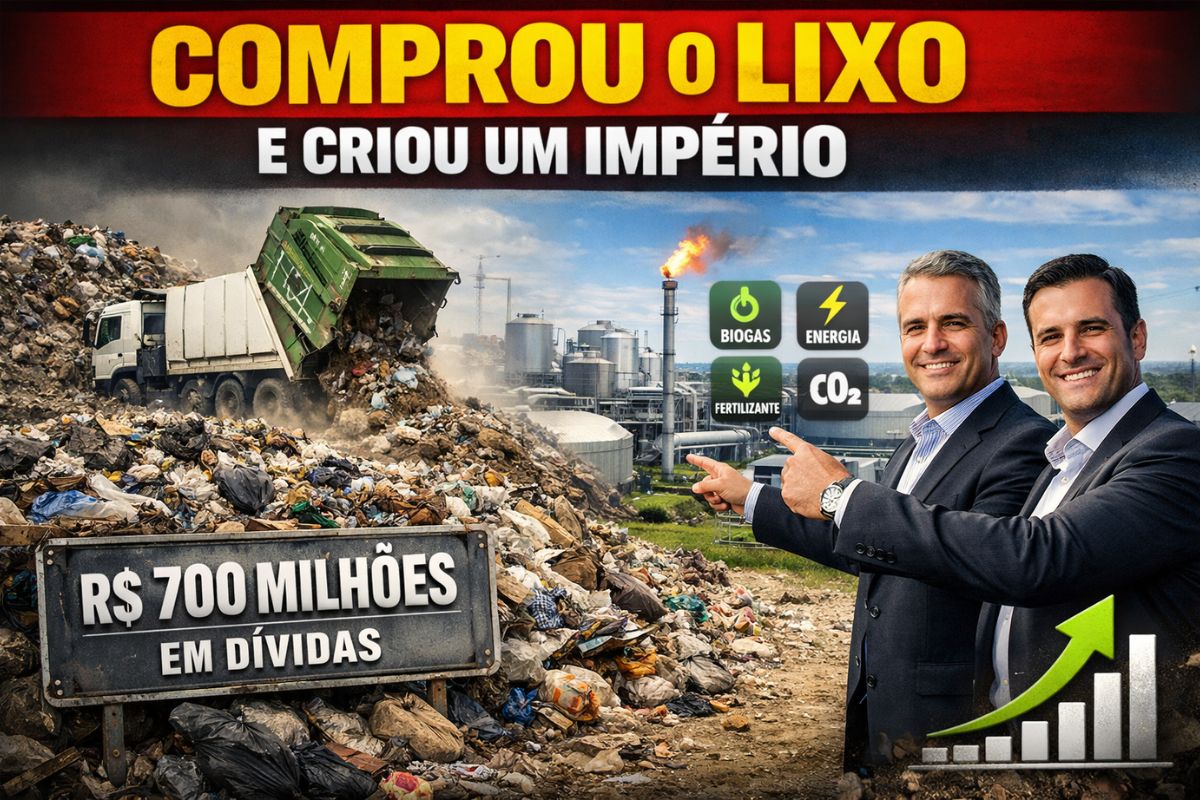
After Buying A Bankrupt Company With R$ 700 Million In Debts, They Created A Billion-Dollar Empire With Orizon Waste By Using Ecoparks And Waste Valuation To Turn Trash Into Energy In The Green Economy.
After buying a bankrupt company with nearly R$ 700 million in debts, two Brazilian entrepreneurs created a billion-dollar empire betting on something that nobody wanted: trash. While governments and municipalities saw only environmental liability, they viewed landfills as strategic assets capable of generating energy, fuel, fertilizer, carbon credits, and a new green economy.
By transforming dumps and landfills into industrial ecoparks, these entrepreneurs formed Orizon, a company that today receives millions of tons of waste annually and earns significantly in a market that seemed unglamorous. They proved that when trash is treated as a resource, it’s possible to create technology, scale, and profitability, effectively demonstrating how they built a billion-dollar empire on what the entire country was throwing away.
When The Trash From Brazil Became An Opportunity

The starting point of this story is an old problem known to every Brazilian. For decades, trash was treated as something to be hidden, pushed away from cities, and forgotten in open dumps, contaminating soil, rivers, and groundwater.
-
IPTU exemption for seniors in 2026: see how to secure the benefit.

-
The institute that trained the greatest aerospace engineers in Brazil has just opened its first campus outside São Paulo after 75 years: ITA Ceará will have R$ 445 million, new courses in energy and systems, and classes are expected to start in 2027.
-
Luciano Hang, owner of Havan, goes to Juiz de Fora after the tragedy in February, brings R$ 1 million, hands out R$ 2,000 cards, and donates up to R$ 15,000 to victims in the region.

-
The Brazilian passport allows legal residence in dozens of countries without the need for a prior visa, and most Brazilians are unaware that they can apply for residency directly upon arriving in nations in South America, Africa, and even Europe.


Even with the advancement of landfills, over three thousand dumps continued to operate in the country, maintaining a scenario of chaos and disregard.
For governments, this was a costly and recurring nightmare. For the population, an inevitable annoyance. For most companies, a sector without glamour, attracting little investment interest.
In this scenario, two entrepreneurs, already wealthy and with their financial lives settled, decided to make a move that very few would have the courage to make. They looked at Brazil’s trash and concluded that there was one of the most resilient businesses in the world.
Who The Entrepreneurs Behind The Turnaround Were
The first was Milton Pilão, heir and CEO of Pilão S.A., a company founded in 1955 and specialized in equipment for the paper and cellulose industry.
In the 1970s, Pilão developed a technology that revolutionized the preparation of paper pulp from short eucalyptus fibers, enabling Brazil to produce high-quality paper and export this technology to dozens of countries. After decades at the helm, Milton sold the company to an Austrian group and pocketed a fortune.
On the other side was Smar Machado Assali, former owner of Gomes da Costa, the largest canned seafood company in Latin America. He also sold the business, received millions, and could have retired comfortably.
Two experienced, capitalized entrepreneurs, at an age to slow down, decided to do the opposite: return to the game by betting on the most ignored sector in the country.
The Lecture That Changed Everything And The Focus On Waste
The trigger came at a high-level international conference, with names like George Soros and Bill Gates in the audience. There, they heard a summary that stuck in their minds: “The businesses of the future are three, water, energy, and waste.”
Back in Brazil, they began to study each one. Energy already had consolidated giants. Water and sewage required huge investments and were dominated by state-owned companies. Waste remained. What they discovered was shocking: the waste sector in Brazil was around 30 years behind what was seen abroad.
While abroad, trash was already being used to generate energy, biogas, fuels, and fertilizers, here the logic was still basically to collect, sweep, and bury.
They understood that if they bet on waste, they could be pioneers in a segment with a very high barrier to entry and permanent demand, the perfect ground for anyone wanting to create a long-term billion-dollar empire.
The Bankrupt Company With R$ 700 Million In Debts

The strategy seemed simple on paper. Bring waste valuation technology to Brazil, sit down with landfill owners, and propose partnerships to turn trash into value. In practice, they only heard “no.” Those with landfills were not selling or wanting to share. A landfill occupies millions of square meters, takes years to be licensed, and functions as a regional monopoly, with a lifespan of decades.
Then, Hastec emerged, a giant company in the sanitation and waste collection sector, with water, sewage, equipment manufacturing, collection, and, mainly, the landfills that Milton and Smar wanted. The problem: the company was bankrupt, disorganized, and buried under nearly R$ 700 million in debts.
Even so, they decided to buy the business that no one wanted to touch. They were called crazy, and rightly so. They were handing over a legacy built over decades in exchange for an indebted, confused company full of legal problems.
To make matters worse, just months after the purchase came the first blow, a lost arbitration of tens of millions of reais, further increasing the financial burden. But instead of backing down, they continued with the plan.
They sold non-strategic areas, cut costs, renegotiated debts, laid off employees, reorganized processes, and focused all energy on one front: transforming landfills into waste valuation ecoparks.
The Birth Of Orizon And The Logic Of Ecoparks
With the house minimally in order, a new name came as well. The old company was left behind, and the group became known as Orizon, with a stated focus on waste valuation. Starting in 2016, they began to implement within their own landfills a novel concept on a large scale in Brazil, the ecoparks.
An ecopark is much more than a fenced and organized landfill. It is an environmental industrial complex designed to extract value from practically everything that was previously buried.
In the same space coexist mechanized sorting units, biogas plants, biometane production, clean electric energy generation, manufacturing of fuel derived from waste, treatment of leachate that turns into reuse water, as well as facilities for organic fertilizers, material recycling, and generation of carbon credits.
In practice, what was once the end of the line for trash became the beginning of a chain of products and revenues. Municipalities and companies pay to send waste to Orizon.
From there, trash transforms into various revenue sources, from recyclables to energy and environmental credits. It was in this integrated model that they effectively created a billion-dollar empire on something that the country treated merely as annoying dirt.
How They Created A Billion-Dollar Empire With Trash

With the proven model, the numbers began to show the magnitude of the turnaround. In just a few years, Orizon began operating dozens of ecoparks in several Brazilian states, handling millions of tons of waste per year and directly or indirectly managing the trash of tens of millions of people.
The next step was to go public, in an IPO that valued the company in the billions of reais. Over time, the market value skyrocketed, annual revenue surpassed the billion mark, and profit began to reinforce the original thesis of the two founders.
These results did not appear out of nowhere. They are the result of a vision that understood that trash is a permanent flow, not dependent on trends, government, or current technological trends. Crises pass, technology changes, governments swap, but trash continues to arrive every day.
By dominating landfills and transforming them into value factories, the two entrepreneurs created a billion-dollar empire with recurring revenue, high predictability, and an environmental component that enhances the image of the operation itself.
Trash As A Resource, Not As A Shame
The main message behind Orizon’s story is simple and powerful. There is no trash, there are resources in the wrong place. When waste is dumped into landfills or buried indiscriminately, it becomes an environmental, public health, and image problem. When it enters an ecosystem of technology, management, and scale, it can become energy, fuel, raw material, fertilizer, and even carbon credit currency.
Milton and Smar were called crazy when they decided to bet everything on trash. In the end, they demonstrated that the true madness lay in ignoring a sector with guaranteed demand and enormous growth for decades.
By purchasing a bankrupt company and reorganizing everything around the landfills, they created a billion-dollar empire that is now a reference for Brazil’s new green economy, helping solve a historic problem while generating profit and positive impact.
And you, after learning this story, do you think you would have the courage to bet your assets on a bankrupt company to try to create a billion-dollar empire on top of the trash that everyone ignores?





-

2 pessoas reagiram a isso.