





 Portuguese
  English
  Spanish
  4 min of reading
  0 comments


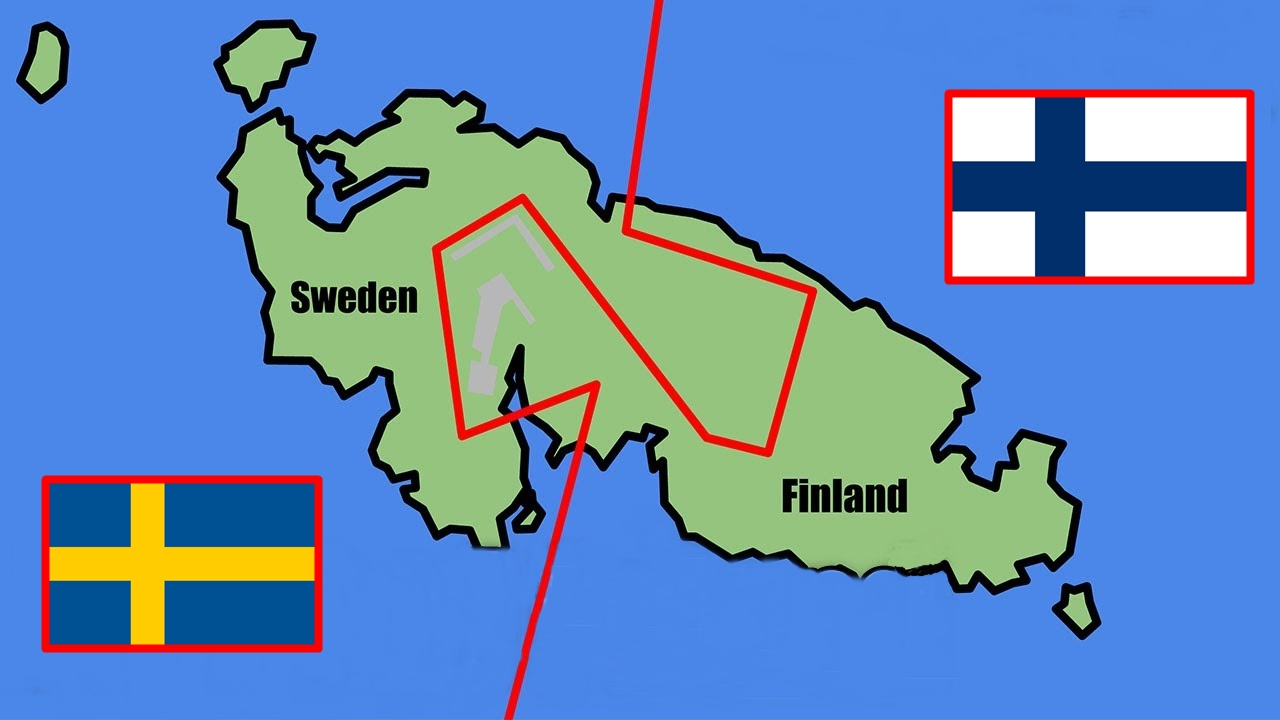
Discover The Smallest Island In The World Divided Between Two Countries And Learn About Its Unique Border And Fascinating History.
Between Sweden and Finland, in the Baltic Sea, there is a small island that defies the logic of international borders. Märket Island, with only 3 hectares, has one of the most peculiar territorial arrangements in the world.
The border between the two countries forms a winding shape, almost like a folded origami design. But this unusual configuration did not arise by chance.
The History Of The Island
The story begins in the 19th century when Finland was still under the rule of the Russian Empire. In 1885, the Russians built a lighthouse on the island to prevent maritime accidents.
-
Trump’s tariffs reduced trade between the US and China by up to 30% in 2025, but China did not lose; it redirected exports, cut prices, and found new markets, while Southeast Asia grew by trading with both, and Europe was squeezed between the two sides.

-
Why U.S. federal judges have increasingly blocked decisions by Donald Trump and how this wave of injunctions is reshaping the limits of presidential power.

-
The US bombs Iran’s largest oil center and raises global tension after Trump’s explosive ultimatum with a threat of total destruction.

-
Eurasia Group, a group that has accurately identified the biggest geopolitical risks of the last 20 years, issues a new warning and states that the greatest danger of 2026 does not come from China or Russia, but from within the United States itself, and that the world’s greatest power is dismantling the global order it created on its own.
The problem was the location of the structure: it was erected in the part that was later recognized as Swedish territory. At the time, the area was considered no man’s land, and the construction did not raise major questions. Some believe that the Russians had strategic intentions, but there are no concrete records to confirm this theory.
After Finland’s independence in 1917, the question of the island’s border remained unresolved. Only in 1985 did the two countries decide to resolve the situation.
The goal was to divide the island fairly, without affecting fishing rights or the already established maritime boundaries. The solution was to draw a map that ensured an equitable division, with an irregular outline around the lighthouse.
Thus, Sweden and Finland each retained half of the island, preserving territorial and maritime balance.

The Island Today
Today, the island is uninhabited, and the lighthouse operates automatically. Despite this, Märket attracts visitors, especially amateur radio explorers.
There are no visible fences or barriers on the rock to mark the border. The only indication is drilled holes along the outline, marking where the division was defined.
The shape of the island changes over the years due to wave action. Therefore, Sweden and Finland conduct new topographic surveys every 25 years.
This monitoring ensures that the border remains balanced and that no country ends up with a larger portion of the territory. The outline may even change shape, but it always maintains the principle of fair division.
Other Islands Divided By Borders
Märket Island is not the only small island in the world shared by two countries. There are other curious divisions that deserve attention.
Koiluoto (Finland and Russia)
With about 5.5 acres, Koiluoto is located in the Gulf of Finland, near the land border between Finland and Russia. The region has several small islands, reefs, and islets, but Koiluoto stands out for having the international border passing through its territory.
Despite its small size, its division between two countries makes it a rare case. There are no records of disputes over this delimitation, but its position reinforces the phenomenon of small islands with shared sovereignty.
Hans Island (Canada and Greenland)
Hans Island, approximately 1/2 square mile, starred in one of the most unusual territorial disputes of the 21st century. Located in the Nares Strait, between Canada and Greenland (an autonomous territory of Denmark), the island was the subject of decades-long contention between the two countries.
For years, the governments held symbolic gestures of sovereignty, exchanging flags and even leaving bottles of alcoholic beverages on the site.
In 2022, Canada and Denmark reached an agreement to officially divide the island. The resolution ended the impasse peacefully and established a recognized border between the two nations.
Saint Martin / Sint Maarten (France and the Netherlands)
Unlike the other islands mentioned, Saint Martin / Sint Maarten is inhabited and receives a significant flow of visitors. Covering 34 square miles, the island is divided between France and the Netherlands. The northern part belongs to France and is known as Saint Martin. The southern portion, Sint Maarten, is an autonomous nation within the Kingdom of the Netherlands. The island has about 70,000 inhabitants and attracts millions of tourists annually. Despite the division, both sides share infrastructure and services, maintaining peaceful and collaborative coexistence.
Unique Borders And International Cooperation
The existence of these islands demonstrates that borders can be defined in various ways, often challenging conventional standards.
In the case of Märket, the solution adopted shows how diplomacy can resolve territorial disputes peacefully and rationally. In Koiluoto, the division occurs without conflicts, while Hans Island required prolonged negotiations to reach a consensus. Meanwhile, Saint Martin / Sint Maarten exhibits an example of coexistence between different administrations in a single territory.
Although small, these islands carry fascinating stories about sovereignty, diplomacy, and international cooperation. The way each one is divided reflects not only the negotiations between countries but also the need to adapt to geographical and historical circumstances.
Märket, with its peculiar outline, remains one of the most curious examples of this phenomenon. Its shape may change over time, but its essence as a symbol of diplomatic balance remains.









-

-

3 pessoas reagiram a isso.