





 Portuguese
  English
  Spanish
  6 min of reading
  2 comments




In The Nevada Desert, Ivanpah And Crescent Dunes Used 300 Thousand Heliosats, Solar Towers And Molten Salts At 565 °C To Generate Energy Even At Night, Becoming The Largest Concentrated Solar Power Complex In The US.
When we talk about solar energy, the most common image is that of flat, static photovoltaic panels producing electricity only while the sun is shining. But in the Nevada desert, a rare combination of technologies has led the country to test an alternative path: Concentrated Solar Power (CSP), capable of storing heat and producing electricity even after sunset. Between 2010 and 2018, the Ivanpah and Crescent Dunes projects, with support from the U.S. Department of Energy (DOE), the National Renewable Energy Laboratory (NREL), and private investors, became the largest set of CSP plants in the country, using over 300,000 mirrors, solar towers, thermal receivers, and molten salts at 565 °C to provide an alternative to natural gas during peak hours.
Next, a detailed explanation of how these projects work, their technical numbers, their challenges, and why the Nevada CSP model remains one of the boldest experiments ever made in renewable energy in the United States.
What Is Concentrated Solar Energy (CSP) And Why Was Nevada Chosen
According to documents from the NREL and DOE, CSP technology uses heliostats, mirrors that automatically move to follow the sun to concentrate solar radiation onto a receiver located at the top of a tower. This receiver transforms sunlight into heat, which can heat water, thermal oil, or molten salts.
-
A Canadian retiree creates a hydroelectric system on a real river, generating energy continuously throughout the day and demonstrating how the power of water can supply a house with stability even in a simple structure.
-
Solar Pyramid draws attention by converting solar energy into million-dollar savings and repositioning the City Hall of Curitiba as an example of innovation, sustainability, and intelligent use of public resources.
-
Petrobras reaffirms its commitment to the market and ensures that it will carry out the energy transition safely to maintain national sovereignty.

-
Researchers discover a possible hydrogen deposit of up to 46 million tons beneath an ancient coal basin, and the volume could exceed half of the entire global production.


The Nevada desert was chosen for three clear reasons:
- High Direct Normal Irradiance (DNI) — essential for CSP, unlike photovoltaics.
- Large flat areas available, without shading.
- Proximity to transmission lines connecting Nevada and California, where consumption is enormous.
With this, the state became a natural laboratory for testing the technology.
Ivanpah: 300 Thousand Mirrors And Three Thermal Towers In The Middle Of The Desert
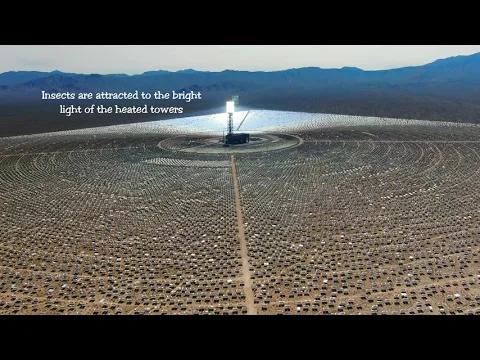

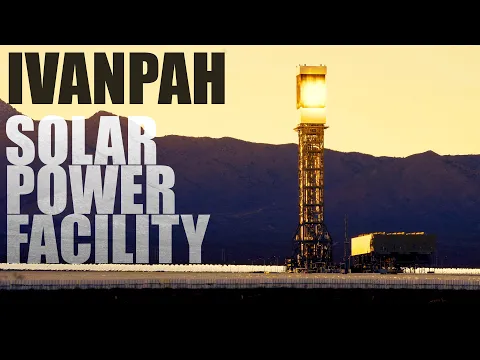
The first major component of this complex was the Ivanpah Solar Electric Generating System, built between 2010 and 2014 near the border between Nevada and California. According to reports from the DOE, the complex:
- Has 300,000 heliostats
- Features three solar towers 140 m tall
- Has an installed capacity of 392 MW
- Occupies approximately 14 km² of area
- Uses water to generate steam and drive turbines (traditional thermodynamic cycle)
Each heliostat adjusts its angle hundreds of times a day, directed by solar tracking algorithms. All the mirrors reflect light to the tops of the towers, where the receiver heats water to levels capable of generating superheated steam, driving turbines similar to those in conventional thermal plants. It is a model that replaces the heat from gas or coal with the heat of the sun.
The goal of Ivanpah was to test the feasibility of generating solar energy on a large scale during the midday hours, when industrial demand is high and natural gas tends to dominate California’s energy mix.
Crescent Dunes: When The Sun Powers Turbines Even At Night
If Ivanpah proved that CSP could generate steam directly, the Crescent Dunes Solar Energy Project, built between 2011 and 2015 near Tonopah, Nevada, sought to solve the more complex solar problem: storage.
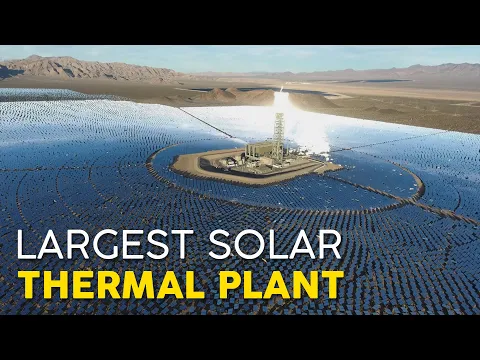
According to documents from the DOE and the responsible company, Crescent Dunes:
- Uses 10,347 heliostats
- Features one tower 195 m tall
- Has a rated capacity of 110 MW
- Uses molten salts at 565 °C for thermal storage
- Has a hot tank and a cold tank to manage the heat
- Was designed to provide up to 10 hours of electricity after sunset
This technology works like this: the mirrors reflect light to the tower’s receiver, heating sodium nitrate + potassium nitrate to temperatures close to 565 °C. The hot salt is stored, and when needed, its heat is used to generate steam and drive turbines.
It is the same principle as thermal energy but with the sun as fuel and integrated storage, something that conventional photovoltaics cannot do without batteries.
Molten Salts At 565 °C: The Heart Of Solar Thermal Storage
Molten salts are the most fascinating part of the system, as they function as a thermal battery. They have:
- High thermal capacity
- Low volatility
- Low cost per kWh thermal
- Long lifespan
According to the Sandia National Laboratories, this type of system can store thermal energy for over 30 years with minimal degradation.
This allowed Crescent Dunes to deliver electricity in the late afternoon — precisely when demand increases and conventional solar energy diminishes.
For the electric grid, this resolves the biggest renewable bottleneck: availability.
Why CSP Is So Different From Photovoltaic Solar
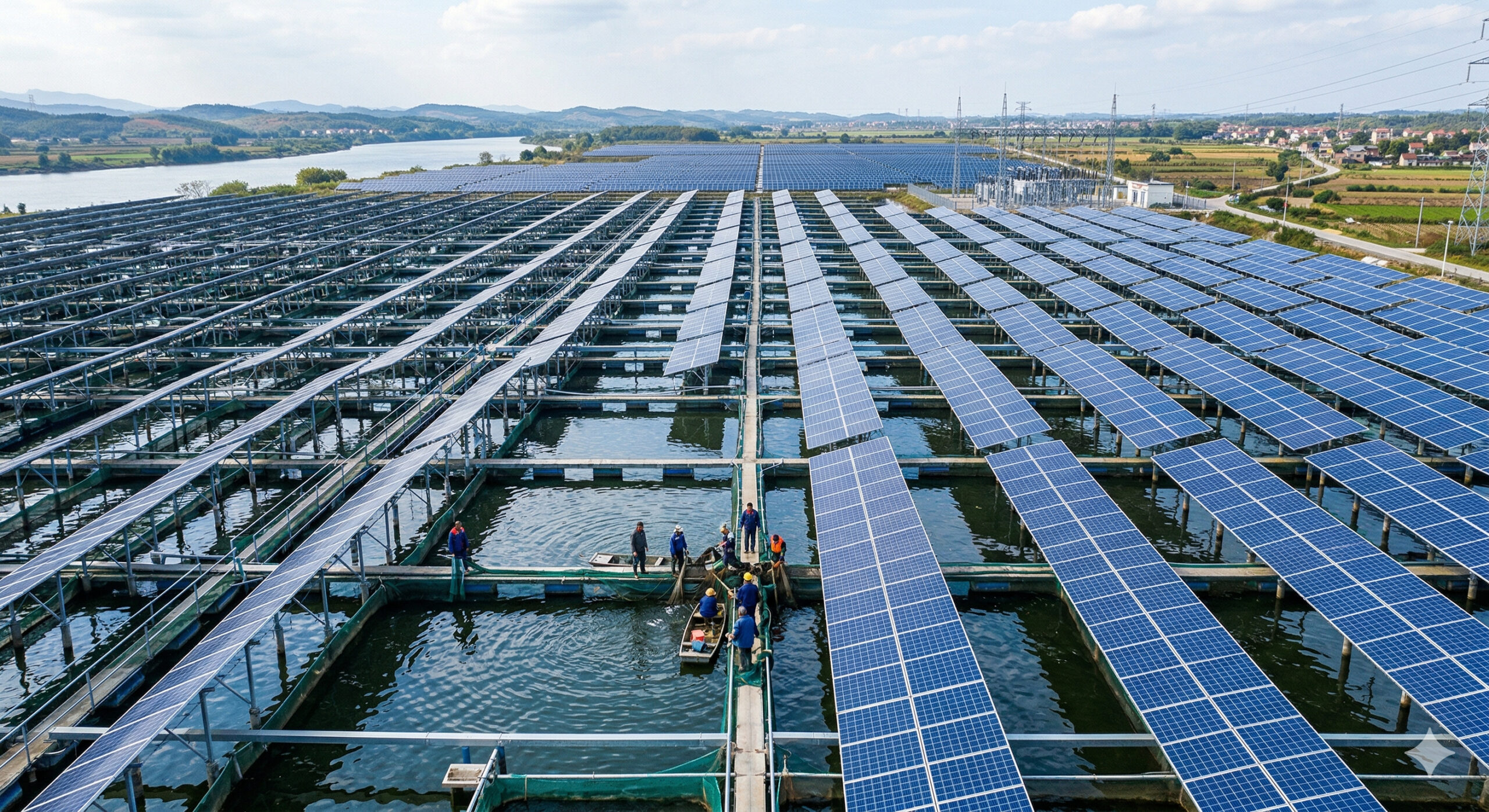
While photovoltaics (PV) convert photons into electrons instantaneously, CSP converts the sun into heat, then heat into mechanical energy, and mechanical energy into electricity. It is a cycle similar to that of thermoelectric plants, nuclear plants, and gas turbines.
The strategic advantages:
- Can store energy for hours without batteries
- Can produce at night
- Can provide dispatchable power, aligned with consumption
- Uses well-known thermoelectric infrastructure
The main limitations:
- Needs direct sunlight (no clouds)
- Requires lots of area
- Has high initial cost
That’s why Nevada is ideal and cloudy cities are not.
Power, Consumption And Integration With California
The strategic goal of these projects was singular: to provide renewable energy on a scale for the Californian market, which has aggressive decarbonization targets.
With 392 MW in Ivanpah and 110 MW in Crescent Dunes, the set surpassed 500 MW installed in CSP, something never done before in the U.S.
For comparison, plants of this scale can meet the demand of tens of thousands of households or relieve industrial demand during peak hours.
Environmental Impacts And Technical Learnings
The DOE and NREL highlighted three important learnings:
- CSP works at scale, but requires correct geographical planning.
- Thermal storage is viable and can compete with natural gas at critical times.
- Costs can fall with standardization, but adoption depends on gas and photovoltaic prices.
There were also ecological impacts and debates about local wildlife, especially birds, since thermal towers can create zones of hot air. Environmental studies have been conducted over the years and mitigators have been implemented.
What Worked, What Didn’t And What Left A Legacy
- Ivanpah showed that large CSP plants can operate continuously and participate in the energy market.
- Crescent Dunes proved that thermal storage with molten salts works on a commercial scale.
But there were also challenges:
- Demand drops
- Competition with photovoltaics + batteries
- High initial costs
- Operational issues with the Crescent Dunes receiver at the beginning of operations
The market changed significantly: between 2013 and 2020, the price of photovoltaics fell by more than 80%, and lithium-ion batteries became popular. This diverted the focus from CSP in the U.S., despite countries like Spain, Morocco, the United Arab Emirates, and China having expanded their parks.
The Future Of CSP And The Role Of Nevada In The Global Energy Map
Even with photovoltaic competition, CSP remains strategically interesting because:
- Stores energy at low cost per kWh thermal
- Operates as a firm plant, not intermittent
- Is capable of replacing gas-fired thermal plants during peak hours
Today, Nevada’s legacy extends to other countries, especially China, the Emirates, and Morocco, which already operate plants with multi-hour thermal storage, including Noor Ouarzazate (Morocco), one of the largest CSP complexes on the planet.
What Nevada proved is simple and historic: it is possible to use the sun as thermal fuel and deliver energy when the consumer truly needs it — not just when it is sunny.





Ótima iniciativa!
Bom Dia.
Energia CSP/Termo Solar
Tou Por Entender No Nosso Brasil,Onde a Mais Energia Solar Térmica,do Que F.V Solar, Até Então,Isso Não Ter Frutificado, e Com Uma Das Tecnologias,Das 4 Existentes,de Custo Mais Acessível e Com Armazenamento, Calha Cilindro Parabólico,Um Show!!
A Quase 3 Anos,Executaram Um Projeto Piloto de 1/2 Megawatts,Em Área de Uma Mega Usina Hidroelétrica,Porto Primavera,Estado de São Paulo,Na Divisa Com o Estado do Mato Grosso do Sul,Onde Inclusive a Outros Projetos Pilotos de Fonte FV Solar, Eólico,Etc e Pouquíssimo se Divulgou,e Falou se Sobre o Tema.
O Sistema Lá Implantado,Foi Calha Cilindros Parabólicas,Com Armazenamento,Com Sal Fundido.
Existe 3 Outros Projetos, No Papel, a Quase 08 Anos Em Petrolina, Pernambuco,Sob Responsabilidade da Chesf,de 1 Megawatts Cada,Sem Armazenamento,Torre Com Heliostatos, Até Então,no Papel.
Enfim,Esse Brasil de Muita Conversa e de Poucas Atitudes Práticas,Ainda,Prevalece.
Acompanhei Desde 2014 a Obra Da Mega Usina Termo Solar,Torre Com Helioestatos,e Com Armazenamento,Cerro Dominador,No Chile.Deu Trabalho,Parou Por Diversas Vezes,Ficou Com Custo Faraônico, Produzindo Apenas 110 Megawatts,Eregida No Deserto do Atacama,Dono da Melhor Radiação Solar do Mundo,Pela Altitude,
Podido o Nosso Brasil Buscar Uma Parceria,Fato Que Não Ocorreu,e Tão Pouco o Chile Ofertou Alguma Coisa!!
Enfim,América Latina e Do Sul,as Coisas Ainda Funcionam No Improviso!!
Emerson/Cuiabá MT/ Projeto de Responsabilidade SocioAmbiental,
“Consultoria Solar Cidadã” Vide You Tube,a Quase 2 Décadas.