





 Portuguese
  English
  Spanish
  6 min of reading
  6 comments


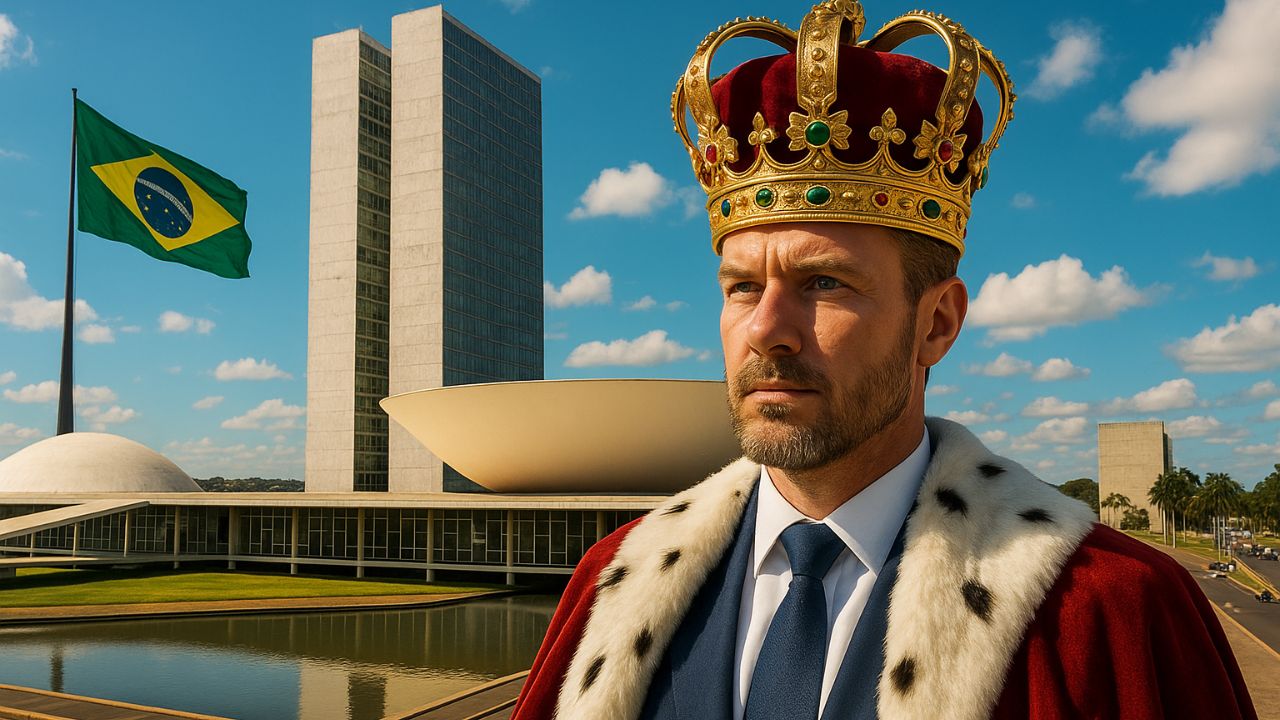


In An Alternative History Exercise, A Monarchic Brazil In 2025 Is Reimagined With Another Path For Education, Political Stability, And National Development
Have you ever imagined what it would be like to live in a monarchic Brazil in 2025? Instead of a republic, presidential elections, and cycles of upheaval, the country would have continued with emperors, dynastic succession, and a stable parliamentary system, similar to some European monarchies. In this alternative scenario, it is not about nostalgia or propaganda, but about exploring possibilities based on historical facts and comparisons with other countries.
This is an alternative history exercise, inspired by real trajectories of the Brazilian monarchy and examples from nations that retained their monarchs throughout the 20th century.
The idea is to imagine what might have happened if the proclamation of the Republic had not occurred in 1889 and if the country had evolved into a monarchic Brazil, constitutional and democratic, by 2025.
-
Iceberg A23a, one of the largest in the world, is undergoing accelerated collapse and may disappear: what explains the end of the ice giant?

-
The simplest swap at home can reduce energy consumption by up to 90% without changing habits, using a technology that lasts up to 25 times longer and consumes only a fraction of the electricity.

-
With over 14 million baskets of earth moved, an ancient North American metropolis built a monumental pyramid of 30 meters and established a city with 20,000 inhabitants nearly a thousand years ago.
-
A 1,900-year-old treasure emerges from a Roman house destroyed by fire and sealed since antiquity in Romania, with coins and metals fused among the ashes.

Monarchic Brazil In 2025: Starting Point Of The Alternative Reality

To understand this imaginary monarchic Brazil, it is necessary to go back to 1889. In our real timeline, the proclamation of the Republic was a military coup, without popular consultation, that overthrew the emperor and abruptly ended the Empire.
In the alternative reality, that November 15 would have been just another ordinary day, without troops on the move and without institutional rupture.
In this version of history, the reign of Dom Pedro II would continue until his death, and the transition of power would occur according to dynastic rules, not by military intervention. Instead of a new regime imposed by force, there would be institutional continuity, with the throne being occupied by the legitimate heir and the country gradually adjusting its political system.
Imperial Succession And Isabel’s Ascent To The Throne
From this point, the central figure is Princess Isabel. Instead of being removed by the end of the monarchy, she would take the throne as empress, ushering in a new phase of the Empire. The alternative timeline imagines Isabel as head of state from the end of the 19th century, continuing the legacy of Dom Pedro II.
In a monarchic Brazil in 2025, this succession would have advanced through several generations. The crown would have passed through different monarchs, culminating in a contemporary emperor or empress, prepared from an early age to act as a national symbol and figure of continuity. The role of this monarch would be primarily symbolic, while the day-to-day government would be in the hands of a prime minister chosen by parliament.
Education As A State Priority Over Generations
One of the points where this scenario would diverge the most from our reality is education. Dom Pedro II had a declared interest in the subject and viewed education as a central axis of progress.
If this emphasis had been maintained and deepened through imperial succession, education could have become the great long-term project of the Brazilian state.
In a monarchic Brazil, with institutional continuity and a focus on long-term policies, it is plausible to imagine a progressive expansion of public schooling, greater access to literacy, and encouragement for the training of teachers and researchers.
Comparing with countries that followed this path, the exercise suggests a country, in 2025, with very low illiteracy rates and a more established educational culture, the result of over a century of prioritization of the subject.
Economy, Industrialization, And Infrastructure In Continuous Line

Another central aspect of this alternative reality is the economy. The Empire was already flirting with modernization projects, railways, telegraphs, and support for industrial entrepreneurs.
If this movement had been maintained, Brazil could have anticipated part of its industrialization, investing earlier in integrated infrastructure, modern ports, a more robust railway network, and a diversified productive sector.
In this scenario, a monarchic Brazil in 2025 would have benefited from additional decades of long-term planning. Instead of cycles of discontinuity, coups, and abrupt changes in course, the economy would grow anchored in state projects, not just in the policies of governing parties.
The comparison with other economies that followed a stable trajectory helps visualize a more competitive country, integrated into international trade.
Parliamentary Monarchy And Political Stability
The significant difference, however, lies in political stability. The alternative history exercise considers that Brazil would have evolved into a parliamentary monarchy, a model in which the monarch reigns but does not govern.
The head of government would be a prime minister, chosen in parliamentary elections, while the emperor would be a symbol above party disputes.
In this context, there would be no presidency to be taken by coups, which would reduce the incentive for military ruptures. Political conflicts, changes of government, and crises would be resolved in parliament and at the polls, not in barracks.
Instead of successive institutional breaks, the country could have developed a continuous democracy, with party alternation, but with the crown as a pillar of stability. A monarchic Brazil in 2025, in this logic, would have a history with fewer dictatorships and more institutional predictability.
Territory, Diplomacy, And Brazil’s International Role
The imperial continuity would also affect how the country would position itself in the world. A stable state, with a consolidated monarchy and a stronger economy, could have played a more relevant role in international negotiations, including in the great wars and in the formation of multilateral organizations.
In diplomacy, a monarchic Brazil with a long parliamentary tradition would have built a reputation as a predictable country, with solid institutions and a consistent discourse over decades.
Although this scenario is speculative, it helps reflect on how political stability and long-term vision influence a country’s weight in the international arena.
Culture, National Identity, And Continuity Of Symbols
Another significant impact would be on national identity. The Republic replaced symbols, flags, and official narratives, breaking with part of the imperial memory. In an alternative path, a monarchic Brazil would have maintained and updated its symbols over nearly two centuries, creating a continuous thread between past and present.
This would not mean a country stuck in the 19th century. On the contrary, the exercise imagines a modern, connected, technological Brazil, but preserving ceremonies, rituals, and historical references as elements of cohesion. Just as occurs in other countries that maintained constitutional monarchies, the everyday life of citizens would be fully contemporary, while the monarchy would serve as a piece of memory and identity.
Limits Of The Exercise And What We Can Learn From This Hypothesis
It is essential to remember that this scenario of monarchic Brazil in 2025 is neither a prediction nor a defense of a regime, but rather a tool to reflect on the consequences of historical choices.
The 19th-century monarchy had serious problems, such as slavery and land concentration, that cannot be ignored. The point here is not to idealize the past, but to ask how this system could have evolved, with reforms and gradual democratization.
By comparing our timeline with this hypothesis of a monarchic Brazil, the aim is to better understand the impact of the rupture of 1889, the way the Republic was implemented, and the decisions that followed.
Thinking about alternative scenarios helps us see more clearly the choices that were made and their consequences in the present, without turning the exercise into a defense of one regime or another.
In the end, this type of reflection shows that the country we have today is the result of decisions made over a century ago and reinforces the importance of debating institutions, continuity, and long-term projects.
In your opinion, would a monarchic Brazil in 2025 be better, worse, or just different from what we have today, and which aspect do you think would change the most: education, politics, or economy?




Acredito que seria diferente, talvez estivesse entre os países mais desenvolvidos de regime monárquico, pois tudo o que o Brasil teve de desenvolvimento em infraestrutura, educação e saúde veio do período monárquico, no segundo reinado. A República surgiu de um sonho, idealista, porém refém daqueles que descontentes com o governo monárquico, queriam manter seus privilégios e a exploração e expropriação dos trabalhadores. Para isso, deram o golpe dentro do golpe, utilizaram -se dos militares e por diversas vezes essa elite atrasada, ****, mantém-se no poder, através de golpes políticos, de estado. O mais recente? Em 2016, misógino, e em 8 de janeiro de 2023, a tentativa de abolição violenta da democracia. Felizmente, o comando do Exército e pessoas inteligentes no governo, conseguiram fazer parar a ameaça, a tentativa de golpe. Por isso, a importância de se estudar e defender de forma intransigente a democracia e a soberania de um povo tão violentado como o brasileiro. Viva o Brasil, livre e soberano!
Seria uma tragédia e atualmente colhemos os efeitos de termos sido colonizados por um dos povos mais atrasados do planeta.
Teríamos um país com um nível de educação bem melhor. Onde tem pessoas mais preparadas há um país mais desenvolvido em todos os aspectos.
Qto a escravidão creio que ocorreria a libertação.
Hoje os pobres são escravos.
Não teriam tantos dominados.
Sem dúvida teríamos problemas, mas seria melhor pq educação é a base de tudo.