





 Portuguese
  English
  Spanish
 4 min of reading
  0 comments


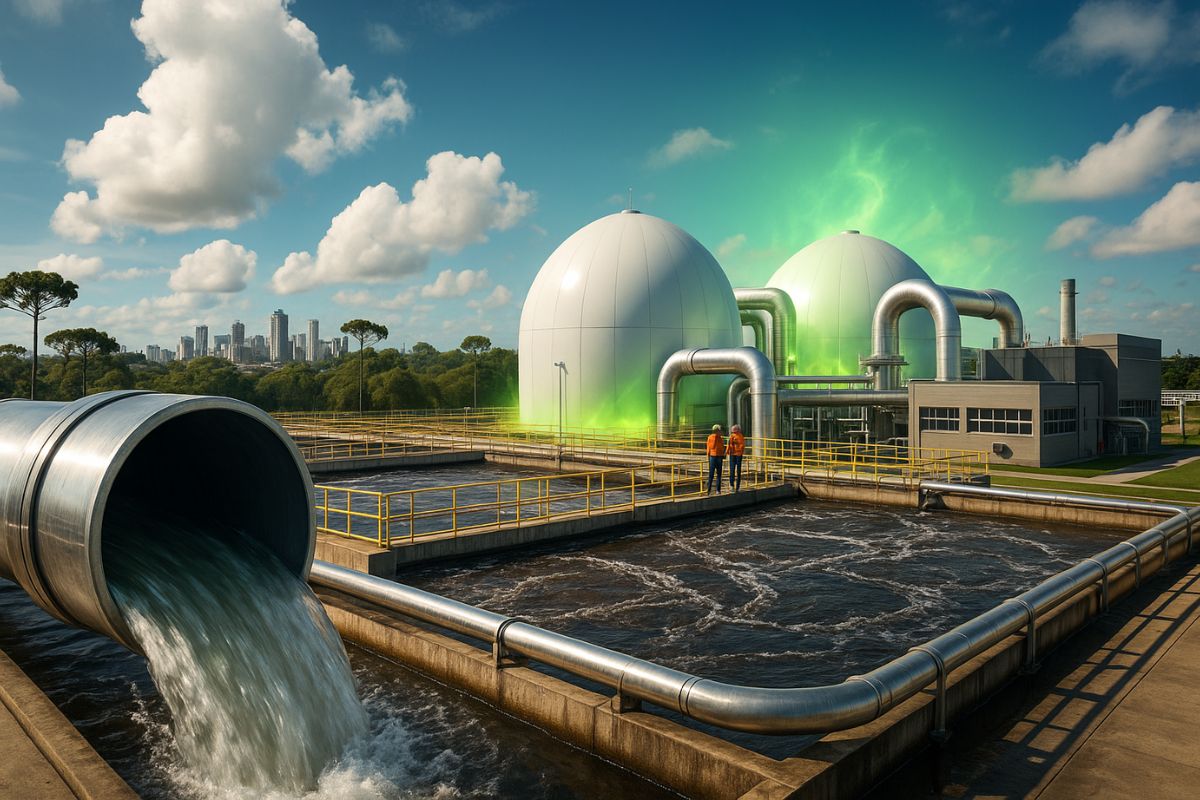
With an Investment of R$ 300 Million, Largest Sanitation Project in the South Modernizes Sewage Treatment at ETE Atuba Sul, Increases Capacity to 2,100 L/s and Converts Biogas into Energy to Serve 1 Million Residents
Curitiba is at the center of the largest sanitation project in the South, with the renovation and expansion of the Atuba Sul Sewage Treatment Plant, which increases from 1,680 to 2,100 liters per second. The investment of over R$ 300 million repositions the capital of Paraná on the sanitation map, enhancing sewage treatment capacity and ensuring service for about 1 million residents between Curitiba and Pinhais.
More than just increasing flow, the project of the largest sanitation work in the South aims to modernize processes, reduce environmental impact, and make the system more energy-efficient. The combination of new technologies, biogas reuse, and construction carried out without interrupting service turns ETE Atuba Sul into a real laboratory for advanced sanitation solutions for the country.
Capacity Expansion and Structural Reinforcement of the Station

At the core of the largest sanitation project in the South is the operational capacity expansion of ETE Atuba Sul, which rises from 1,680 to 2,100 L/s.
-
Neither the Pyramids nor the Great Wall of China, this gigantic construction in Spain is the human mark on planet Earth that intrigues the most when seen in images from space.
-
Surrounded by cliffs, mist, and chilling stories, the ancient Hotel del Salto has been reborn as a museum while still unable to shake off its reputation as a haunted place.

-
This star-shaped fortified construction, hidden near the border of Spain, may be the largest fortress on the planet.

-
Congonhas receives the monorail promised for the 2014 World Cup after more than a decade of delays and becomes the first airport in Brazil with integrated subway.

This increase allows Curitiba’s sanitation system to keep pace with population growth and urban expansion, reducing the risk of overload on networks and sewage treatment units.
To enable this expansion, new structures are being built alongside the existing operational station, avoiding service interruptions.
This strategy ensures that sanitation continues to function while tanks, treatment units, and pumping systems are modernized and resized for the new capacity.
Biogas Converted into Energy Within the ETE Itself
One of the technological differentiators of the largest sanitation project in the South is the energy utilization of the biogas generated during sewage treatment.
Instead of being simply burned or discarded, biogas is converted into electrical energy for internal use at the station.
This solution reduces dependence on external energy and lowers the operational costs of sanitation in Curitiba, while reinforcing the project’s sustainability.
By converting biogas into energy, ETE Atuba Sul reduces emissions, utilizes a byproduct of sewage treatment, and creates a more efficient cycle of resource use.
Thermal Drying of Sludge and Environmental Gains
Another significant aspect of the largest sanitation project in the South is the new thermal drying system for sludge.
The process significantly reduces the volume of waste generated by sewage treatment, facilitating transport, disposal, and, in some cases, allowing for sludge to be used as an alternative energy source.
With less volume and greater control, the environmental impact of sludge disposal decreases, paving the way for more advanced waste management solutions.
This stage complements the sanitation cycle, demonstrating how sewage treatment can generate reusable inputs and not just liabilities.
Engineering Work Without Stopping Sanitation
Executing the largest sanitation project in the South without interrupting sewage treatment requires meticulous planning.
The new units are being built in parallel, while the existing station remains active. This demands coordination between construction fronts, operation, and safety.
Advanced engineering methods are employed in the ground stabilization, movement of large structures, and installation of heavy equipment, without compromising the daily functioning of sanitation in Curitiba.
The result is a construction site that coexists with continuous operation, maintaining service to the population while the infrastructure is updated.
Impacts on Water Quality, Rivers, and the Neighborhood
By increasing the efficiency of sewage treatment, the largest sanitation project in the South directly improves the quality of the effluent returned to the environment.
Modernized systems allow for removal of more contaminants, odor control, and reduction of pollution risk in the rivers that receive the treated water.
For the neighborhood surrounding ETE Atuba Sul, the project includes specific odor and noise control solutions, improving urban perception around the station.
In practice, more efficient sanitation means less impact on watercourses, greater environmental protection, and tangible benefits for public health.
Curitiba as a Reference in Sanitation and Innovation
With the largest sanitation project in the South, Curitiba consolidates its position as a reference in sewage treatment management and technology use in the sector.
The combination of capacity expansion, biogas reuse, and process modernization creates a model that can be replicated in other Brazilian cities.
Beyond the numbers, the investment of R$ 300 million and the capacity of 2,100 L/s at ETE Atuba Sul represent a significant shift: a more robust sanitation system, prepared for the future, and more aligned with environmental requirements.
The expectation is that the project will generate technical learning, attract new solutions, and strengthen the agenda for quality urban infrastructure.
Thinking about your city’s reality, do you believe that sanitation projects like this in Curitiba should be a priority for public investments in the coming years?




-

Uma pessoa reagiu a isso.