





 Portuguese
  English
  Spanish
  5 min of reading
  17 comments


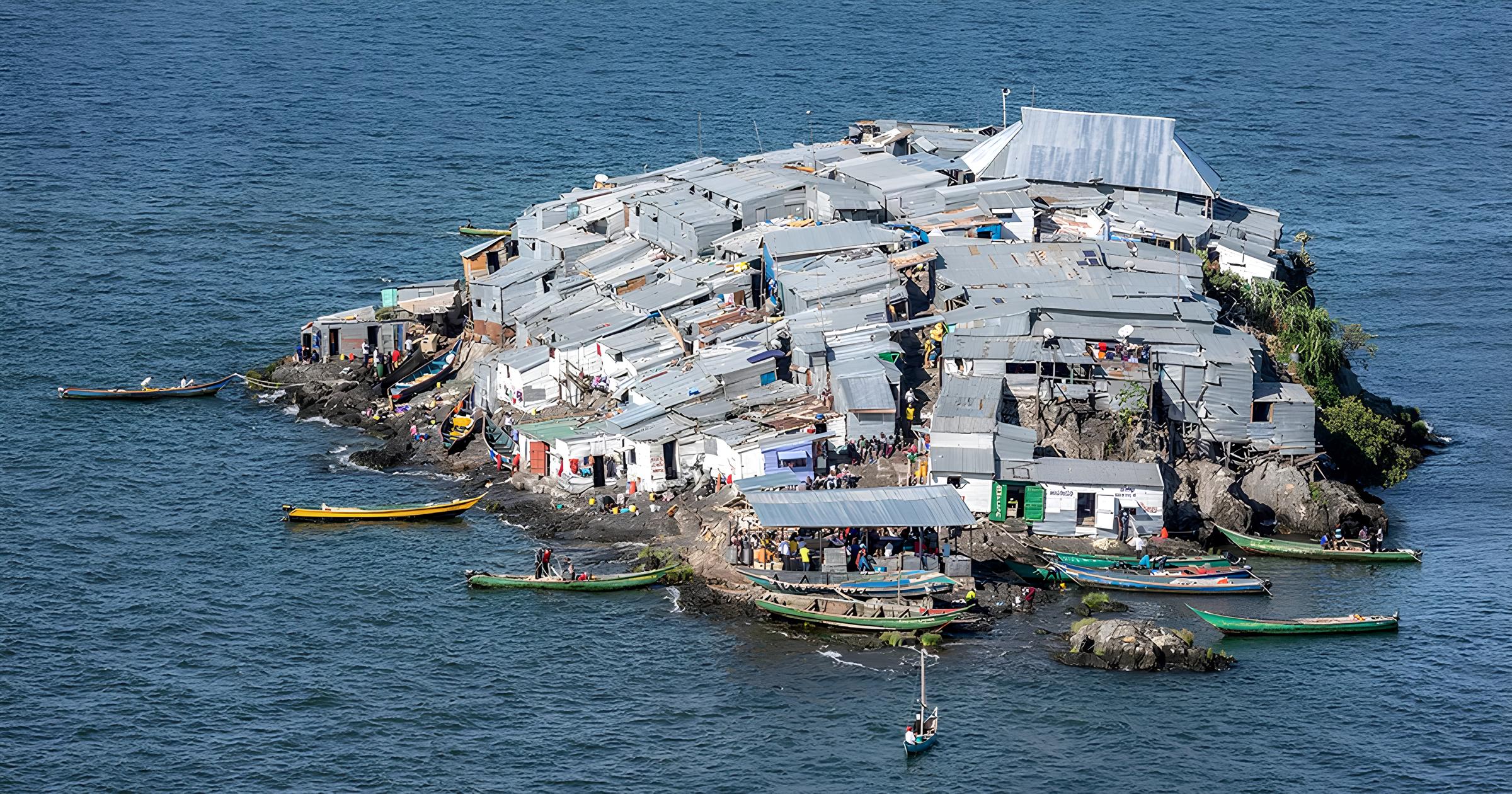


Migingo Island on Lake Victoria Has Less Than 2,000 m², Extreme Density, Territorial Dispute, and an Economy Based on Nile Perch Fishing.
Few people outside East Africa have heard of Migingo Island. Smaller than half a football field, this small piece of land on the western side of Lake Victoria tells one of the most astonishing human stories on the planet: an extreme population density, an economy based on high-value fishing, and a geopolitical impasse between two nations that still lack a definitive consensus on who truly owns that rock full of metal roofs and cramped buildings.
Migingo is not a metropolis, it is not a slum, and it is not an artificial experiment. It is a real case of human adaptation to a minimal space where life happens stacked, under the smell of the lake, amidst the sounds of boats, and under the shadow of a global fish market that generates millions of dollars per year.
The Extreme Geography of Migingo Island on Lake Victoria
Located in the largest tropical lake in the world, Lake Victoria, Migingo is positioned between Kenya and Uganda, near the axis where the political border crosses the waters.
-
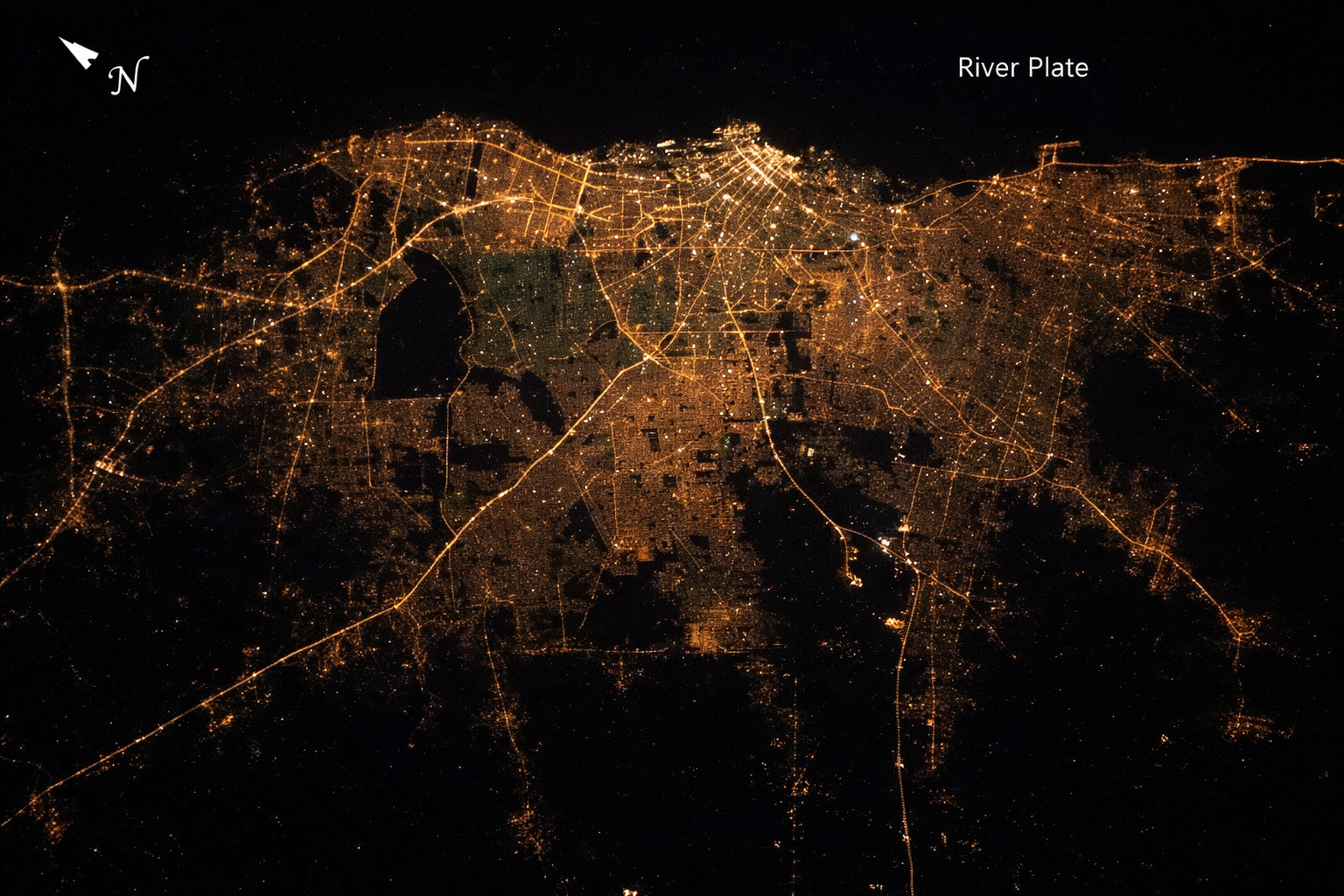
From space, Buenos Aires appears as a colossal spot of light surrounded by kilometers of darkness, revealing at a single glance the exact boundary between the metropolis and the countryside, seen from 400 km altitude.
-
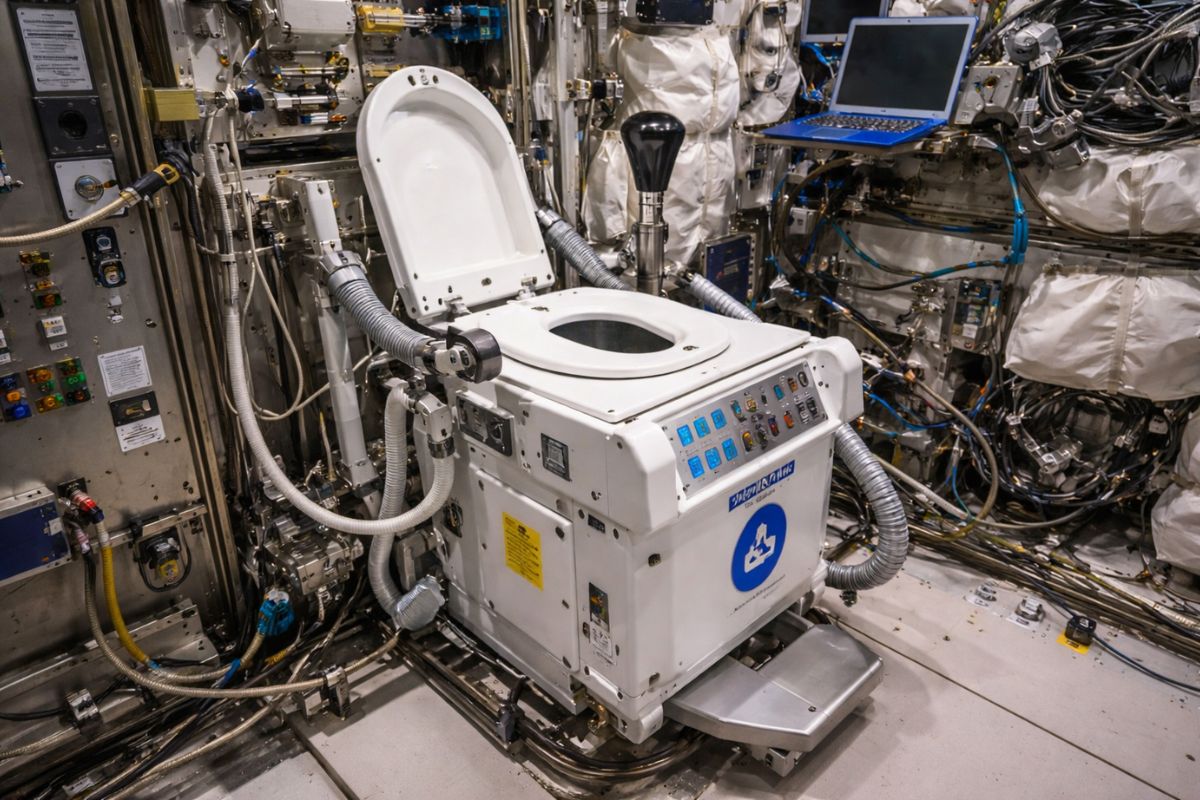
NASA spent over 118 million reais to build a single bathroom that works in zero gravity, and it has just gone to space on the first crewed mission to the Moon in more than 50 years.
-
Man never set foot on the Moon? 5 scientific proofs confirm that humanity has been there and definitively dismantle conspiracy theories.
-
The Brazilian Army will adopt humanoid robots to test the concept of future combat, says a website, surprising everyone, but later revealing that it was all just an allusion to April Fool’s Day.


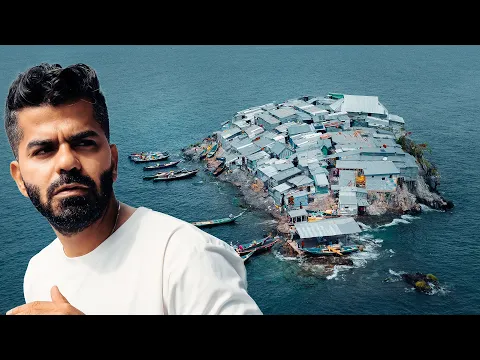
The island has about 2,000 square meters, or 0.002 km², equivalent to approximately 0.49 acres. For a concrete comparison, a FIFA football field can be over 7,000 m² — Migingo could fit inside it more than three times.

The topography is practically nonexistent: it is a rocky outcrop with short slopes and few flat areas. There is no significant vegetation, no deep soils, and no freshwater sources. Everything that exists there has been brought by humans: from the metal sheets of the houses to the generators that create constant noise after sunset.
The climate in the region is tropical humid, with heavy rains at some times and long clear periods at others. The lake plays a moderating role, preventing thermal extremes but also creating conditions conducive to waterborne infectious diseases.
A Territory Smaller Than a Condo, but With Record Density
Historical data from the early 2000s recorded about 131 inhabitants in Migingo. However, that number quickly became outdated.
Reports from journalists, researchers, and navigators who visited the island over the last decade indicate population fluctuations reaching 400 or even 500 people, depending on the fishing season.
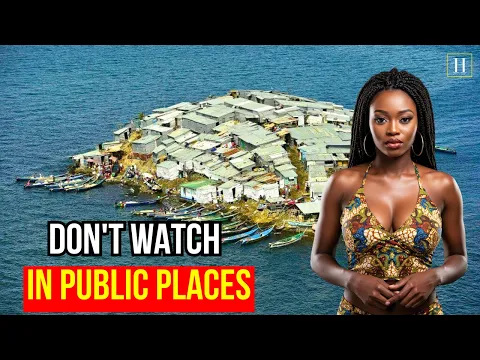
This means that at peak times, the density can exceed 65,000 inhabitants per square kilometer, a figure greater than that of megacities like Manila, Dhaka, or Hong Kong in their most crowded neighborhoods. In practice, this translates to having one resident for every 2 m².
The island has no streets, only narrow corridors between houses and establishments. There is no room for yards, squares, or trees. Vertical occupancy with two or three levels arose out of necessity, creating what some visitors describe as a “floating slum that doesn’t float.”
The Economic Engine: Nile Perch Fishing (Lates niloticus)
What brings so many people to such a small island is the same phenomenon that has transformed port cities throughout history: a valuable resource.
In the case of Migingo, that resource is the Nile perch (Lates niloticus), a fish species introduced to Lake Victoria in the 20th century, which completely transformed the ecosystem and the economy of the riparian countries.
The perch has become highly profitable for several reasons:
- it has white meat that is well-received
- it can reach large sizes
- it has a high export value
- it generates processing chains for cold storage and transportation
Eastern Africa has seen the emergence of factories focused on processing this species, and part of this meat is exported to Europe and the Middle East. As a result, fishermen from various regions began to migrate to strategic points in the lake, and Migingo emerged as a commercial hub.
The island concentrates:
- fish landing points
- ice depots
- bars and restaurants for workers
- makeshift pharmacies
- informal exchange houses
- small inns
Everything operates as an advanced base for extracting biological resources.
Territorial Dispute: A Piece of Rock Between Uganda and Kenya
Migingo’s geopolitical relevance expanded throughout the 2000s, when Uganda and Kenya began to claim ownership. The dispute is not about the land itself, but about the right to explore the waters and fish around it.
The lake does not have a simple delimitation; its borders were defined during the British colonial era, when maps were drawn with limited accuracy. As Nile perch catches increased, its strategic value grew.
The tension has included:
- police deployments
- tax collections by Ugandan forces
- diplomatic negotiations
- discussions about cartographic borders
Today, the dispute remains unsolved, but there is a practical understanding: much of the island’s population identifies as Kenyan, while part of the police and administrative operations has, over the years, had Ugandan presence.
It is a unique case where geography, biology, and economics collide directly with politics.
Daily Life on an Island Where Almost Everything Is Lacking
Another impressive aspect is that Migingo lacks:
- sewage system
- potable water supply
- public health system
- constant electricity
- any traditional urban infrastructure
Water needs to be brought in containers from the mainland or obtained through collection and boiling. Electricity comes from diesel generators, shared or private, which creates a constant noise until late at night and raises the cost of any operation.
Despite this, the island has:
- bars
- restaurants
- beauty salons
- barber shops
- small hotels
- supply stores
- makeshift pharmacies
Trade functions spontaneously and adaptively. Public security is minimal, but there is a kind of internal economic order, regulated by the need for coexistence and the episodic presence of police and regulatory forces.
Migingo as a Living Laboratory of Extreme Urbanization
Although apparently chaotic, the island has attracted the attention of scholars in fields such as:
- urban anthropology
- human geography
- fishing economy
- studies of internal migration
The reason is simple: Migingo represents an extreme case of how communities can form and sustain themselves in limited territorial conditions when there is a clear economic incentive.
It also raises relevant questions:
What will happen to Migingo if fishing in the lake declines? What will occur if the territorial dispute intensifies? Is it possible to minimally urbanize such a place? What happens when hundreds of people live in such a small space for decades?
There are no definitive answers because there are not many comparable cases in the world.
Migingo may never appear on lists of tourist destinations and will hardly be the subject of global debates, but its existence exposes something fundamental about the human species: we are capable of colonizing practically any space when the economic stimulus is strong enough.
In the age of large cities, skyscrapers, migrations, and competition for natural resources, the small island of less than 2,000 m² in Lake Victoria acts as a mirror for much larger tensions — tensions that have shaped and continue to shape the planet.
The question that remains is: how long will Migingo continue to be one of the most densely populated places in the world? The island’s future will depend less on its rocks and much more on what happens beneath the waters that surround it.





Eu que não comeria desses peixes!
Não fizeram comentários sobre o lixo que produz, qual o tratamento?
Is comércios tem AVCB (Auto de Vistoria do Corpo de bombeiros ?
Usam papel higiênico? Kkkkk