





 Portuguese
  English
  Spanish
  5 min of reading
  0 comments


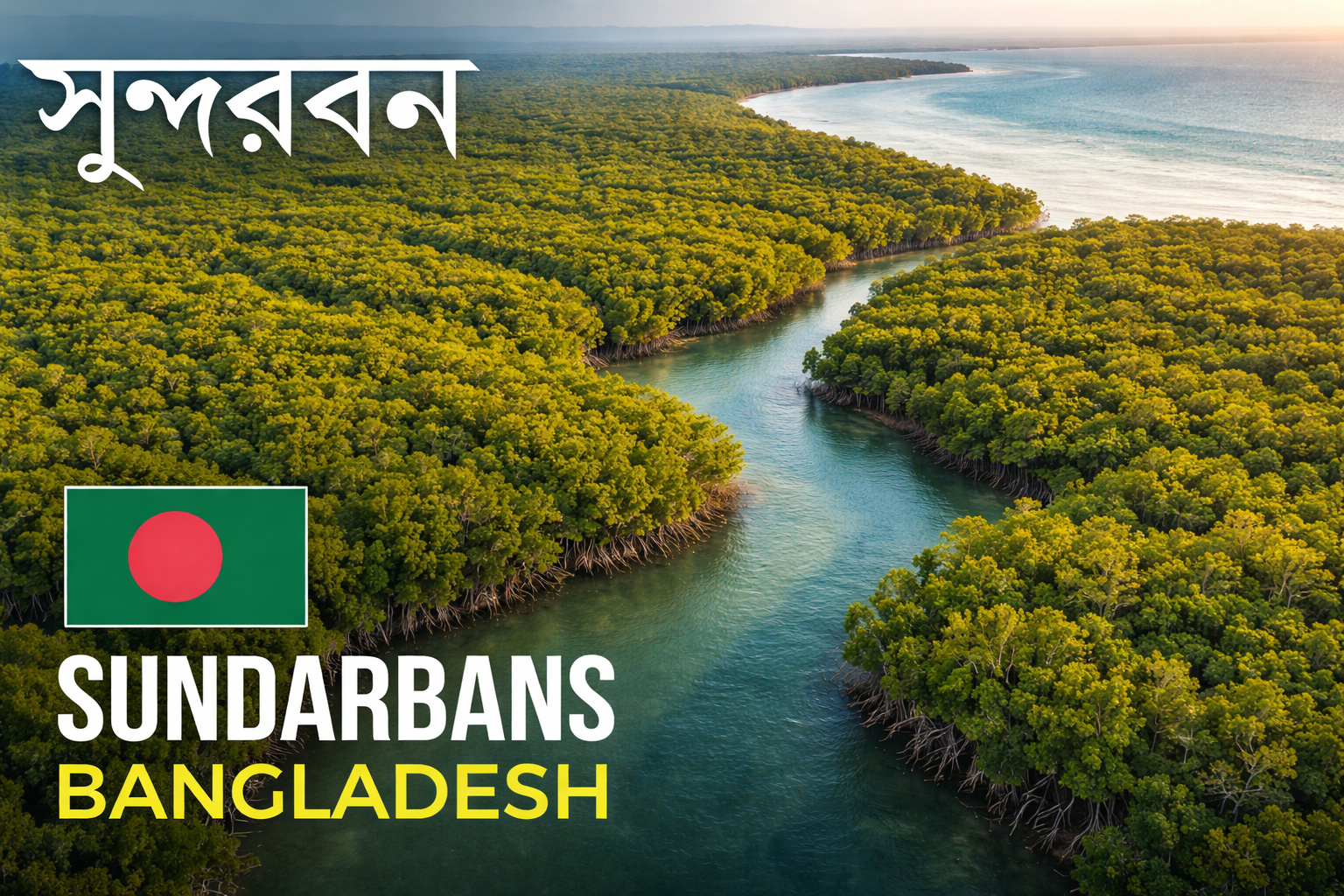
Bangladesh Created One of the Largest Natural Barriers on the Planet with Mangroves, Reducing the Impacts of Cyclones, Coastal Erosion, and Mass Deaths Along the Coast.
Sundarbans: Bangladesh is at the center of one of the largest environmental and natural engineering experiments ever conducted on a national scale. Located in the Ganges-Brahmaputra-Meghna delta, the country has over 710 kilometers of extremely vulnerable coastline, exposed to tropical cyclones, storm surges, rising sea levels, and accelerated coastal erosion. For decades, these conditions have turned the Bengali coastline into a synonym for humanitarian tragedy, with climatic events capable of killing hundreds of thousands of people in a single episode.
The response found was not purely technological or concrete-based, but biological, strategic, and surprisingly effective: the creation of an immense living wall formed by millions of mangrove trees.
Why Bangladesh Needed an Extreme Solution Against Cyclones and Sea-Level Rise
Bangladesh is among the most vulnerable countries in the world to climate change according to the IPCC. Much of the territory is less than five meters above sea level, and about 30% of the population lives in coastal or deltaic areas.
-
Tourists on Everest were poisoned by guides who mixed substances in food to provoke false symptoms of altitude sickness while helicopter operators and hospitals charged inflated rescue fees to insurance companies.
-
Few people know this, but Neil Armstrong, one of the most famous NASA astronauts in history, survived the Korean War after jumping from the plane during his seventh combat mission aboard the USS Essex aircraft carrier of the United States.

-
Diving with a camera in Lake Furnas reveals a submerged city with an entire street, almost intact houses, a preserved bridge, a wood stove, a Kombi, and even a bus at the bottom of the largest lake in the Southeast.

-
Iceland accidentally drilled into a magma pocket at 2,100 meters and revealed that the extreme heat beneath the crust could pave the way for a new source of continuous energy.


Between the 1960s and 1970s, cyclones like Bhola (1970) caused over 300,000 deaths, driven by storm surges that pushed dozens of kilometers inland.

The problem was not only the strength of the winds, but the volume of water pushed by the ocean during cyclones. Without natural barriers, tides invaded villages, destroyed crops, salinized the soil, and made entire regions uninhabitable for years.
Faced with the financial and technical impossibility of building concrete dikes along the entire coastline, the country bet on a solution based on the very dynamics of coastal ecosystems.
How Mangroves Function as a Natural Barrier Against Cyclones
Mangroves are not just ordinary trees. They form dense ecosystems, with intertwined aerial roots that create a highly efficient structure for dissipating energy. Scientific studies show that bands of mangroves 100 to 500 meters wide can reduce storm surge heights by up to 66%, as well as drastically decrease the speed of water and winds close to the ground.
In the case of Bangladesh, mangroves operate on three simultaneous fronts. First, they absorb the impact of the waves, reducing the extent of flooding.
Second, they retain sediment, combating coastal erosion that advances dozens of meters per year in some areas. Third, they act as a shield against extreme winds, protecting villages and agricultural areas just behind the green belt.
This effect is not theoretical. It has been measured during real events over the past decades.
The Sundarbans and Coastal Reforestation Projects
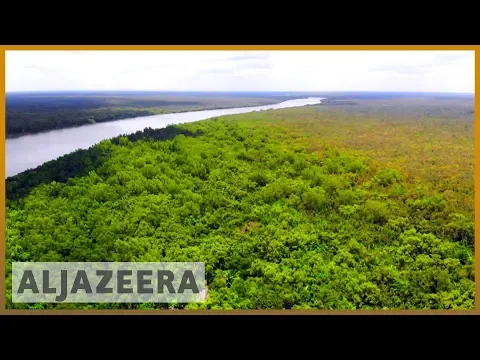
The largest symbol of this strategy is the Sundarbans forest, the largest continuous mangrove forest on the planet, covering about 10,000 square kilometers, shared between Bangladesh and India. In addition to housing the Bengal tiger and hundreds of species, Sundarbans serves as a true climate buffer.
After recent cyclones like Sidr (2007), Aila (2009), and Amphan (2020), official analyses showed that areas protected by mangroves suffered significantly less damage than regions where vegetation had been degraded.

In some locations, the difference was stark: villages behind preserved mangrove belts reported material losses, while unprotected regions were completely swept away.
In addition to preserving Sundarbans, Bangladesh has initiated continuous programs of artificial coastal reforestation since the 1960s, planting millions of mangrove seedlings on river islands, unstable banks, and areas newly formed by sediment deposition.
These projects, conducted by state agencies and supported by international organizations, have already created thousands of hectares of new coastal forests.
Proven Reduction of Mass Deaths Over the Decades
The most impressive data is not only in the landscape but in the human numbers. While the Bhola cyclone killed hundreds of thousands of people in 1970, cyclones of similar intensity in the following decades caused orders of magnitude fewer casualties.
Part of this reduction is due to alert systems and elevated shelters, but comparative studies indicate that mangroves played a direct role in diminishing the destructive power of storm surges.
Research published in scientific journals and World Bank reports indicate that regions with dense mangroves can experience up to 50% less mortality during cyclones compared to unprotected areas, even when socioeconomic factors are similar.
Economic Protection, Fishing, and Groundwater
In addition to disaster protection, mangroves generate long-term economic and environmental effects. They function as natural nurseries for fish, crustaceans, and mollusks, sustaining the artisanal fishing that feeds millions of people. They also help maintain water quality and reduce salt intrusion into subterranean aquifers, one of the greatest challenges of the Bengali coast.
In areas where mangroves have been restored, farmers report lower soil salinization and greater stability of agricultural lands, even after extreme climatic events. This creates a positive cycle: less forced displacement, greater food security, and reduced coastal poverty.
Why This Strategy Draws Attention from the Entire World
The case of Bangladesh has become internationally cited as an example of nature-based solutions applied at a national scale. Unlike rigid structures, mangroves grow, regenerate, and adapt to the gradual rise in sea levels, as long as they have space to migrate inland.
Economically, the cost-benefit ratio is compelling. Studies indicate that every dollar invested in mangrove restoration can generate between 5 and 10 dollars in economic benefits, considering damage reduction, infrastructure protection, fisheries, and ecosystem services.
Limits and Future Challenges
Despite the success, the model is not without challenges. Population pressure, urban expansion, pollution, and global warming threaten the health of mangroves. Furthermore, the accelerated rise in sea levels may surpass the natural adaptive capacity of these forests in some regions.
For this reason, Bangladesh combines biological strategy with land planning, restrictions on the occupation of critical areas, and investments in environmental research. The living wall does not completely replace other measures, but it has become the central axis of the country’s coastal defense.
When Trees Do What Concrete Cannot
The case of Bangladesh shows that, in certain contexts, ecological engineering can be more effective than traditional megastructures.
Millions of trees, planted over decades, now save lives, protect cities, stabilize the coastline, and offer a concrete response to one of the greatest challenges of the 21st century: living with a constantly advancing ocean.
In an increasingly exposed world to extreme climatic events, Bangladesh proves that sometimes the most powerful solution does not come from steel or concrete, but from a deep understanding of how nature works and how it can be an ally, not an enemy, of human survival.




-

-

9 pessoas reagiram a isso.