





 Portuguese
  English
  Spanish
  6 min of reading
  2 comments


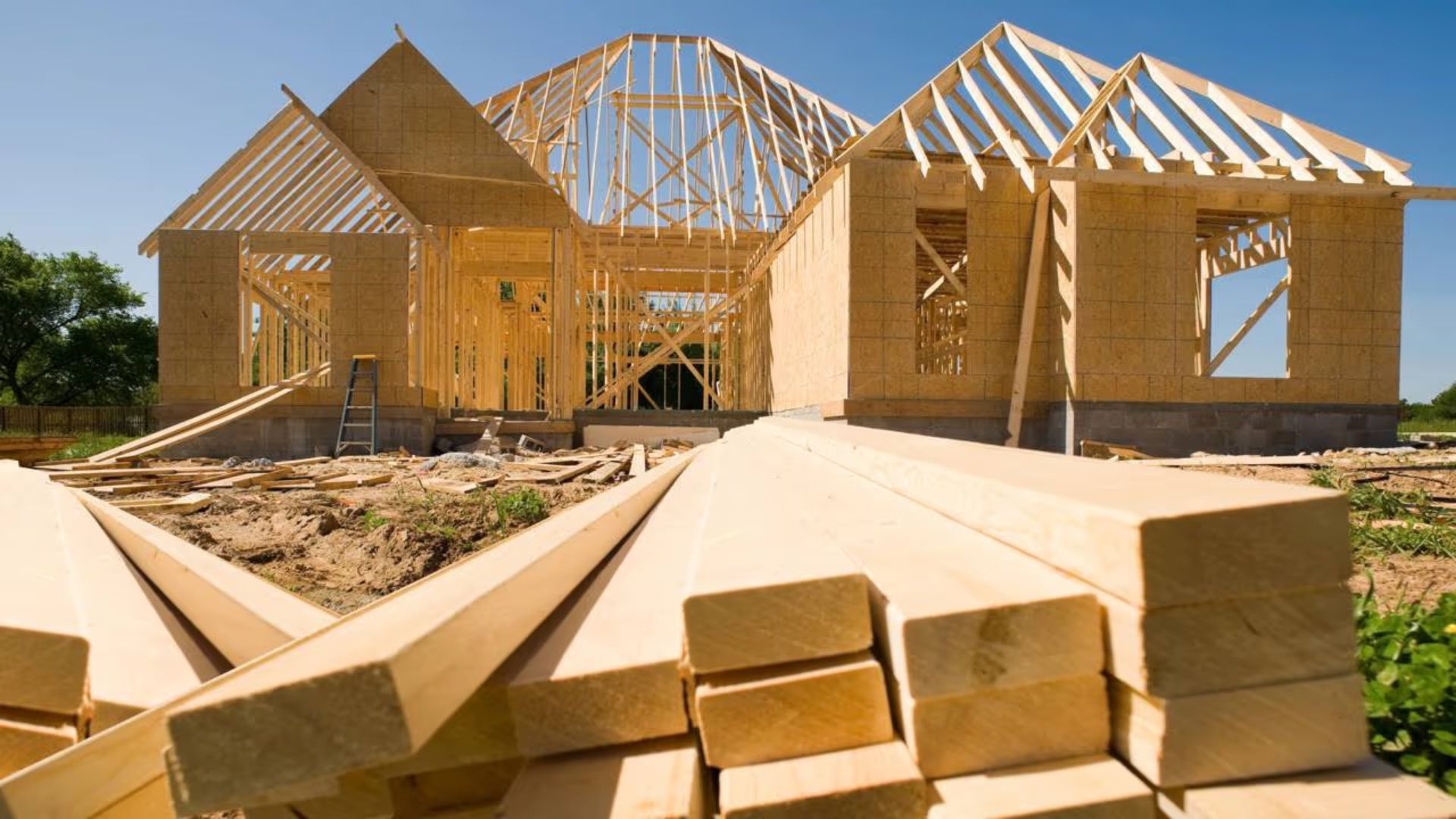


Traditional building material goes through industrialization, gains high technical performance and expands its presence in urban projects, with modular systems, new composites and integrated solutions that seek to reduce deadlines, increase environmental comfort and enable buildings in different scales and climates.
Wood construction has ceased to be associated only with country houses and has begun to integrate urban projects with industrialized systems, high-performance components and techniques that seek to reduce construction time and expand the range of applications.
Companies in the sector are betting on prefabricated modules, more predictable structural connections and new composites that alter the material’s properties in an attempt to place wood on the same level as traditional solutions such as concrete, steel, and masonry.
At the same time, the advancement does not depend solely on panels and beams.
-
The section of Serra da Rocinha on BR-285 is now open in Timbé do Sul: 50 m tensioned curtains and top-down technique stabilize the slope, with a stairway duct controlling the water.

-
Scientists use sawdust mixed with clay to create a lighter brick, promising efficient thermal insulation and impressing by transforming waste into a solution for construction.

-
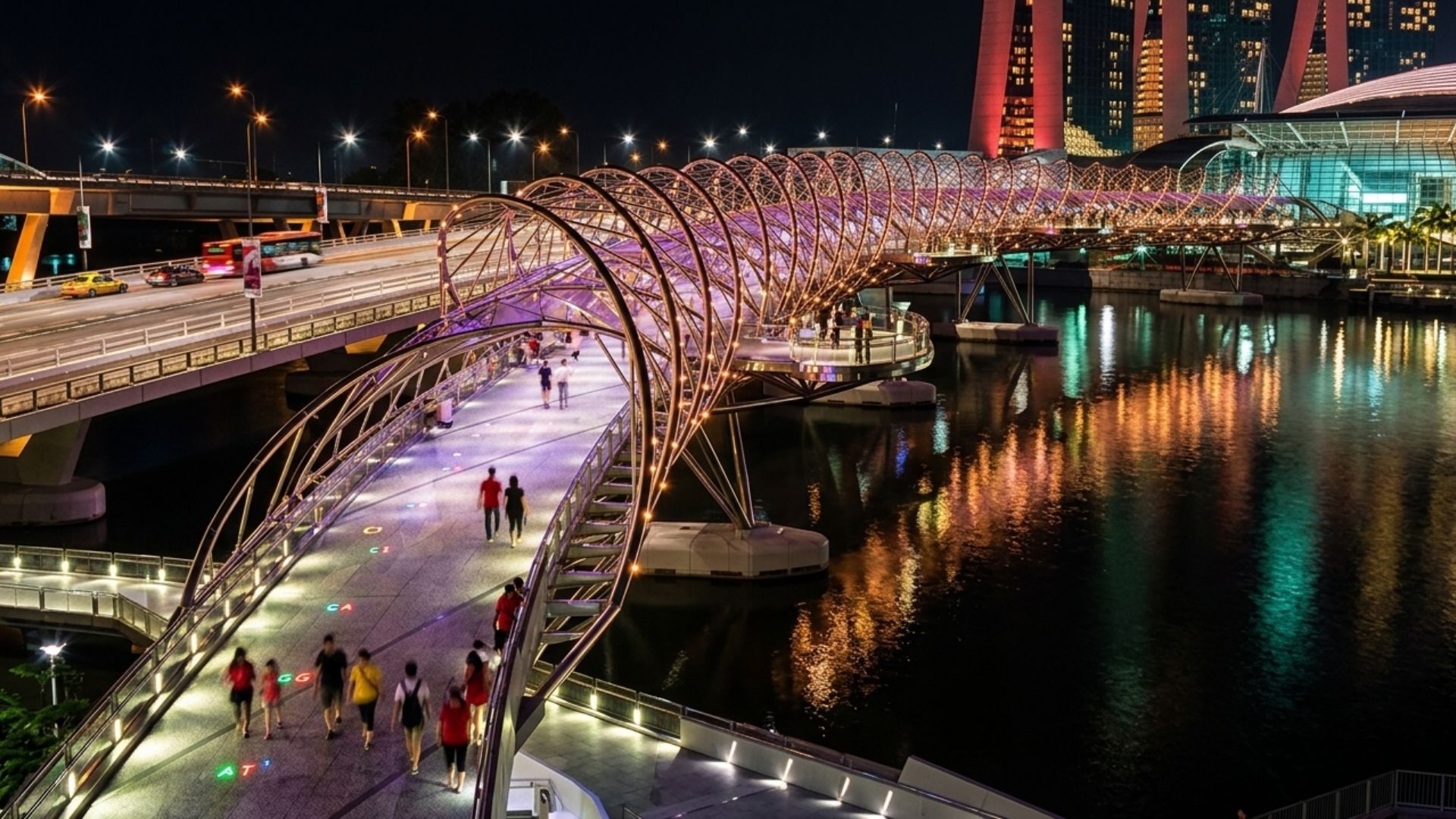
With a DNA shape, this bridge in Singapore draws attention in modern architecture and surprises tourists by transforming a simple crossing into an unforgettable visual experience in the urban heart.
-
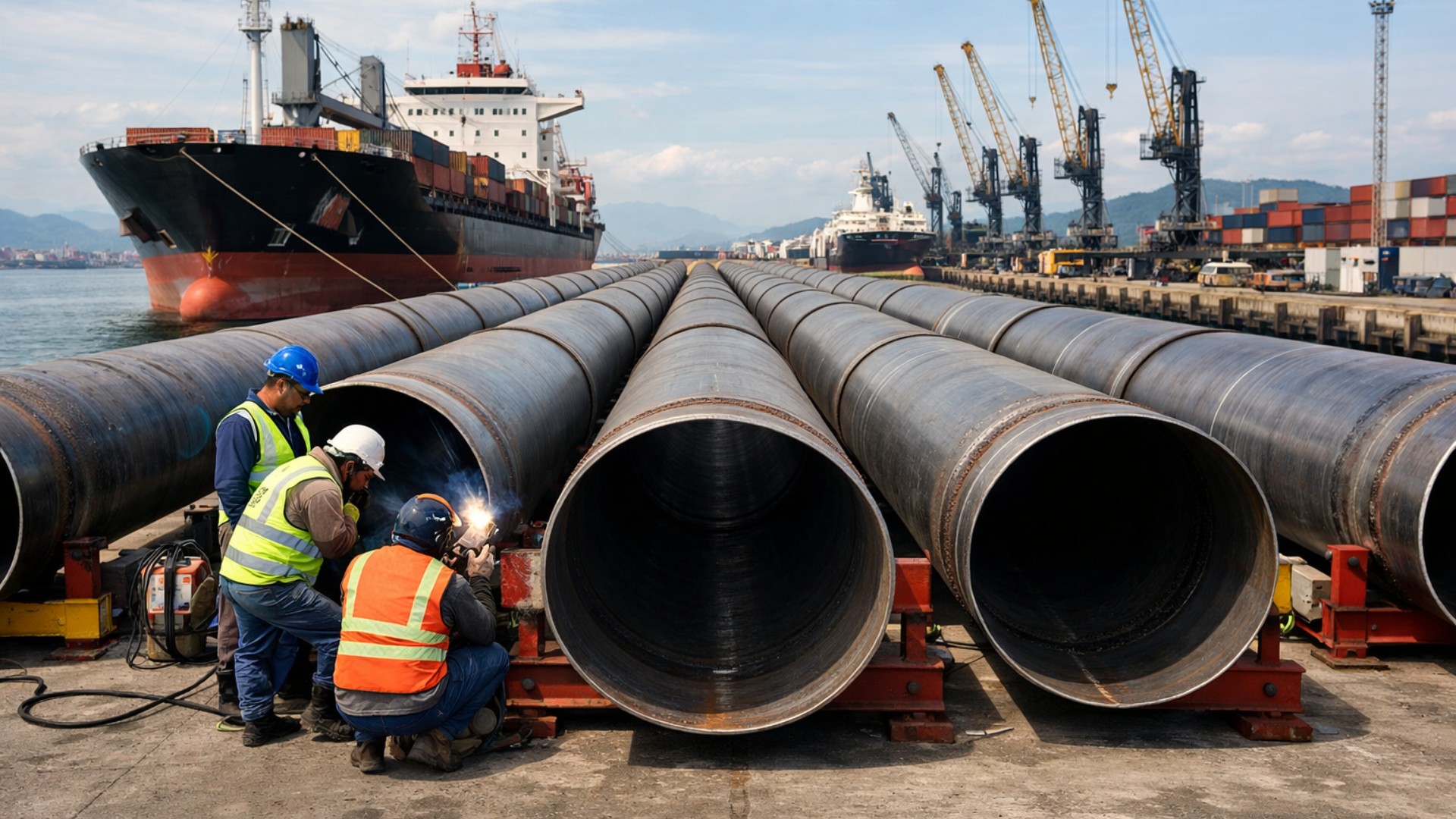
Giant underwater pipeline begins to take shape with a R$ 134.7 million project at the Port of Santos: the 1.7 km structure uses 12-meter and 700 mm pipes to supply water to 450,000 people in Guarujá.

What has been gaining space is the idea of a complete system that brings together structure, connection between pieces, sealing and layers of thermal and acoustic comfort designed to work together, with cleaner assembly on site and greater quality control.
Modular Wood Construction Reduces Steps on Site

A central part of this change lies in industrialization.
In modular construction, sections of the building can come ready from the factory and arrive on site as modules of environments, panels, and components already sized for assembly.
The German company DERIX, for example, describes the production of “cells” of wooden environments that are assembled on-site and presents cases where about 60% of the module is prefabricated in the factory.
This type of method seeks to reduce typical steps of wet work, minimize waste, and shorten deadlines, although the exact time difference compared to concrete varies according to the project and does not have one single applicable number to all constructions.
Still, the logic is clear.
Less improvisation on site and more decisions made beforehand, in a controlled environment, with pieces produced with greater tolerances and repeatability.
Even with the advancement of prefabrication, the sector’s promise is to maintain architectural flexibility.
In general, wooden structures can take on various geometries, receive different facades, and work with significant spans when combined with solutions like CLT and LVL, in addition to engineered wood components that are already used in larger scale projects.
Enhanced Wood Expands Structural Applications
Another front is the transformation of the material itself.
The French startup Woodoo describes a process that replaces part of the lignin with a high-performance binder, creating what the company calls “enhanced wood”.

The technique is presented as capable of significantly altering the final product’s characteristics, including mechanical resistance and stability, in addition to opening applications where wood is often less chosen.
The idea of removing lignin and impregnating the structure with polymers also appears in materials and technical reports on the subject.
These sources mention resistance gains in the order of multiple times compared to conventional wood, although the measurement depends on the type of test and the specific product.
In practice, what the market tries to enable is the use of wood in more exposed areas and in components with greater demands.
This scope also includes interior applications where aesthetics and technical performance need to coexist.
Woodoo itself presents versions geared towards use in commercial environments, with information on fire behavior classification and protection against UV radiation in product lines.
Structural Connections and Deformation Control
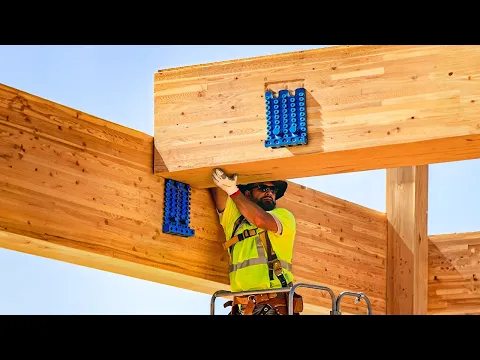
In any building, the final performance does not depend solely on beams and panels.
The connections between the pieces play a decisive role in safety and behavior over time.
Connectors designed for specific joints help make assembly more predictable and reproduce, in practice, the behavior expected in structural calculations.
An example cited in this universe is ALUMEGA.
The manufacturer describes the system as an articulated type connection for unions between beam and column in wooden structures.

This type of approach addresses a recurring need in buildings of this kind.
It is necessary to ensure that the predicted deformations are accommodated by project details and connections, especially in structures with greater spans and variable loads throughout their lifespan.
Thermal and Acoustic Insulation as Part of the System
The gain in scale in wood construction also involves performance layers that go beyond the structure.
Insulation and finishing solutions are presented as an essential part of the package, especially to meet thermal and acoustic comfort requirements in residential and commercial buildings.
Mineral wool panels, such as those from the Heraklith line, are advertised as materials with sound absorption properties, thermal insulation, and fire resistance.
These products include versions geared towards decorative use on walls and ceilings.
In the case of floors and internal systems, AGEPAN describes AGEPAN TEP as an insulating board with fittings.
The material is recommended for use as a dry floor element and associated with properties such as vapor permeability, thermal insulation, and sound reduction, under the normative specifications mentioned by the manufacturer.
In parallel, there are products with acoustic and design appeal for interiors.
WoodUpp, for example, describes ribbed panels based on acoustic felt and indicates composition with a portion of recycled plastic in the felt.
The proposal targets residential and corporate environments where aesthetics is part of the sales argument.

From Foundation to Finishing, Integrated Solutions in Wood
The expansion of wood as a construction solution has been accompanied by foundation and assembly alternatives designed for lightweight and rapid works.
There are systems that rely on screw-type metal foundations and removable solutions.
These alternatives are often cited as a way to reduce soil intervention in small constructions, although the suitability depends on the project and geotechnical conditions.
In the field of “brick-type” wood components, commercial initiatives like NiTO Wooden Brick have emerged.
The system is presented as a set of solid wood blocks for assembly, with a discourse aimed at speed of execution and recycling.
As it is a specific product, performance claims depend on local certifications and standards, which requires case-by-case analysis.
In finishing and facade protection, techniques and treatments remain part of the repertoire.
The surface carbonization associated with Shou Sugi Ban, also known as yakisugi, is described as a method that creates a carbonized layer capable of helping to protect against moisture and biological agents, in addition to the characteristic aesthetic effect.
Another front is heat-modified wood.
This heat treatment, in a controlled environment, seeks to improve dimensional stability and durability for outdoor use, including facades, without necessarily resorting to traditional chemical additives.

In interior design, systems such as WOOD-SKIN panels present themselves as composites and patented processes aimed at customized surfaces.
The focus is on architectural applications that require more complex geometries.
Large Wooden Structures as Technological Showcase
Some recent projects are used as showcases to demonstrate the scale that wood can achieve.
In Stockholm, Wisdome Stockholm is described as an expansion with a freely structured wooden cover.
The project has an area of about 1,325 square meters and a span of 48 meters without internal columns, according to the museum and technical publications.
Suppliers involved in the execution highlight the use of LVL in the structural grid and the production of specific components.
This reinforces how large wooden structures often depend on manufacturing and assembly engineering as crucial as the architectural design.
In another line of application, the Swiss company Blumer Lehmann describes wooden silos for storing salt and other bulk materials.
The argument is that the material’s low thermal conductivity helps reduce condensation and corrosion compared to metal alternatives.
Bamboo also appears as a renewable alternative in large surfaces.
Examples include the ceiling of Terminal 4 of Barajas Airport in Madrid, with solutions in sheets and multilayer structures developed to meet curvature and performance requirements.
Finally, the transition from design to construction depends on less visible elements.
Seals and sealing systems, such as those used to ensure air tightness at corners and connections, directly influence the performance of the envelope and the durability of the whole.







Hola.soy maestro mayor de obras.me gustaría trabajar con ustedes vivo barcelona.desde ya gracias
Gostaria de informações