





 Portuguese
  English
  Spanish
  6 min of reading
  0 comments



Discovery made by a child in England reveals a 500-year-old gold pendant with a secret compartment and connection to the Tudor era.
In 2009, 3-year-old James Hyatt, still in early childhood, was participating in a common activity in rural areas of England alongside his father, using a metal detector in a field in Hockley, Essex. What began as an informal outing turned into a find that would gain national attention: according to the official record from the British Museum and reports from Sky News, the object found was a rare gold locket pendant titled Hockley Pendant, from the early 16th century. During the scan, the detector emitted a signal in an apparently ordinary area of the land, and after digging about 20 centimeters deep, father and son found a small metal piece that initially did not reveal its true importance. Later, analysis confirmed it to be a gold locket pendant dated from 1500 to 1550, corresponding to the Tudor period in England, with an internal cavity intended to hold a religious relic.
The object, which would become known as the Hockley Pendant, caught the attention of archaeologists and historians for its unusual combination of material value, religious devotion, and technical sophistication. According to the British Museum, the piece measures 33 millimeters in length, has a lozenge shape, inscriptions related to the Magi, and images associated with Saint Helena and the Five Wounds of Christ, and has survived in remarkably preserved condition after more than five centuries beneath English soil.
Structure of the Hockley Pendant reveals sophisticated engineering for the 16th century
The pendant found by James Hyatt measures approximately 2.5 to 3 centimeters, weighs about 8.6 grams, and has a composition of approximately 73% gold, indicating a high level of purity for the standards of the time. Its lozenge shape, resembling a diamond, already demonstrates aesthetic care, but it is the internal structure that makes the piece extraordinary.
-
Brazil feels the record heat: 2025, the 3rd hottest year on the planet, brought 1,493 hydrological disasters, affected 336,656 people, and caused losses of R$ 3.9 billion, according to Cemaden in the country.

-
From a childhood marked by hunger to a symbol of hope: the house where Maradona was born becomes a cafeteria that feeds hundreds every day amidst the economic and social crisis in Argentina.

-
Few people know about this Greek island with 6 ideal months for visiting, perfect winds for kitesurfing, a medieval village on a cliff, almost untouched beaches, and a cuisine featuring fresh fish that surprises travelers.

-
The secret to having a fruit-laden tree all year round is not luck or a green thumb, but rather a combination of three nutrients that most people do not know how to apply correctly.

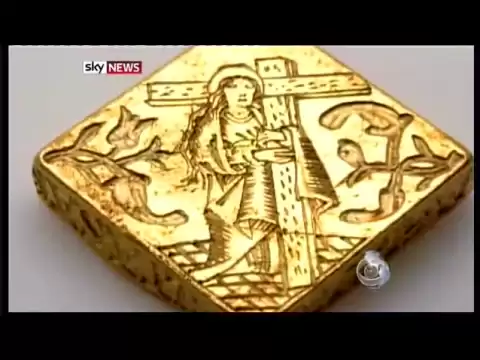

The object has a secret compartment accessed by a sliding panel, a discreet mechanism that is not visible at first inspection. This type of construction requires precision in fitting and technical mastery in handling metal, especially considering the tools available in the 16th century.
During the restoration process conducted by specialists from the British Museum, linen fiber residues were found inside the compartment, indicating that the pendant was indeed used to store some object throughout its history.
This detail completely transforms the nature of the piece, as it confirms that it was not merely ornamental, but functional within a specific religious context.
Religious and symbolic function of the reliquary in Tudor England
The Hockley Pendant belongs to the category of reliquaries, objects used to store fragments considered sacred, such as pieces of fabric associated with religious figures or particles of objects linked to the Christian tradition.
In the context of 16th century England, especially during the reign of Henry VIII, these objects played a central role in everyday religious practice. They were used as instruments of spiritual protection, believed to ward off diseases, bad luck, and even evil influences.
The found pendant features inscriptions with the names of the Three Wise Men — Caspar, Melchior, and Balthazar — as well as representations associated with the Five Wounds of Christ, recurring elements in devotional objects of the time.

These symbols were not merely decorative. They carried specific meanings and were linked to popular beliefs about healing and protection. In some cases, reliquaries like this were used as personal amulets, carried on the body by individuals of different social classes, although gold versions were more common among people of higher status.
Connection with the era of Henry VIII enhances historical relevance
The dating of the pendant between 1500 and 1550 AD places it directly in the reign of Henry VIII (1509–1547), one of the most influential monarchs in English history. This period was marked by profound transformations, including the break with the Catholic Church and the creation of the Anglican Church.
The existence of a reliquary of this type raises relevant hypotheses. Religious objects associated with the Catholic tradition continued to circulate even during periods of religious tension, especially among groups that maintained practices predating the Reformation.
Experts point out that pieces like the Hockley Pendant could be associated with individuals of high social status, possibly linked to the court or circles close to power. The quality of the material, the level of detail, and the symbolism present reinforce this possibility.
Although it is not possible to accurately identify the original owner, the historical context suggests that the pendant was not a common object.
Million-dollar appraisal and actual value paid for the artifact
After its identification as an archaeological treasure, the pendant underwent an official appraisal process. Initial estimates indicated that the piece could reach values of up to £2.5 million, equivalent to about US$ 4 million, considering its rarity, state of preservation, and historical relevance.
However, the actual amount paid was significantly lower. The British Museum, responsible for the acquisition, paid about £70,000 for the piece, a value that was divided between the discoverer and the landowner, as determined by British legislation on archaeological finds.

This difference between theoretical appraisal and actual value paid is common in such cases. The estimated value takes into account historical and symbolic factors that do not always translate directly into market price.
Still, the pendant remains one of the most valuable objects ever found by amateur detectorists in the UK.
British legislation allows discoveries by civilians
One of the factors that make this story possible is the legal model adopted by the United Kingdom. The country has specific legislation known as the Treasure Act, which regulates the discovery of archaeological objects by civilians.
According to this law, any artifact over 300 years old and made of precious metals must be reported to the authorities. After analysis, the object can be acquired by public institutions, such as museums, with financial compensation to the discoverer.
This system encourages collaboration between detectorists and archaeologists, resulting in thousands of documented discoveries over the past decades.
The case of James Hyatt is one of the most emblematic examples of this model, showing how significant discoveries can occur outside of official excavations.
Why the piece remained buried for over 500 years
The presence of the buried pendant raises a central question: why was such a valuable object left in the ground for centuries?
There are a few plausible hypotheses. The first involves accidental loss. The owner may have lost the object during movements or activities in the field.

Another possibility is deliberate concealment. In times of instability, hiding valuable objects was a common practice, especially in rural areas.
The hypothesis of intentional deposition for religious reasons cannot be ruled out, although this is less likely in the specific case of the Hockley Pendant.
Regardless of the cause, the fact is that the object remained preserved for more than five centuries until it was rediscovered by chance.
Discovery reinforces the importance of amateur archaeology
The case of the Hockley Pendant demonstrates the relevant role that amateur archaeology can play in preserving history. While professional excavations are essential, discoveries made by civilians have significantly contributed to expanding knowledge about the past.
In the UK, thousands of objects are recorded annually by detectorists, many of which end up in public collections and are studied by specialists.
The story of James Hyatt stands out not only for the value of the object found but for how it occurred. The combination of chance, curiosity, and access to simple tools resulted in a discovery that is now part of British historical heritage.
What do you think about this discovery made by a 3-year-old child?
The discovery of the Hockley Pendant brings together rare elements in a single narrative: childhood, chance, gold, sophisticated engineering, and a direct connection to one of the most important periods in English history.
Now I want to know your opinion: do you believe that objects like this are still scattered around the world waiting to be found, or is this type of discovery becoming increasingly rare?









Seja o primeiro a reagir!