Portuguese
  Spanish


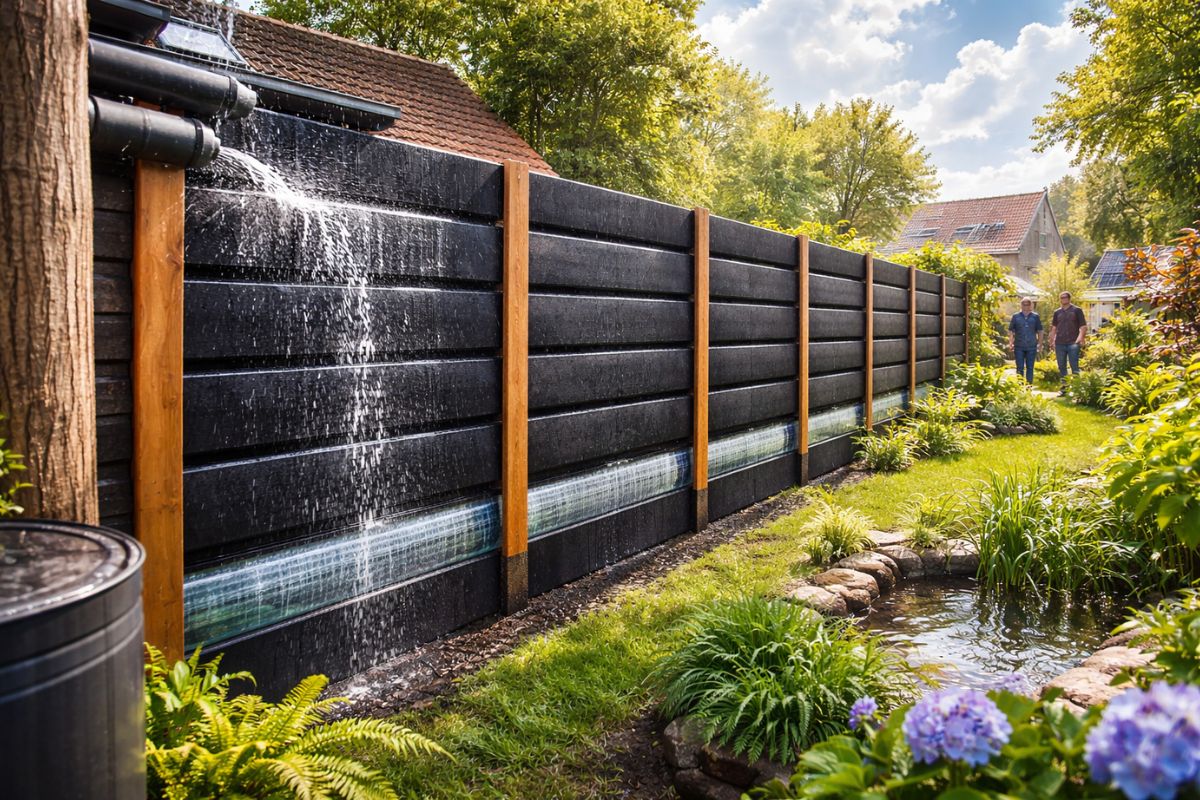


With rainwater storage built into garden fences, housing companies in the Netherlands reduce flooding during heavy rains and maintain reserves for summer drought.
Garden fences in the Netherlands are gaining a new function: to become reservoirs for rainwater to protect homes, plants, and streets when the weather changes quickly between storms and dry periods.
The idea, dubbed rain fences, is already appearing in neighborhoods like Veldhoven, where a pilot project connects plastic blocks to roof drainage to store water in the yard itself and reduce pressure on the sewage system.
What are rain fences and why do they catch attention

Rain fences are fences that incorporate a storage system right at the garden boundary. Instead of just separating plots, they function as a “deposit” for water, using modules connected to roof drainage.
-
Affordable Housing Project in Brazil’s Mato Grosso Aims for 700 Deliveries and $34 Million in 2026, Outpacing Major Developers in High-Demand Areas

-
Brazil’s Largest Port to Accommodate Bigger Ships by October as Ibama Approves Non-Explosive Removal of Hidden Rocks and Sediments
-
Mexico Develops 3D-Printed Concrete from Corn Waste, Cutting Emissions by 70% and Reducing Construction Waste by 90%
-
Traditional Mortar to Decline by 2026: ACIII-E Solution for Large Porcelain Tiles Offers Better Adhesion and Reduces Risk of Loose Pieces in Floors and Facades


In the case installed in Veldhoven, the plastic blocks between the panels can hold up to 2,160 liters, helping in two critical moments: when it rains too much and when water is scarce.
How fences store rainwater in the garden
The mechanism is straightforward: the water that would flow into the street is diverted to the modules installed in the structure. This reduces the volume that reaches the sewage system all at once during heavy rain, decreasing the risk of backflow and overload.
Later, this same water can be used in the garden when the rain disappears. In times of restriction, having a nearby reserve helps maintain plants, trees, and green areas, without relying on hoses or extra supply.
Veldhoven and the “curious neighbor” effect

In an organized neighborhood in Veldhoven, the social housing company Woonstichting ’thuis is installing its first fences of this type. A couple, Theo and Willy Bolder, report that the novelty has become a topic in the neighborhood, with people stopping by to ask about prices and details.
The interest is not just aesthetic. The perception that rains are heavier and urban drainage cannot keep up reinforces the search for practical solutions that fit into small areas, like gardens.
Stronger rain, higher heat, and a country vulnerable to water
The Netherlands is a low-lying country highly exposed to extremes. According to KNMI, the average temperature has increased by 1°C since 2000, and cities tend to be about 5°C warmer than rural areas. This increases thermal stress and accelerates the loss of water from the soil.
Extreme events also come into play. In 2021, floods in Limburg drew attention after more than 15 cm of rain in 48 hours and the overflow of the Geul River. When urban infrastructure is pressured like this, storing some of the water on the surface becomes a strategy, not a luxury.
Why the sewage system does not keep up with the pace of storms

Local authorities point out that expanding the capacity of the sewage system is not always feasible. The alternative, then, is to retain water before it flows into the pipes, using measures on the surface: infiltration into the soil, green roofs, retention areas, and fences with storage.
The logic is simple: capture as much as possible where the rain falls to reduce the peak volume that reaches the sewage system all at once.
A business that also protects the property and reduces losses
For property managers, these fences are not just “a good environmental deed.” The calculation is quite practical: if the water does not drain and floods the building, the damage comes in maintenance, disruption, and recurring costs.
The idea fits into prevention. Instead of fixing leaks and damage later, the project aims to reduce the problem at its source, making properties more resilient.
From “mastering nature” to adapting the city

The discussion also touches on the Dutch narrative of water engineering. A country that has reclaimed part of its territory from the sea for decades operated under the idea of total control.
Now, with green infrastructure and distributed retention, the bet shifts to coexisting with water, slowing down runoff, and reducing urban heat.
In this scenario, fences cease to be a detail of landscaping and become part of climate adaptation at scale, especially in dense areas with little free space.
And you: if the fences in your yard could store rainwater for use during drought and also reduce flooding, would you install a rain fence at home?