





 Portuguese
  English
  Spanish
  5 min of reading
  30 comments


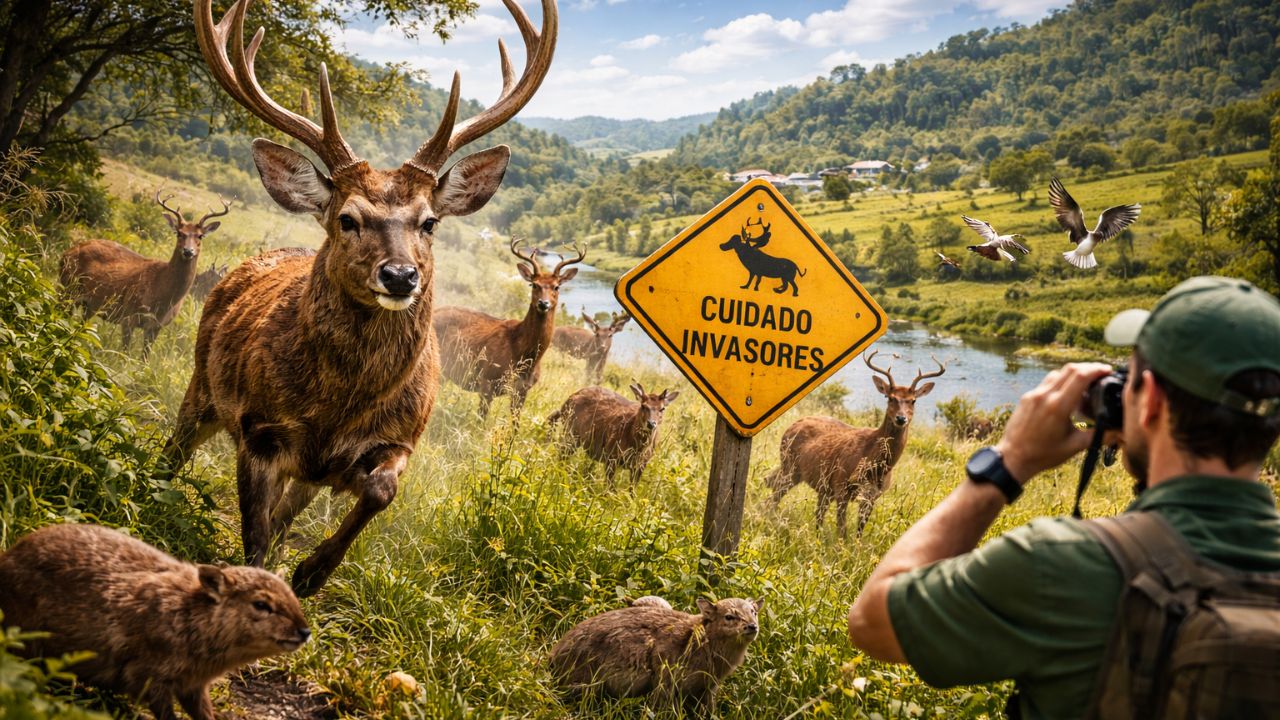


The Advance Of The Asian Deer Invades The South Of Brazil Quickly, Pressures Native Fauna, Alters Vegetation And Worries Scientists Who Advocate Control Before It Is Too Late.
The Asian deer invades the south of Brazil silently, but the signs are already drawing attention: sightings in urban areas, records in conservation units, and a growing risk of environmental impact similar to what happened with other exotic species that escaped control.
The reason for concern is straightforward. Without relevant predators and with a high capacity for adaptation, the Asian deer invades the south of Brazil at a pace that can escalate from an “isolated case” to a difficult-to-reverse problem.
What Is The Asian Deer And Why Does It Draw So Much Attention
The species referred to in the source material is the chital, also called shital, a deer native to regions of Asia such as India, Sri Lanka, Nepal, Bangladesh, and Bhutan.
-
What if the Sun disappeared suddenly? Simulation shows Earth in darkness within minutes, extreme cold, and rapid collapse of life on the planet.

-
A 2,400-year-old iron foundry has been discovered in Senegal with 100 tons of slag, 35 furnace bases, and signs of nearly eight centuries of continuous metallurgical activity.

-
Four humans are flying towards the Moon inside the Orion capsule launched by the SLS rocket, and on April 6, Artemis II will disappear behind the far side of the Moon without communication with Earth for nearly an hour.

-
Worlds covered by water, atmospheres filled with hydrogen, and the possibility of life beyond Earth: ocean planets are rewriting the map of cosmic search and forcing scientists to rethink where to look.


It lives on forest edges and clearings with grasses and tends to stay close to water sources.
The appearance helps explain why many underestimate the risk. It Is A Beautiful And Apparently Docile Animal, with spotted fur and prominent antlers in males.
However, appearance does not lessen ecological impact when the species is out of its natural environment.
How The Asian Deer Invades The South Of Brazil And Where It Came From
The introduction to South America is attributed to imports made from the 1930s, when farmers from Argentina and Uruguay brought exotic deer for sport hunting reserves.
The environment found in these countries was favorable, with subtropical climate, pastures, and abundant water.
The decisive point was the imbalance. In South America, the deer did not encounter enough natural predators to contain the population, which favored their multiplication and expansion beyond the properties. Over time, the species crossed borders and reached Brazil.
In Brazilian territory, the first official records mentioned appeared in 2009, at the Espinilho State Park, in the far west of Rio Grande do Sul, on the border with Argentina and Uruguay.
Subsequently, sightings expanded to other regions of Rio Grande do Sul and began to occur on beaches, roads, and urban areas.
The Episode That Became A Symbol Of Warning


A notable case occurred in December 2023 when a deer was found in the yard of a school in Passo Fundo, Rio Grande do Sul.
The animal was said to have been surrounded by dogs, entered the premises, and became trapped until it was rescued by authorities.
This type of occurrence reinforces the perception that the Asian deer invades the south of Brazil with more reach than it seems, because the appearance in urban centers indicates territorial expansion and greater contact with people, dogs, and traffic.
Why The Asian Deer Invades The South Of Brazil So Easily
The source material points out three main factors.
The first is adaptability. The chital can withstand temperature variations, live in different environments, and survive with little water, which facilitates its establishment in the Pampa and transitional areas.
The second is its wide diet. It Eats Practically Any Available Vegetation, including grasses, leaves, flowers, and fallen fruits, which reduces food barriers and gives it a competitive advantage.
The third is reproduction. The text describes that females can give birth throughout the year and reach maturity relatively early, which accelerates population growth.
When this is combined with the absence of efficient predators, the result is predictable: the Asian deer invades the south of Brazil and tends to expand its presence over time.
The Real Risk To Native Fauna And The “Cascade Effect”
The problem is not an isolated deer. It’s what ecologists call the cascade effect: an invasive species alters the balance around it and affects various levels of the ecosystem.
One of the cited impacts is competition with native deer. Brazil is home to several species of wild deer, and the text mentions the marsh deer, the brown brocket, and the Brazilian catinga deer.
When a larger, more adaptable, and rapidly reproducing invader enters the same area, the pressure for food and space tends to increase, especially on populations already weakened by habitat loss.
Vegetation Alteration And Impacts That Spread Through The Food Chain
The source material indicates that in Argentina, where the species has been present for decades, there is reference to changes in the composition of native plants because the deer prefers to consume certain species and ignores others. This can alter growth patterns and vegetation structure.
This type of change is not restricted to the “green.” Insects, Birds And Small Mammals Depend On The Local Flora, so any alteration can reverberate throughout the chain.
Health Risk, Traffic Accidents And Expansion Into New Areas
In addition to ecological impact, the text raises health risks. As an exotic species, there is still uncertainty about parasites and pathogens that may be carried and eventually transmitted to wildlife, livestock, pets, and even humans.
There are also mentions of occurrences on highways, with records of traffic accidents on roads in Rio Grande do Sul.
This point is important because it shows that, as the Asian deer invades the south of Brazil, the points of contact with infrastructure, traffic, and urbanized areas grow.
The aforementioned advance includes confirmation in 2023 in Paraná, including within the Iguaçu National Park, and reports in Santa Catarina.
What The Public Authorities Have Done And Why It Still Does Not Solve
The source material states that in Rio Grande do Sul, there was a regulation in 2022 that classified the chital as an invasive exotic species and authorized population control in the state. This paves the way for actions such as monitoring with camera traps, using GPS and drones, capturing, and removing from risk areas.
In extreme situations, the text mentions that there may be a need for controlled and authorized culling, under technical supervision, to prevent abuses and new imbalances.
The problem is that regulation does not equal execution. The content points to a lack of specific studies on ecology and distribution in Brazil, an absence of clear population estimates and reproduction rates, which hinders coordinated actions. Without data, control becomes a late reaction.
Why Act Now Changes The Outcome
The text makes an indirect comparison with other invasions that started small and became practically irreversible in other countries. The alert is simple: waiting for it to “resolve itself” does not work with an exotic species.
The difference here, according to the material, is that there is still time. The focal points are said to be more concentrated, and there is growing attention from researchers and managers.
If control progresses with science, political support, and local participation, the chance of avoiding a bigger problem increases.
Do You Think The Asian Deer Invades The South Of Brazil To The Point Of Becoming A Pest Like Wild Boars, Or Do You Believe That Proper Control Can Still Curb Its Expansion Before The Damage Increases?







Acredito eu que num espasso muito pequeno esse **** vai torna uma praga igual ao javali,depois de invadir nosso território não adianta mais fica criando grupos de ecologista pra fica defendendo se não coloca em prática, atrás de uma mesa com papeis não vai resolve nada.O javali o que aconteceu todos sabem muito bem a espancao deles, e outra ele vão começa a cruzarem com o cervos nativos da região e acaba com os que temos aqui do mesmo gesto do javali te mais javaporco do que javali.No estado de SC não adianta esconde não já tem bastante
Isso mesmo, quanto mais veado melhor!!!
O humano faz **** e quem paga é o ****