





 Portuguese
  English
  Spanish
  4 min of reading
  0 comments



Technology with a barrier made from hair strands to contain oil and waste arrives at Guanabara Bay and reinforces environmental protection of mangroves.
A new strategy to combat pollution is beginning to transform the reality of Guanabara Bay in Rio de Janeiro. This involves the installation of a barrier made from hair strands to contain oil and waste, positioned at the Bom Jesus Cove on Fundão Island.
The action was implemented through the union of the Orla Sem Lixo Transforma (OSLT) and Fiotrar projects, with support from the Boticário Group Foundation.
The initiative uses repurposed human hair to capture pollutants and prevent waste from reaching sensitive areas.
-
The oceans are darkening all over the planet – what is happening?
-
An engineer designs a solar plane to fly on Mars at an altitude of 1,000 meters and a speed of 300 km/h, covering 16,000 kilometers in a Martian year, 900 times the distance traveled by the Ingenuity helicopter in three years on the planet before experiencing a rotor failure, and NASA is already funding the feasibility study.

-
A new phenomenon of contactless magnetic friction intrigues scientists and questions a theory that has been valid since the 17th century.

-
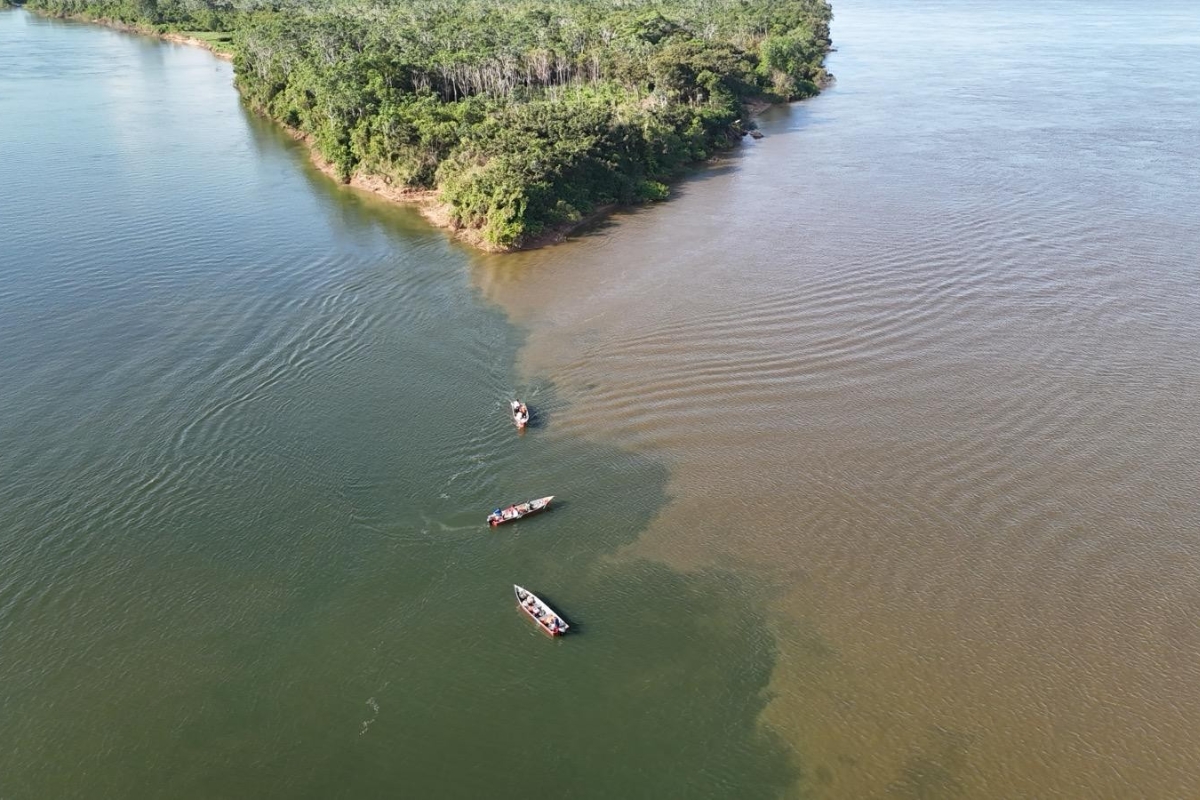
An impressive phenomenon in Northern Brazil causes rivers of different colors to flow side by side, revealing secrets about sediments, currents, and biodiversity.

The main focus is to protect the mangroves, which are essential for the environmental balance of the region.
Meanwhile, the application in a natural environment marks a new stage of technology, which had previously been tested under controlled conditions.
Integration of solutions increases efficiency in combating pollution
Unlike isolated methods, the barrier made from hair strands to contain oil and waste acts complementarily.
The existing structure, about 300 meters long, continues to be responsible for retaining solid waste.
However, the novelty lies in the incorporation of rolls made from cotton mesh filled with hair strands.
These devices now act directly in the absorption of oil present in the water.
This way, the solution can operate on multiple fronts at the same time. In addition to containing waste, it also reduces the dispersion of oily substances.

Sustainable solution born from years of research
The use of human hair as an environmental resource did not arise by chance. The technology was developed over years of research until a viable model for practical application was achieved.
According to Caroline Carvalho, director of Fiotrar:
“This moment is, above all, the validation of years of research and development of our technology. After a long journey to transform an idea into an applicable solution, reaching this stage means proving, in practice, that it is possible to unite science, sustainability, and social impact in a concrete way.”
Thus, the barrier made from hair strands to contain oil and waste represents a concrete example of sustainable innovation.
Field tests ensured adaptation of the technology
Before the definitive installation, the solution underwent a series of tests conducted over the past year.
The goal was to adjust the system to the specific characteristics of Guanabara Bay.
According to Susana Vinzon, coordinator of Orla Sem Lixo Transforma:
“The installation of the joint barrier is the result of a cycle of tests conducted over the past year, which sought to adapt the technology to the specific environmental conditions of Guanabara Bay and the structural characteristics of the developed barriers.”
This process was essential to ensure the efficiency of the barrier in a complex and dynamic environment.
Absorption capacity makes hair an environmental ally
One of the most striking points of the technology is the use of human hair as raw material. The material, often discarded, has a high capacity to contain oil.
Studies indicate that a single gram of hair can absorb up to five grams of oily substances.
This makes the barrier made from hair strands to contain oil and waste an efficient and low-cost alternative.

Moreover, repurposing contributes to sustainable practices and reduces waste.
Preservation of mangroves is a priority in the region
The installation of the barrier has a direct impact on the conservation of the mangroves of Guanabara Bay. These ecosystems perform essential functions for the environment.
They act as natural protection against erosion and help mitigate the effects of extreme weather events. In some cases, they can reduce wave strength by up to 60%.
However, the presence of oil and waste compromises this balance. By preventing these pollutants from reaching the roots and soil, the new technology helps maintain the functioning of this natural system.
Partnerships strengthen innovative environmental solutions
The initiative also highlights the importance of collaboration among different sectors. The project brings together researchers, institutions, and local communities around a common goal.
For Liziane Alberti, a specialist at the Boticário Group Foundation:
“This initiative shows how different solutions can complement each other to tackle complex environmental challenges such as marine pollution. By supporting the development of projects in different regions of the country and promoting this connection, we aim to enhance positive impacts, bringing science, innovation, and local communities together around concrete solutions.”
Therefore, the integration of scientific knowledge and social participation amplifies the impact of the action.
Technology points to new paths for a sustainable future
With positive initial results, the expectation is that the solution will be replicated in other regions affected by water pollution. The simplicity of application and low cost favor this expansion.
Furthermore, the proposal reinforces the concept of a circular economy by transforming waste into useful resources.
Thus, the barrier made from hair strands to contain oil and waste consolidates as a promising alternative, capable of redefining environmental preservation strategies in Brazil.
Source: Ciclo Vivo










Seja o primeiro a reagir!