





 Portuguese
  English
  Spanish
  8 min of reading
  0 comments


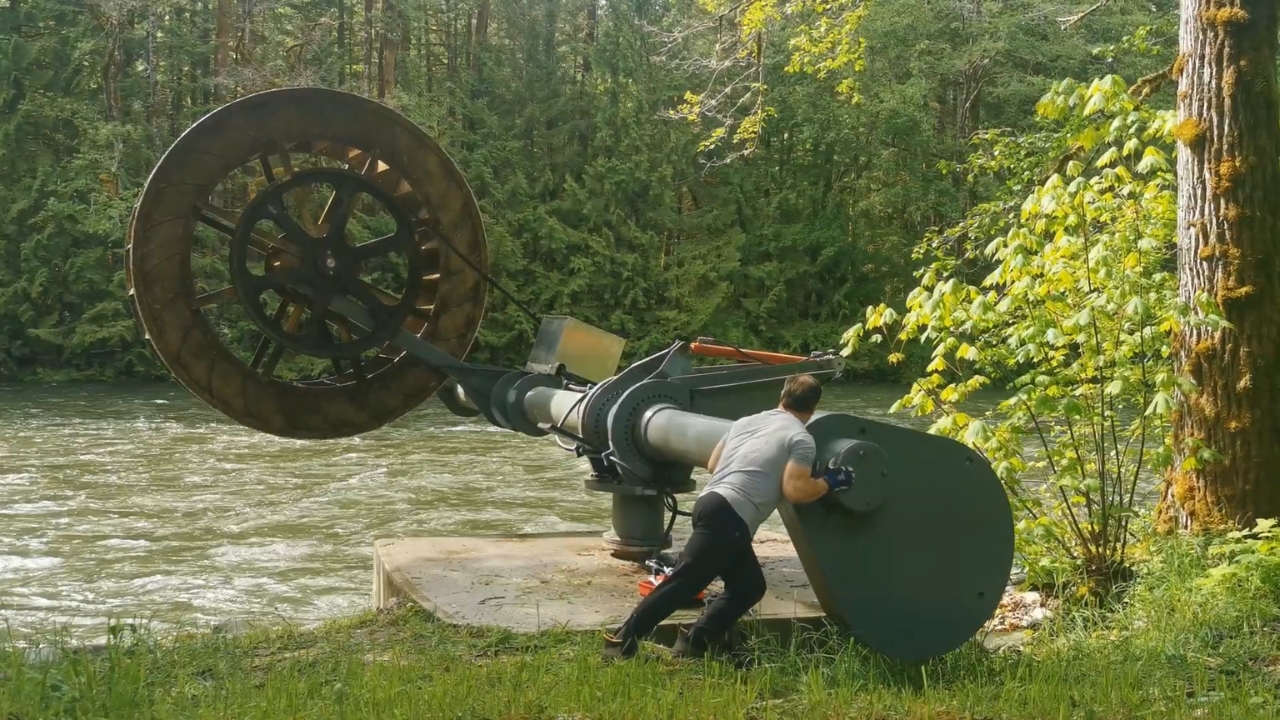
Micro-hydroelectric system installed in river generates between 800 and 900 W normally, approaches 2 kW in favorable moments and draws attention for continuous production that can reach 36 kWh daily without complex structures
A retired engineer from Canada has developed a hydraulic microgeneration system that has been attracting attention for its ability to produce energy continuously in a real river, without relying on large structures or excessively complex technologies. The project demonstrates, in practice, how the force of water can be converted into stable electricity with simple mechanical solutions that are well adapted to the environment.
The most impressive aspect is not just the peak power, but the regularity of generation. Under stable conditions, the system can operate close to 1,500 continuous watts, which represents about 36 kWh per day over 24 hours. For a compact system installed in a natural environment, this is a highly relevant result.
System works in a real river, and that changes everything
Unlike many experimental projects that only perform well under controlled conditions, this micro-hydroelectric system was installed in a real scenario, with constant humidity, heavy rain, surrounding vegetation, and natural water flow. This means that the equipment has to face wear and tear, fluctuations, and limitations that do not appear in bench tests.
-
Petrobras reaffirms its commitment to the market and ensures that it will carry out the energy transition safely to maintain national sovereignty.

-
Researchers discover a possible hydrogen deposit of up to 46 million tons beneath an ancient coal basin, and the volume could exceed half of the entire global production.

-
China bets on the Fishery-PV model and transforms fish farms into giant solar plants, covering ponds with panels that generate energy while utilizing the same space for large-scale aquaculture production.

-
Green hydrogen at home: Belgium launches new technology that makes solar panels produce fuel from the moisture in the air, which could boost the energy transition.

This characteristic makes the project even more interesting from a technical perspective. It is not just a theoretical idea or an isolated prototype, but a system subjected to the challenges of continuous use. And it is precisely here that it reveals its true value as a viable alternative for distributed generation.

Extreme humidity requires practical and robust solutions
In such an environment, water is present all the time, whether in the form of splashes, condensation, heavy rain, or constant dripping from vegetation. This creates a constant pressure on the electrical and mechanical components, requiring effective physical protection and frequent maintenance to avoid failures.
The aluminum cover used on the generator meets this need perfectly. More than just a finish, it acts as an essential barrier to protect the electronics in an aggressive environment. In systems installed outdoors, this type of shielding can be crucial for ensuring longevity and operational stability.
Belt adjustment is one of the most critical points of the project
One of the biggest mechanical challenges of the system lies in the adjustment of the drive belts. This adjustment requires fine balance: when the tension is too high, the bearings suffer excessive wear; when it is too low, slippage occurs, leading to loss of efficiency and premature deterioration of components.
This detail shows how seemingly simple projects hide a much more delicate engineering than it appears. In hydraulic microgeneration, every adjustment directly affects the performance and durability of the system. A poorly adjusted belt can compromise efficiency, stability, and even the mechanical safety of the system.


High torque at low speed explains unusual wear
The hydraulic wheel used in the system generates a very characteristic mechanical behavior: high torque at low speeds. This profile is typical of systems powered by the force of water and helps to understand why some belts may fail even though they are theoretically sized to withstand higher powers.
The problem is not just in the nominal power, but in the way energy is delivered to the transmission system. The high torque imposes intense and constant stresses on shafts, belts, and bearings. In other words, it is not just a matter of force, but of the type of force being applied over time.
Wear on the belts became a valuable clue about operation
After about two years of operation, the wear observed on the belts began to serve as a kind of natural diagnosis of the system. The marks left by continuous use help to reveal how gravity, irregular tension, and alignment of components directly influence energy transmission.
Visible wear of up to approximately 8 millimeters was recorded, a significant value in terms of mechanical analysis. Instead of indicating just failure, this wear also provides important information about how the system operates in the field, allowing for smarter adjustments and more secure structural decisions.

Water ended up helping in an unexpected way
One of the most curious details of the project is that the natural environment itself ended up contributing to reduce some of the mechanical friction. The entry of water into the bearings, although not a controlled or ideal solution from the perspective of conventional engineering, began to act as a kind of rudimentary lubrication in certain situations.
This does not mean that water replaces proper lubrication or planned maintenance. But the behavior shows how systems installed in a real environment can develop unexpected interactions with their surroundings, generating practical effects that often do not appear in simulations or purely theoretical designs.
Wood structure raises alerts about resistance and safety
Another important technical point involves the structural support of the hydraulic wheel. The use of wood raises doubts about long-term resistance, especially in a humid environment, with constant stress and the possibility of progressive deformation. Even woods recognized for their durability can develop cracks over time.
In this case, the risk is serious. A structural failure could lead to the complete loss of the wheel in the river, compromising the entire operation. In systems like this, physical support is not a secondary detail: it is a central part of the project’s reliability, just like the generator or the transmission mechanism.
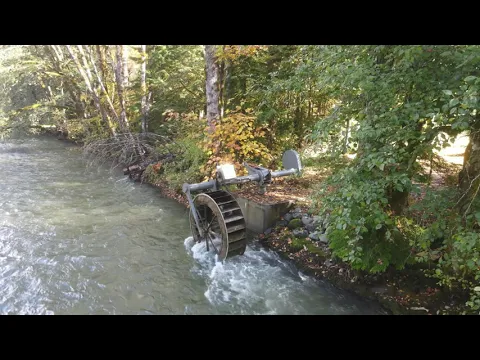
Stainless steel reinforcement made the system safer
To reduce this risk, the chosen solution was to reinforce the structure with stainless steel. The decision makes sense for several reasons: the material is more resistant to corrosion, performs well in aggressive environments, and adds structural redundancy without requiring a complete redesign of the entire system.
It is a pragmatic response, very typical of projects developed in the field. Instead of rebuilding everything, the system was strengthened with a reliable and durable material, maintaining its original operating logic. It may not be the most sophisticated solution in appearance, but it is efficient, realistic, and technically coherent.
Power varies with the river, but continuous generation is the great highlight
During normal operation, the micro-hydroelectric system usually generates between 800 and 900 watts, following the natural fluctuations of the river’s flow. In favorable moments, the system can approach 2 kW, although this value seems to be the current limit imposed by the mechanical configuration and the transmission set.
Even so, the most important data is not in the peaks. The real differentiator lies in the continuous production close to 1,500 watts under stable conditions. For those considering distributed generation, this consistency is worth much more than a high number achieved only for short periods.
36 kWh per day puts microgeneration on another level
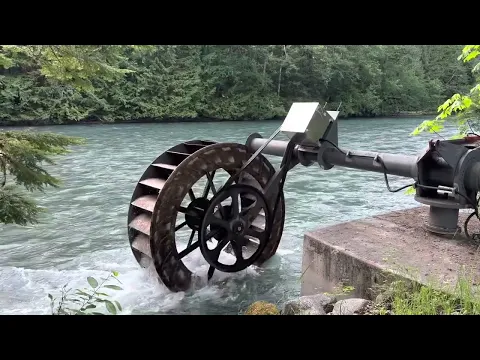
Maintaining around 1,500 watts for 24 hours, the system can reach approximately 36 kWh per day. This is a significant volume for a small-scale solution and helps explain why micro-hydroelectric systems continue to be such a promising technology in regions with permanent watercourses.
In practice, this amount of energy can meet various needs in rural properties, isolated installations, and self-consumption models. The most interesting aspect is that this production occurs steadily, without requiring gigantic structures, large civil works, or extremely complex electronic systems.
For rural areas, stability may be more valuable than peak power
In many scenarios off the electrical grid or in remote locations, the regularity of supply is more valuable than impressive maximum powers. This is because constant energy facilitates consumption planning, reduces dependence on massive storage, and makes the entire system more predictable on a daily basis.
That is precisely why small-scale micro-hydroelectric systems can become an excellent solution for rural areas. When there is a continuously available water resource, generation tends to be more uniform than in sources that heavily depend on sun or wind at specific times.
Technology can gain strength with hybrid systems
The potential of this solution increases even more when it is combined with other renewable sources, such as solar panels and home batteries. In hybrid systems, micro-hydraulics can provide the continuous energy base, while solar generation complements production during the day and improves the balance of energy supply.
This integration creates a much more robust model for small properties, isolated communities, or autonomous installations. Instead of relying on a single source, the user can count on a more resilient, flexible energy architecture adapted to variations in climate and consumption.
Sensors, remote monitoring, and new materials can elevate performance

Although the project is already functional, it can still evolve significantly with the use of technologies that already exist in the market. Vibration sensors, remote monitoring, automatic control of belt tension, and improvements in transmission are examples of resources capable of increasing efficiency and reducing maintenance.
Moreover, advances in materials and power electronics can enhance the durability and reliability of the system. The most promising path does not seem to be making the system excessively complex, but rather integrating targeted improvements that preserve its simplicity and increase its real performance in the field.
Simpler regulation can unlock this type of project
In some European countries, movements are already emerging to facilitate the legalization and connection of small renewable installations. This trend is especially important for microgeneration technologies, which often face more bureaucracy than actual technical limitations.
If the regulatory environment advances, projects like this could cease to be exceptions and become more widespread solutions. Simplifying the rules could pave the way for rural communities, small producers, and isolated consumers to better take advantage of local resources for clean and continuous generation.
What is most striking is not just the energy, but the idea behind it
In the end, the project impresses not only with the numbers but with the logic it represents. It proves that it is possible to harness a resource already present in the environment with intelligence, adaptation, and respect for the territory, without relying on mega-infrastructures or industrial systems that are inaccessible to most people.
This vision brings energy closer to the local reality and shows that smaller solutions can also be technically solid, economically useful, and environmentally relevant. It is precisely this combination of practical simplicity, technical data, and sustainable appeal that gives the topic enormous potential for interest in mobile reading and distribution on platforms like Google Discover.







Seja o primeiro a reagir!