





 Portuguese
  English
  Spanish
  3 min of reading
  0 comments


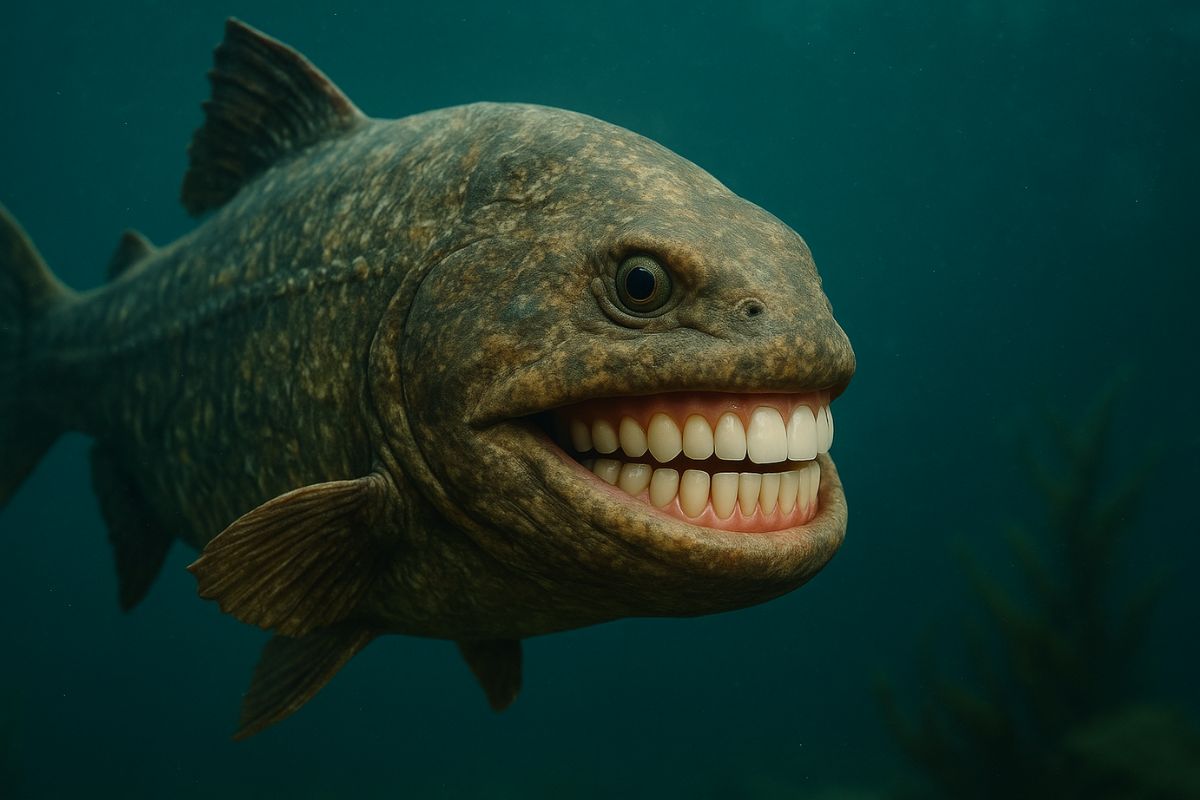


Researchers Discover That The Origin Of Human Dentin May Be Linked To Sensory Structures Of Jawless Vertebrates From The Ordovician Period
A new study published in the journal Nature indicates that the toothache we feel today may have evolutionary roots in an armored prehistoric fish that lived around 465 million years ago. Researchers identified sensory structures in these animals that contained dentin, the same tissue responsible for transmitting pain in human teeth.
These findings reinforce the so-called “Outside-In” Hypothesis, which suggests that teeth evolved from external body structures originally used to sense the environment. The research, led by Dr. Yara Haridy, reveals how primitive sensory elements gave rise to the foundations of the modern dental system.
The First Teeth Emerged Outside The Mouth
For a long time, the origin of teeth has been a topic of debate among scientists. Previous theories proposed that hard external protrusions called odontodes, found in ancient fish, evolved into the teeth as we know them today. However, until then, there was uncertainty about the true role of these structures.
-
The village where two rivers run side by side without mixing in Santarém and Alter do Chão reveals some of the most beautiful freshwater beaches on the planet.

-
Brazil’s nuclear submarine with a speed 5 times greater than normal advances after nearly 50 years and R$ 40 billion spent.

-
A Brazilian island charges R$ 0.50 to receive visitors and prohibits any new residents.

-
Why was the Great Wall of China built? The truth that many are unaware of!


Using 3D scans of Ordovician fish fossils, researchers identified dentin in the odontodes — a clear signal that these structures not only provided protection but also functioned as tactile sensors capable of sensing temperature and pressure in the water. In other words, before biting, the teeth felt.
Armored Fish And Crustaceans Evolved Similar Sensors
The team also compared these structures to sensilla, sensory organs present on the exoskeleton of arthropods such as crabs and shrimp. Interestingly, these similarities arose independently, in groups with very distant ancestors. This presents a classic case of evolutionary convergence, according to Haridy.
These rigid sensory systems provided an adaptive advantage for both jawless vertebrates and marine invertebrates. Both developed external plates that, in addition to providing protection, detected the surrounding environment — an essential evolutionary innovation for survival.
The Confusion With The Anatolepis Fossil
For decades, scientists believed that the fossil Anatolepis, from the Cambrian period, was one of the first vertebrate fish due to its surfaces with small protrusions resembling teeth. However, new examinations revealed that these structures did not contain dentin, being more compatible with sensilla of arthropods.
This misclassification was corrected using high-resolution computed tomography, which allowed researchers to analyze the internal composition of the fossils. The case of Anatolepis highlights how similar characteristics can confuse even specialists, especially when evolution acts in a parallel manner across different groups.
Modern Denticles Help Tell This Story
To reinforce their conclusions, scientists also studied living specimens, such as catfish raised in the laboratory. These fish have denticles on their skin — scales with a structure similar to teeth, directly connected to the nerves. Just like ancient odontodes, these denticles function as touch sensors.
This discovery supports the idea that modern dental structures evolved from the skin and not directly within the mouth. The first teeth, therefore, were part of a sensory armor, and the pain we feel today may be a direct inheritance of this ancient perception function.
Did you imagine that tooth pain originated in prehistoric fish? What do you think of this surprising discovery about our evolution?








Faz sentido a analogia.