





 Portuguese
  English
  Spanish
  6 min of reading
  0 comments


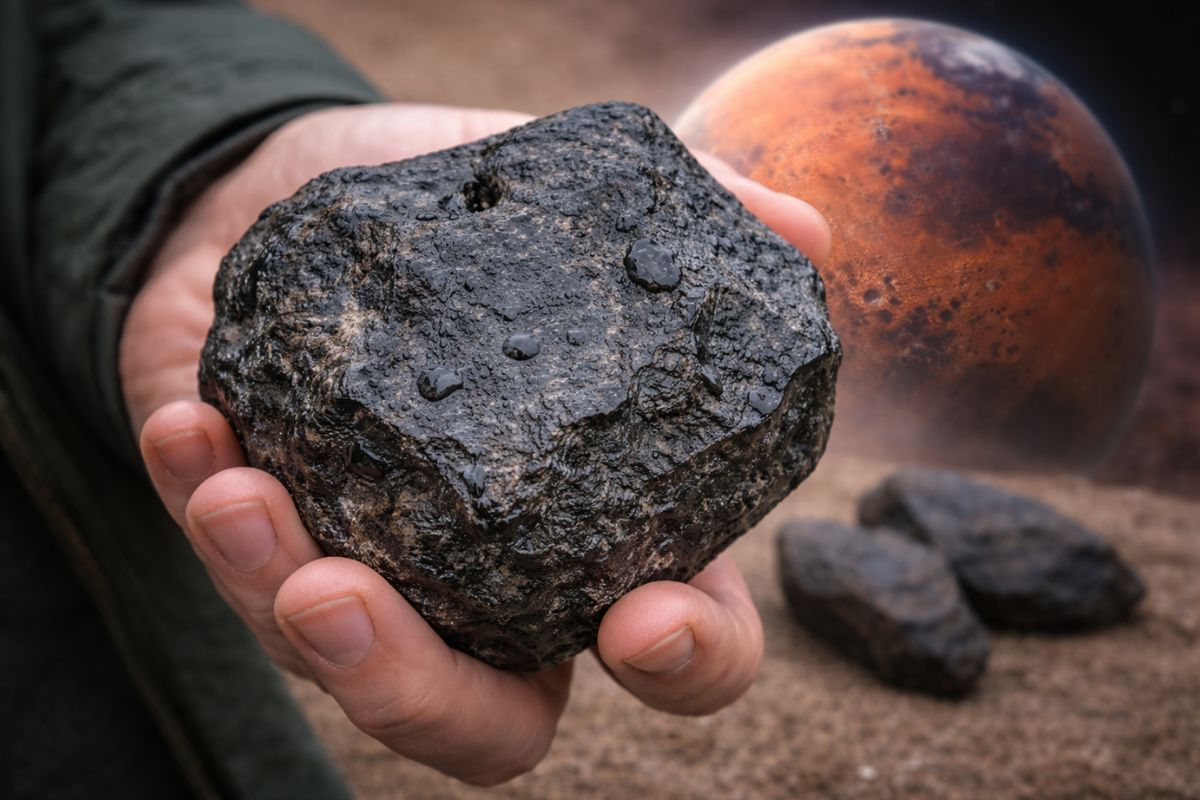
A black stone bought by a collector named Jay Piatek in Morocco in 2011 was actually a Martian meteorite 4.45 billion years old that contains ten times more water than any other fragment of Mars ever found on Earth, and its analysis revealed evidence that the red planet had hydrothermal conditions favorable to life; the rock became known as Black Beauty.
In 2011, an American collector Jay Piatek bought a black stone in Morocco. He knew it was a fragment of a meteorite found in the Sahara Desert and was informed that the material was part of Mars’ crust. What he didn’t know, and what no one knew at that moment, was that this dark rock carried ten times more water than any other Martian meteorite ever analyzed on Earth. More than a decade later, science revealed that this casual purchase in North Africa placed one of the most important pieces in the history of planetary exploration into the hands of a private individual.
The Martian meteorite was officially named Northwest Africa 7034, but it became known as Black Beauty. According to a study published in the journal Science Advances, its age is estimated at 4.45 billion years, placing it in the earliest stages of Mars’ formation. The black stone is not just old: it is a time capsule that holds information about what the red planet was like when it still had abundant water and conditions that could have supported life.
How a black stone bought in Morocco became a key piece of science

The story of Black Beauty begins in the Sahara Desert, where meteorite fragments are found with some regularity. Space rock hunters scour the sands in search of pieces that can be sold to collectors and scientific institutions. The black stone that would become one of the most studied meteorites in the world was found in this context, without ceremony, without a laboratory, without fanfare.
-
European cities are building public climate refuges to cope with extreme heat.

-
Excavations for a highway uncovered an intact Celtic city with gold, jewelry, and ancient production structures.
-
Every pineapple you eat is actually up to 200 different fruits fused into one: discover the fascinating process in which each flower opens for just one day and produces the pieces that form the whole fruit over the course of 3 weeks.

-
Giant from Germany will land in China with a record investment in a 4 km² complex, with up to 32 production lines and 70 products, targeting a market that could reach 70% of the world by 2030.

The collector who bought it in Morocco knew it was Martian material, but the true relevance of the piece only emerged when researchers began to analyze its composition in detail.
Black Beauty belongs to a rare group of Martian meteorites called “basaltic breccia,” fragments of Mars’ crust that were ripped from the planet by asteroid impacts and traveled millions of kilometers before falling to Earth. There are few examples of this type, and none had the volume of water found in this black stone.
The official name, Northwest Africa 7034, follows the convention of cataloging meteorites by the region where they are found. But it was the nickname Black Beauty that stuck, a reference to the dark color of the rock, which contrasts with most known Martian meteorites.
The color is a result of its composition rich in iron oxide and other minerals formed in the presence of water.
A Martian meteorite 4.45 billion years old with ten times more water
The most impressive data about Black Beauty is the amount of water present in its structure. According to the research published in Science Advances, this Martian meteorite contains ten times more water than any other fragment of Mars ever found on Earth.
This is not liquid water, but water molecules trapped in the mineral structure of the rock over billions of years.
The explanation for this extraordinary concentration lies in the origin of the black stone. At 4.45 billion years old, it formed during a time when Mars still had intense hydrothermal activity—environments with high-temperature water circulating through the planet’s crust.
Black Beauty crystallized under these conditions, trapping water in its minerals like a chemical snapshot of Mars’ past.
The age of the rock is particularly significant. It corresponds to the Pre-Noachian period of Mars, a phase when the planet still had very different conditions than today.
A Martian meteorite of this age is rare in itself; one with ten times more water than the others is practically unique. The combination of these two factors is what makes Black Beauty so valuable for planetary science.
What microscopic analysis revealed about Mars and the possibility of life
Researchers subjected the black stone to advanced microscopy techniques that revealed details invisible to the naked eye.
The composition of Black Beauty includes iron, aluminum, and sodium, as well as small crystals of magnetite, an iron oxide that forms in high-temperature water environments. The presence of magnetite is the mineral signature that confirms the hydrothermal origin of the rock.
A crucial detail is that the magnetite was retained in areas of the Martian meteorite that cannot be altered by cosmic radiation. This means that the minerals combined practically at the same time the rock formed, ruling out the possibility that the water was incorporated later, during its journey through space or after falling to Earth. The water in Black Beauty is Martian, not terrestrial.
The most provocative implication is biological. If Mars had hydrothermal conditions in its crust 4.45 billion years ago, the planet may have gathered the necessary ingredients for the emergence of microbial life or, at the very least, to create environments where microorganisms could have existed.
The black stone bought in Morocco reinforces this hypothesis, although definitive confirmation still depends on future space missions that collect samples directly from Martian soil.
Why Black Beauty is more valuable than samples from space missions
It may seem paradoxical, but a Martian meteorite found in the desert and bought by a collector may be more informative than samples collected by rovers on Mars. The reason is that Black Beauty comes from the deep crust of the planet, ripped away by a violent impact that exposed layers that no rover has been able to reach so far.
The Curiosity and Perseverance missions analyze the surface and shallow subsurface of Mars. The black stone, on the other hand, carries information about the primitive crust of the planet, formed when Mars was still geologically active and had water circulating at depth. It is like the difference between scraping paint off a wall and analyzing the foundation of the building.
Moreover, Black Beauty arrived on Earth intact, without contamination from mechanical instruments and without the weight limitations that restrict what rovers can bring back.
Every gram of this Martian meteorite can be analyzed with laboratory technologies that simply do not fit in a space probe. The black stone from Morocco offers a scientific shortcut that complements and, in some aspects, surpasses the work of robotic missions.
What the black stone reveals about the future of Mars exploration
The discovery of Black Beauty reinforces a message that the scientific community repeats: we still have much to learn about Mars, and not all answers will come from billion-dollar missions. A black stone bought for a few thousand dollars in Morocco delivered evidence of water and hydrothermal conditions that billion-dollar missions have yet to replicate.
The next step is the Mars Sample Return mission, a partnership between NASA and ESA to bring samples from Mars directly to Earth laboratories.
When and if these samples arrive, they will be compared with the Martian meteorite Black Beauty. The black stone will be the reference against which new discoveries will be measured, precisely because its composition and age make it the gold standard of what we know about the primitive crust of Mars.
Meanwhile, Black Beauty continues to be studied. Each new analysis technique reveals more layers of information trapped in its minerals for 4.45 billion years. And it all started with a collector who bought a black stone in Morocco without imagining he was taking home a piece of another planet’s past.
With information from the study Science Advances.
Would you buy a stone without knowing it could be a piece of Mars? What did you think of the story of Black Beauty and what it reveals about water on the red planet? Leave your opinion in the comments; this is one of those discoveries that deserves to be discussed.





Seja o primeiro a reagir!