





 Portuguese
  English
  Spanish
  5 min of reading
  0 comments


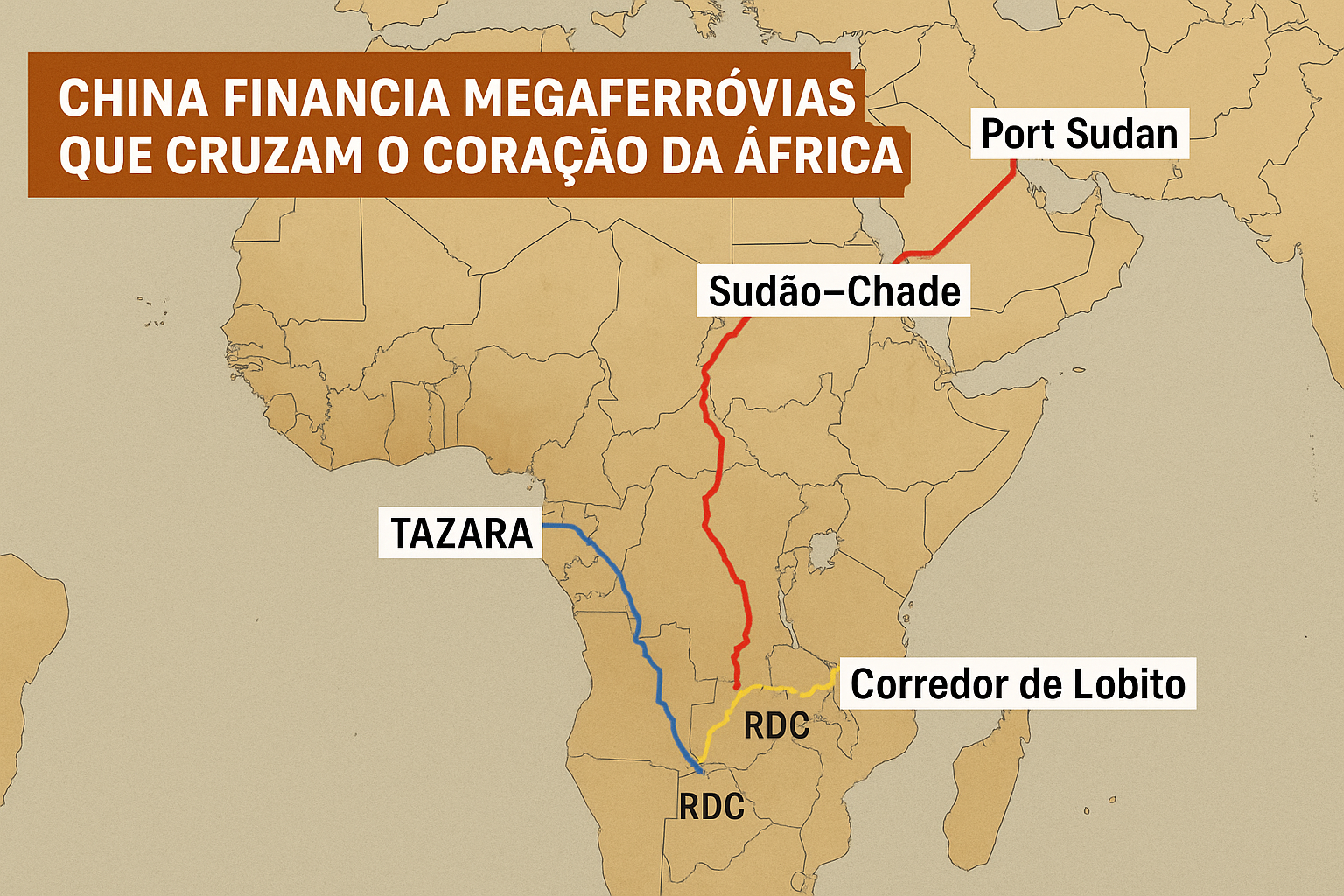
China Advances with Mega-Railway Plan of 3,400 km Between Sudan and Chad, Crossing the Sahara and Transforming Cargo Transport in Central Africa.
The construction of railways has re-emerged as a central development strategy for the African continent. Leading this movement is China, which, through bilateral agreements and infrastructure investments, is enabling strategic railway lines that connect resource-rich regions to seaports. One of the most ambitious projects currently in planning is the railway of 3,400 km between Port Sudan and N’Djamena, the capital of Chad, crossing inhospitable areas of the Sahara Desert—a project that promises to transform Central Africa’s logistical routes.
This initiative adds to others already underway or being revitalized, such as the TAZARA Railway between Tanzania and Zambia, and the Lobito Corridor, which links Angola, the DRC, and Zambia. These projects form a new African railway map, primarily funded by Chinese state-owned companies and development banks.
The Sudan–Chad Project: 3,400 km Route Funded by Beijing
Trans-Saharan Railway: From the Coast to the Sahel
The planned railway between Sudan and Chad, according to an agreement signed in 2017 between the two governments with consultancy from Chinese companies, aims to connect Port Sudan on the Red Sea to N’Djamena in the African interior. The project will have a route of approximately 3,400 km, passing through strategic cities such as Al-Fashir, Nyala, and Abéché.
-
American Airlines starts selling trips as if they were flights, with check-in and baggage check at the airport, but on short routes, passengers board luxury buses connecting cities to major hubs in the U.S.

-
São Paulo surprises the world with a colossal railway network project that promises over 1,000 km of tracks, R$ 194 billion in investments, and 40 projects connecting the capital to the interior with fast and sustainable trains.

-
The world’s largest escalator, measuring 905 meters in China, reduces urban travel time from 1 hour to about 20 minutes and transforms mobility in mountainous regions with an engineering solution adapted to the terrain.

-
A R$ 300 million logistics giant is taking shape in Serra with over 100,000 m² and raises a question: how can this transform e-commerce and distribution in the state?

Chinese Participation
The technical feasibility study has been entrusted to the China Railway Design Corporation and China Friendship Development International Engineering Design & Consultation Company, both subsidiaries of China Railway Construction Corporation (CRCC). China intends to transform the corridor into a logistical backbone of the region, ensuring access to Chadian mineral resources such as oil, uranium, and gold.
According to Global Construction Review, the project is part of the African expansion of the Belt and Road Initiative (BRI), with expected funding from the Exim Bank of China and execution by Chinese state-owned enterprises, which have expertise in large-scale works in arid and politically unstable regions.
Why the Sudan–Chad Railway is So Strategic for China?
Access to the Sea for Landlocked Countries
The Chad, like other landlocked African countries, suffers from logistical isolation. The country relies on expensive and inefficient routes to export its products, such as crude oil, cotton, and cattle. A direct railway link to the Red Sea would drastically reduce transport time and costs to international markets.
Alternative to Regional Instability
With the resurgence of conflicts in Niger and Mali, the route via Sudan appears as a strategic alternative for the transportation of commodities, avoiding regions with increasing risks of insurgency and terrorism.
Expansion of China’s Influence
The project is a clear example of the infrastructure geopolitics that China adopts in Africa: by building and financing large works, Beijing strengthens its influence and secures privileged access to raw materials in exchange for concessions, contracts, and political guarantees.
The TAZARA Railway: Historic Icon of Sino-African Cooperation + China
Built between 1970 and 1975, with Chinese funding and engineering, the TAZARA railway connects the port city of Dar es Salaam (Tanzania) to Kapiri Mposhi (Zambia). With 1,860 km, the line was created as a logistical alternative to apartheid in South Africa, allowing Zambia, then landlocked, to export its copper through a corridor free from colonial control.
Rehabilitation in 2025
After decades of deterioration and mismanagement, TAZARA is undergoing a revitalization process. In 2025, the Chinese company China Civil Engineering Construction Corporation (CCECC) announced an investment of US$ 1.4 billion to modernize the line, re-tread tracks, build bridges and stations, and provide 32 new locomotives and 762 wagons.
The new TAZARA promises to transport up to 5 million tons per year, three times its current capacity, and become the main export corridor of the Copper Belt of Central Africa.
Lobito Corridor: The New Logistical Frontier of the Atlantic
Another prominent project is the Lobito Railway Corridor, a unique alliance between Angola, the Democratic Republic of Congo (DRC), and Zambia, with international funding. The railway links Lobito (Angola) to Kolwezi (DRC), passing through Luau, Dilolo, and Luena.
U.S. and EU Involvement
The railway, although it has a Chinese structure inherited from the colonial era, has begun to be rehabilitated with the support of the U.S., European Union, and African Development Bank, countering China’s influence in the region.
According to the Financial Times, the project aims to transport strategic minerals, such as cobalt, copper, and lithium, which are in high demand during the global energy transition.
Technical Comparison Between Railway Corridors
| Project | Length (km) | Involved Countries | Estimated Investment | Current Status |
|---|---|---|---|---|
| Sudan–Chad | 3,400 | Sudan, Chad | US$ 10 billion (estimated) | Feasibility Study |
| TAZARA | 1,860 | Tanzania, Zambia | US$ 1.4 billion | Under Rehabilitation |
| Lobito Corridor | 1,300 (railway) | Angola, DRC, Zambia | US$ 320 million (phase 1) | Rehabilitation in Progress |
Expected Impacts of China’s Railway Investments
Economic
- Reduction of logistical costs by up to 40% for landlocked countries
- Increased exports of minerals, oil, and agricultural products
- Creation of thousands of direct jobs in construction and operation
- Stimulation of industrialization in currently underserved areas
Environmental
- Lower CO₂ emissions with the replacement of road transport
- Risk of environmental degradation in construction, especially in forested and sensitive fauna areas
- Need for ecological mitigation plans based on impact studies
Social and Geopolitical
- Strengthening regional sovereignty through own export corridors
- Competition for influence between China, the U.S., and the EU for strategic routes
- Potential for continental integration based on the AfCFTA (African Continental Free Trade Area)
The New Race for Tracks in the African Continent
The construction of the Sudan–Chad railway, along with the revitalization of TAZARA and the modernization of the Lobito Corridor, represents a milestone in the history of the African continent. Chinese investments have proven crucial in bringing projects to fruition and placing them on real tracks, even in politically unstable or geographically challenging regions.
More than just infrastructure, these works carry the potential to redefine African geopolitics, redistribute logistical power, and create new routes for prosperity. What was once desert, isolation, or dependence is now transforming into connection, trade, and sovereignty.
Sources:
- Global Construction Review – Sudan-Chad
- Reuters – TAZARA
- Wikipedia – TAZARA Railway
- Financial Times – Lobito Corridor
- European Commission – Global Gateway Angola-Zambia










-

Uma pessoa reagiu a isso.