





 Portuguese
  English
  Spanish
  5 min of reading
  64 comments


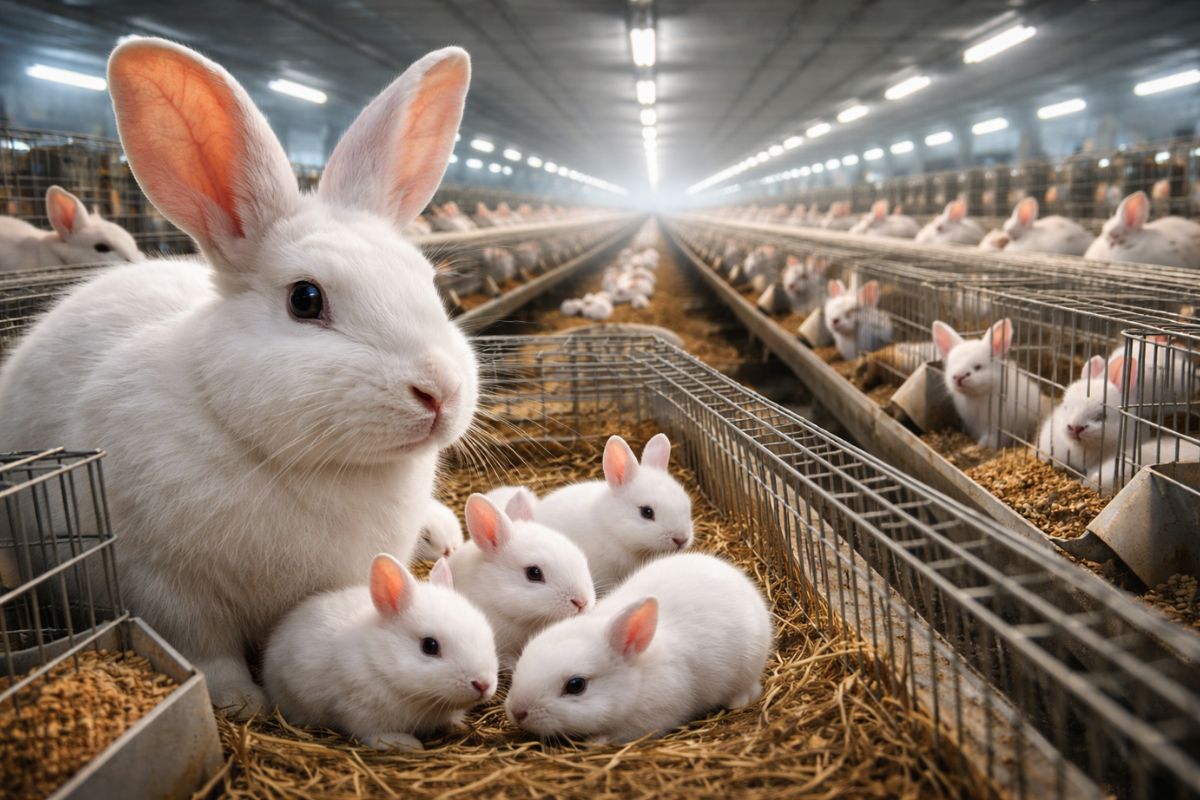


In Closed Bunny Farms, Kits Grow in Weeks, Under Timed Cycles of Artificial Light, Precise Feed and Sanitary Control Until They Become Consumed Meat in Silence.
In the Called Invisible Industry of Bunnies, kits grow in weeks under artificial light, cages aligned like shelves, and an almost surgical control of time, temperature, and feed. While many people still associate rabbits with gentle pets, silent barns scattered around the world transform this fragile creature into a high-efficiency biological machine.
A single couple, in controlled breeding, can produce over 180 kits in a year. Now imagine that multiplied by thousands of farms, all operating simultaneously, with timed cycles and trucks leaving loaded week after week. This is the mechanism that allows kits to grow in weeks and, in just over two months, become ready-to-eat meat, without most people noticing.
The Invisible Industry of Rabbits Begins in the Barn

The rabbits that supply consumption are not born in open fields, nor do they live hopping freely, as many imagine.
-
The sugar-energy sector advances with agricultural technology, but agricultural productivity still raises concerns.

-
The eggshell that almost everyone throws away is made up of about 95% calcium carbonate and can help enrich the soil when crushed, slowly releasing nutrients and being reused in home gardens and vegetable patches.
-
This farm in the United States does not use sunlight, does not use soil, and produces 500 times more food per square meter than traditional agriculture: the secret lies in 42,000 LEDs, hydroponics, and a system that recycles even the heat from the lamps.

-
The water that almost everyone throws away after cooking potatoes carries nutrients released during the preparation and can be reused to help in the development of plants when used correctly at the base of gardens and pots, at no additional cost and without changing the routine.

It all starts in long, closed barns, with narrow aisles and rows of cages that seem endless. The air smells of feed, sawdust, and constant humidity.
The females are kept in individual cages, arranged almost industrially. Each one is selected for a specific characteristic: extreme fertility.
It’s not strength, it’s not aesthetics, it’s the ability to give birth quickly, several times a year, without long breaks. In there, time is money, and each litter counts.
How The Cycle Is Accelerated for Kits to Grow in Weeks
The farmer controls everything. Artificial light simulates longer days to trick the rabbit’s body and speed up the reproductive cycle.
In natural conditions, she would have few litters per year. In these systems, she can give birth up to eight times in 12 months. Each gestation lasts just over 30 days.
When they are born, the kits are tiny, nearly invisible, the size of an adult’s thumb, blind, deaf, and completely dependent.
It is at this point that the logic of the industry comes in force: the goal is to make these kits grow in weeks, not months, until they reach the ideal weight.
The Nest Is a Controlled Incubator

The nests are closed boxes, lined with fur that the mother rabbit pulls from her body before giving birth. The temperature must be perfect. Too cold kills, too hot kills.
A minimal error can wipe out an entire litter. Therefore, sensors, thermometers, and constant inspections are part of the daily routine.
One detail that almost no one knows is that the mother does not stay with the kits all the time. Contrary to what many imagine, she enters the nest once or twice a day for a few minutes, just to nurse.
The rest of the time, the control falls on the farmer. If a kit is not gaining weight at the expected rate, it is separated. There is no room for delay when working with millions of animals.
At about 10 days, the kits’ eyes open. In less than three weeks, they start to leave the nest and explore the cage.
It is in this critical interval that the promise of kits growing in weeks consolidates, as any deviation at this stage impacts the entire cycle.
From Childhood to Fattening in a Few Weeks

In less than a month, that fragile animal transforms into an active rabbit, with strong teeth and a voracious appetite. From then on, the fattening stage begins.
Rabbits are grouped in collective cages, where feed is calculated to the gram, with proteins, fibers, and minerals adjusted for rapid and uniform growth.
Water comes through automatic nipples, always available and filtered. The objective is simple and direct: to turn feed into meat in the shortest time possible. Every extra day means cost, and every day less means efficiency.
In many systems, at about 70 to 90 days old, these animals already reach ideal weight. In just over two months, the cycle that started with kits growing in weeks completes at slaughter, fast, silent, and highly organized.
Meanwhile, the farmer is already thinking about the next round. Females that have given birth a few weeks ago are prepared again.
There are no long pauses. The logic is continuous production. If a rabbit reduces its rate of kits, it is discarded from the system.
Why Rabbit Meat Is So Interesting to The Industry

If you are wondering why rabbits are so valued on this scale, the answer lies in efficiency.
They eat less than cattle, grow faster than pigs, and reproduce at a rate that few animals for consumption can match.
In several countries, rabbit meat is seen as strategic: cheap, nutritious, and capable of being produced in a small space. A medium farm can produce tens of thousands of animals per year.
The largest farms easily surpass millions, with trucks leaving loaded while new kits are just born in the barns next door.
All this is only possible because, in this industrial logic, kits grow in weeks and quickly enter the production line, shortening the time between birth and slaughter.
Silence, Density, and Sanitary Risk
Another little-visible aspect is the behavior of rabbits in this environment. Naturally discreet animals, they hardly vocalize.
In the barn, this constant silence gives a misleading feeling of calm. Behind this, there is a rigid routine where every minute is planned, and every failure can be costly.
In high densities, any disease spreads quickly. Therefore, veterinarians constantly monitor the herd, administering vaccines, controlling outbreaks, and making preventive culls when necessary.
A management error can compromise thousands of animals at once, interrupting the mechanism that relies on daily births and a constant flow in which kits grow in weeks to maintain production.
The Silent Expansion of This Mechanism
While you are reading this text, there are millions of rabbits being fed right now, millions more growing, and thousands being born every minute.
This industry grows precisely because the rabbit, small and seemingly fragile, behaves like one of the most efficient biological machines that exist.
Countries that barely consumed rabbit meat on a large scale are beginning to adopt this model for a simple reason: low cost, reduced space, and rapid production.
The future of this industry is being quietly drawn in the same barns where the artificial light never fully turns off and where kits grow in weeks to feed a market that almost nobody sees.
When someone looks at a rabbit and thinks of just a gentle pet, they ignore this parallel reality.
A reality made of long barns, timed cycles, strict sanitary control, and millions of lives following the same script since day one.
And now that you know that, within this invisible industry, kits grow in weeks until they become meat in a few months, tell me: does this change the way you view rabbit meat on your plate, or do you see this model just as an inevitable response to the demand for cheap protein in the world?







Carne de coelho é mais caro que picanha. Tá louco quem diz que é econômico.
Somos predadores, carnívoros e, pior, inteligentes, com um nível de sofisticação tão desenvolvido que criamos nossas presas em cativeiro para depois abatê-las e banquetearmos. É por aí que, presumo, advém toda maldade humana: precisamos matar para viver.
A reportagem é interessante, mas o texto ficou maçante e repetitivo.