





 Portuguese
  English
  Spanish
  6 min of reading
  0 comments


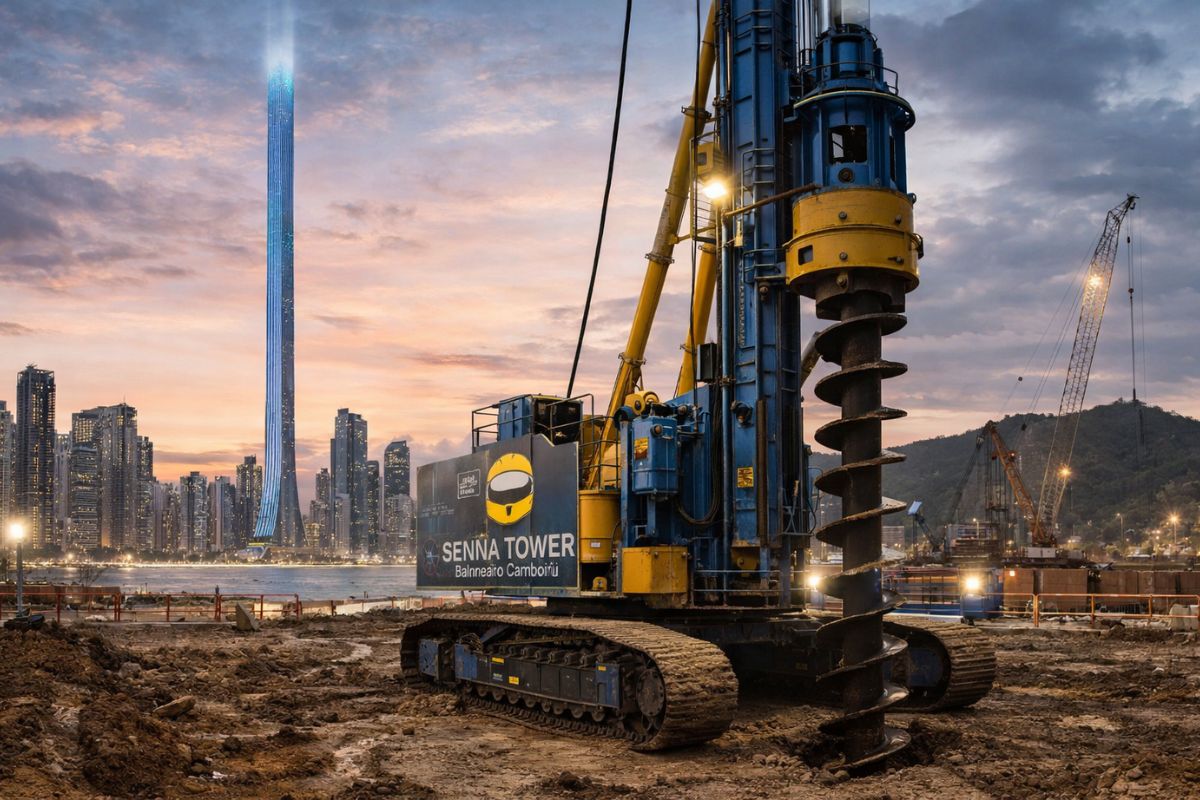
The Italian drill MAIT CFA 34-36, the most powerful drill ever operated in Brazil, has begun operation at the Senna Tower construction site in Balneário Camboriú to execute the foundations of what will be the tallest residential building in the world, over 550 meters high, with an investment of R$ 3 billion.
A mega drill weighing 130 tons, valued at over R$ 50 million and with no similar equipment operating in Brazil, has just begun operation in Balneário Camboriú, Santa Catarina. The machine is the Italian drill MAIT CFA 34-36, equipped with the largest continuous screw ever used in the country, and its mission is to execute the foundations of the Senna Tower, the 154-story skyscraper over 550 meters high that honors the driver Ayrton Senna and promises to become the tallest residential building in the world.
According to FG Empreendimentos, responsible for the project, the mega drill represents an investment of over R$ 50 million and marks the beginning of the most critical phase of construction: the deep foundations that will support the entire weight of the structure. With about 50% more power than traditional models used in Brazil, the equipment can increase daily productivity in pile execution by up to 30%, in addition to allowing real-time monitoring of all operational parameters. Technical coordination is handled by Talls Solutions, a company specialized in supertall building projects.
What is the MAIT CFA 34-36 mega drill and why is it unique in Brazil
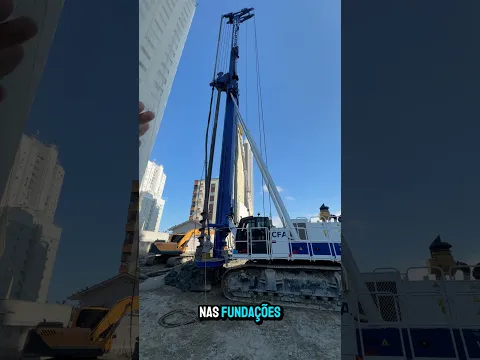

According to the portal NDMAIS, the mega drill that arrived at the Senna Tower site is the MAIT CFA 34-36 model, manufactured in Italy and considered one of the most advanced pieces of equipment in the world for executing deep foundations.
-
The first cold front of autumn arrives in São Paulo this Tuesday with a risk of storms, hail, and gusts of wind, but the real cold is not coming now: April will be dominated by above-average heat and may even see a heatwave.

-
The robust smartphone from Oukitel comes with a 20,000 mAh battery, satellite communication, walkie-talkie, and thermal camera to tackle mountains, deserts, offshore platforms, and disaster zones in a single device designed for extreme operations.

-
Wastewater from steel and cement industries can capture 30 million tons of CO2 per year in a discovery that transforms a common industrial waste into a low-cost climate weapon, with technology already available and direct application in factories.

-
Extinct for over 100 years and considered one of the rarest birds in Brazil, a legendary species reappears in the Northeast, resumes breeding in the wild, and surprises researchers in 2026.

Weighing 130 tons, with a telescopic tower and continuous screw technology, the machine simultaneously drills the soil and pours concrete for the piles meaning that as the screw penetrates the ground, concrete is injected through the central shaft when it is removed. This eliminates intermediate steps and ensures more control over the quality of each pile.
There is no other equipment like this operating in Brazil. The mega drill has an operational capacity about 50% higher than the models traditionally used in large-scale construction in the country, allowing to execute piles with greater depth, precision, and speed—decisive factors for a building that will be over half a kilometer tall.
Engineer Tercio Barduzzi from União Fundações, responsible for the foundations of the Senna Tower, states that the equipment directly impacts the quality and safety of the building’s base, in addition to bringing significant efficiency gains.
Why does the Senna Tower need a mega drill of this size

The Senna Tower is not an ordinary building. With 154 floors, over 550 meters high, and classified as supertall, it will be the tallest residential building in the world when completed, taller than the Empire State Building and the Eiffel Tower.
Supporting a structure of this magnitude requires foundations that penetrate deep into the ground and support colossal loads, especially considering that the construction is located by the seaside, subject to coastal winds and with rocky terrain characteristics.
That is why FG Empreendimentos decided to bring an unprecedented mega drill to the country. Gustavo Simas, production director of the company, states that the decision aligns with the commitment to use the most advanced engineering available.
The mega drill places the Senna Tower on a level compatible with the most demanding international projects in the world, according to Stéphane Domeneghini from Talls Solutions.
The investment of R$ 3 billion in the total project reflects the scale of the challenge: to build a half-kilometer tall skyscraper on the Brazilian coast.
The Senna Tower: the skyscraper that honors Ayrton Senna and aims to be the largest residential building on the planet
The project is a partnership between FG Empreendimentos, the Senna brand (from the driver’s family), and Havan.
The Senna Tower will be built on Avenida Atlântica, facing the sea of Balneário Camboriú, a city that already houses eight of the ten tallest buildings in Brazil and is nicknamed the “Brazilian Dubai”.
The project includes high-standard apartments, public leisure spaces, gastronomy, entertainment, and an immersive experience dedicated to the history of Ayrton Senna.
The building will be the first in Latin America to use tuned mass damper (TMD) technology, which reduces oscillations caused by wind in very tall structures.
It will also be the first supertall residential skyscraper in the world with LEED Platinum certification, the highest level of sustainability in civil construction.
FG Empreendimentos is responsible for the construction and holds the largest land bank in the region, with 3.5 million square meters reserved for future projects that are expected to generate over R$ 100 billion in sales value.
The impact of the mega drill on the schedule and safety of the construction
The arrival of the mega drill at the site is not just a matter of power; it is a strategic scheduling decision. With the ability to increase productivity by up to 30% during the foundation phase, the equipment allows FG Empreendimentos to gain predictability regarding deadlines in a project that will last for years and consume billions of reais.
The real-time monitoring technology integrated into the mega drill also means that each pile can be tracked centimeter by centimeter, reducing the margin of error at a stage where any failure compromises the entire structure above.
For Jean Graciola, president of FG Empreendimentos, bringing to Brazil a unique mega drill in operation is a decision that reflects a commitment to innovation and strengthens market confidence in the project. The foundation phase is under the responsibility of União Fundações, and the technological coordination continues with Talls Solutions.
With this phase underway, the Senna Tower is consistently moving towards its completion, and Balneário Camboriú is positioning itself as a global reference in residential superstructure engineering.
A R$ 50 million machine for a R$ 3 billion building: the scale of what is being constructed in Balneário Camboriú
The MAIT CFA 34-36 mega drill is more than just a machine; it is a symbol of the scale of what is being constructed in Balneário Camboriú.
A 130-ton piece of equipment, unique in Brazil, manufactured in Italy and valued at R$ 50 million, working to lay the foundations of the largest residential building in the world—a 154-story skyscraper named after Ayrton Senna.
Brazilian engineering has never operated on a scale like this, and the mega drill is the piece that makes the start of this construction possible.
The Senna Tower still has a long way to go from foundations to facade; it will be years of construction. But the arrival of this mega drill is the concrete signal that the project has moved from paper to reality, pile by pile, meter by meter, into the ground of Balneário Camboriú.
What do you think about building the tallest residential building in the world on the coast of Santa Catarina? And is a R$ 50 million mega drill just for the foundations an exaggeration or a necessity for a project of this scale? Leave your opinion in the comments.






Seja o primeiro a reagir!